
I will be adding notes to this page as we read this book together through our monthly meetings. You should be able to find the link to this page at the top of my blog.
July 15, 2025
July 17, 2025
During our first session we reviewed some of the following from the reading:
Introduction
Most of us could talk for some time about what “spirituality” means to us, or might mean within the larger conversation of our culture. It arose in use in the 17th Century to describe a personal relationship with God with implications of holiness. However, it remains relative subjective in terms of how it is used.
In our contemporary context, “spirituality” might mean any number of things and be attributed to any number of experiences. A consistent and defensible use of the word spirituality is associated with religious/theological themes, and in our case how such themes are centered upon the Christian life. In the early Church it was assumed that anyone writing theology, giving sermons, or offering reflection on the Scriptures would have been doing so as the result of a personal commitment to Christ.
July 17, 2025
During our first session we reviewed some of the following from the reading. I am relying heavily on the work of Richard Schmidt from the book in the following notes.
Introduction
Most of us could talk for some time about what “spirituality” means to us, or might mean within the larger conversation of our culture. It arose in use in the 17th Century to describe a personal relationship with God with implications of holiness. However, it remains relative subjective in terms of how it is used.
In our contemporary context, “spirituality” might mean any number of things and be attributed to any number of experiences. A consistent and defensible use of the word spirituality is associated with religious/theological themes, and in our case how such themes are centered upon the Christian life. In the early Church it was assumed that anyone writing theology, giving sermons, or offering reflection on the Scriptures would have been doing so as the result of a personal commitment to Christ.
“For centuries most theologians were cloistered monks . . . since it addressed the most important thing in human life, humanity’s relationship to God, theology was known as the queen of the sciences, and it was the spiritual dimension of theology that justified the title.”
A precursor to the “modern” era in Europe was the rise of universities, and theology made its way from the monk’s cell and prayer stall to the classroom. Once theological reflection and writing entered the academic arena as subject among subjects, a science among sciences, essentially cordoned off from a life of prayer, the general population began to see it more and more as a specialized subject for a smaller group of students, rather than a general application beneficial to humanity as a whole.
Through the centuries “spirituality” has more and more come to represent and individualized {potentially} experience of transcendence that may occur with our without a particularized relationship with Christ.
Our author makes the point that Christian spirituality will have a particular “flavor” and substance that allows, or compels, us to hold it separately from other religions; and that at some point the old trope “all roads lead to Chicago,” or that all religious roads lead to God, is not actually the case. While we might learn from other paths, there is a particularity in Christianity that will invite an immovable uniqueness – which might also be said of other religious paths.
Spirituality is build upon the foundation of theological belief and religious practice; and for it to be edifying, rather than self-indulgent and disoriented, spirituality is best explored as rooted, or an attachment, to a larger source of meaning.
Christian Spirituality
Spirituality derives from the Latin – spiritus
Spiritus in the Greek – pneuma – moving air
Pneuma in the Hebrew – ruach – wind, breath
Essentially what we are describing is a movement, a power, an experience, an energy that is “unseen.” In the Christian faith there is some room and description given to those who experience God as a mystery. “Rudolf Offo, in his 1917 classic, The Idea of the Holy, calls this the numinous and adds to energy and mystery a third quality: fascination. There is much of this in the Bible. In the Judeo-Christian tradition, then {this is true of some other traditions as well}, spirituality refers to the search for {and to being sought by} what is all-powerful, beyond understanding, and utterly alluring. This is what I referred to as the search for what is important, valuable, and beautiful. The usual name for this is God.”
Put simply, we are looking for such things through a relationship with Christ. Other paths have much to contribute – Buddhism, Hinduism, Judaism, Aboriginal – but we will be traveling with those who have sought Jesus as the Christ of God.
Polarities to Look For
Holistic verses Dualistic. “The ancient Hebrews saw the material world, including the human body, as God’s creation and a manifestation of God’s glory.” Essentially the Hebrews did not believe that anything spiritual can actually be dislocated from something material. We sometimes thing of the human being as an expression of the “imago dei,” the image and likeness of God; our Hebrew forebearers might say that is true of all that we can see, taste, smell, and touch. The entire created “project” is an extension of God’s presence in our midst. The thinking Greeks – Plato, Aristotle, and the like – often found a gentle separation between the experience of thought and feeling in opposition to living in a material frame. “The Greeks . . . were suspicious of material things and sought to overcome or rise above them, with the human body in particular needing discipline and constraint.”
Christianity is sourced in both of these cosmic assumptions; both to its benefit and detriment. The interplay between a Holistic verses Dualistic interpretation of spiritual or transcendent experiences of God will color the writers we read together.
Mystical versus Cognitive
Some intellectuals, scholars, and writers have an allergic reaction to the entire notion of mysticism. “It suggests something esoteric, superstitious, and occult . . . referring to visions, dreams, and the like – direct, inner experiences of the supernatural, neither mediated nor validated by any doctrine, sacred text, or human influence.”
There have always been these “outliers” in the Church, and sometimes they have paid dearly for their mystical encounters at the hands of those who render and demand that all things of God orbit in the cognitive disciplines. “While most Christian mystics are orthodox in their beliefs, their souls are energized by their direct experiences of the holy.”
Communal verses Individualistic
There has long been tension between the individual and the collective within Christianity. “This reflected the biblical understanding of the holy people or nation and later, of the Church as the body of Christ . . . individual behaviors and beliefs were not overlooked or discounted, but they mattered less than taking one’s place in the community.”
With the rise of learning, individual experience, the value of the individual in the politics and social fabric of the West, there is a corresponding appreciation of individuality in spirituality; or we might even say a “preference” for the individual experience over that of the collective.
Inward versus Outward
For many the spiritual journey is necessarily an inward trajectory that is cultivated through “solitude, prayer, meditation, and acts of self-denial.” However there is also a trajectory that leads outward in a life of service – feeding the hungry, caring for orphans, working for peace and reconciliation, etc. Generally we do not live in one arena well without having a foot in the other.
Prophetic versus Institutional
I might partner this dualism with the notion of individual and the collective; generally, a prophet is a one who has come with a message for the many. Institutional maintenance is sometimes threatened by the solitariness of the individual – especially if that individual is motivated by an experience that either lies hidden, outside, or transcends the responsibilities of the institution in preserving the collective. An illuminated reform is often what the individual brings for the collective; while the collective offers the promise of security and identity to the one living as a solitary.
Spirituality and People
Schmidt points out that this is not a project of simply accumulating ideas – it is a project of getting to know people who happened to be having the significant ideas. “God lives in the hearts of flesh-and-blood human beings, not in mental constructs, inspirational thoughts, and sublime truths.” These “spiritualities” are particularized in the lives of actual people who walked through the world bearing the institutional, denominational, historical, and social limitations that we each share. Some of them have much in common, some little; the unifying thread through their lives is that sought a deeper communion with Christ, or were inexplicably called into that union by divine appointment.
“One other thing emerges from these biographies – virtually all the people discussed in this book changed as they grew older, and in more than the inevitable ways that come with aging . . . some of them ended their lives in a radically different place from where they had begun.”
This is what comes of being willing to give our lives to the larger things and the larger questions of human existence – we do not get to remain immobile.
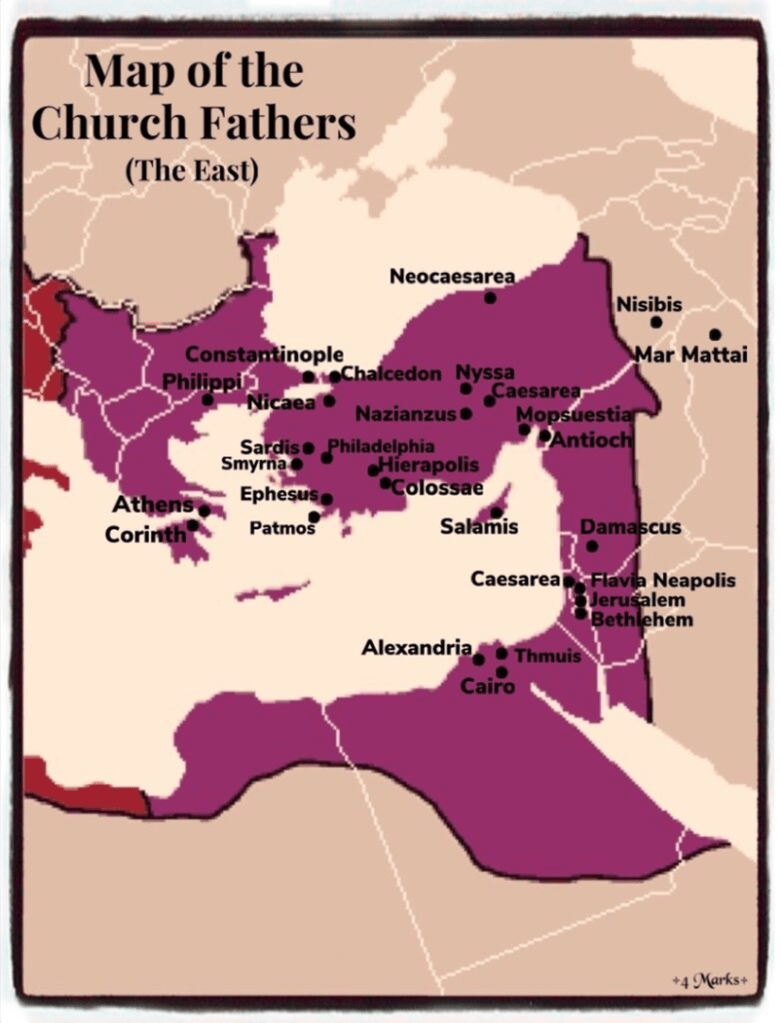
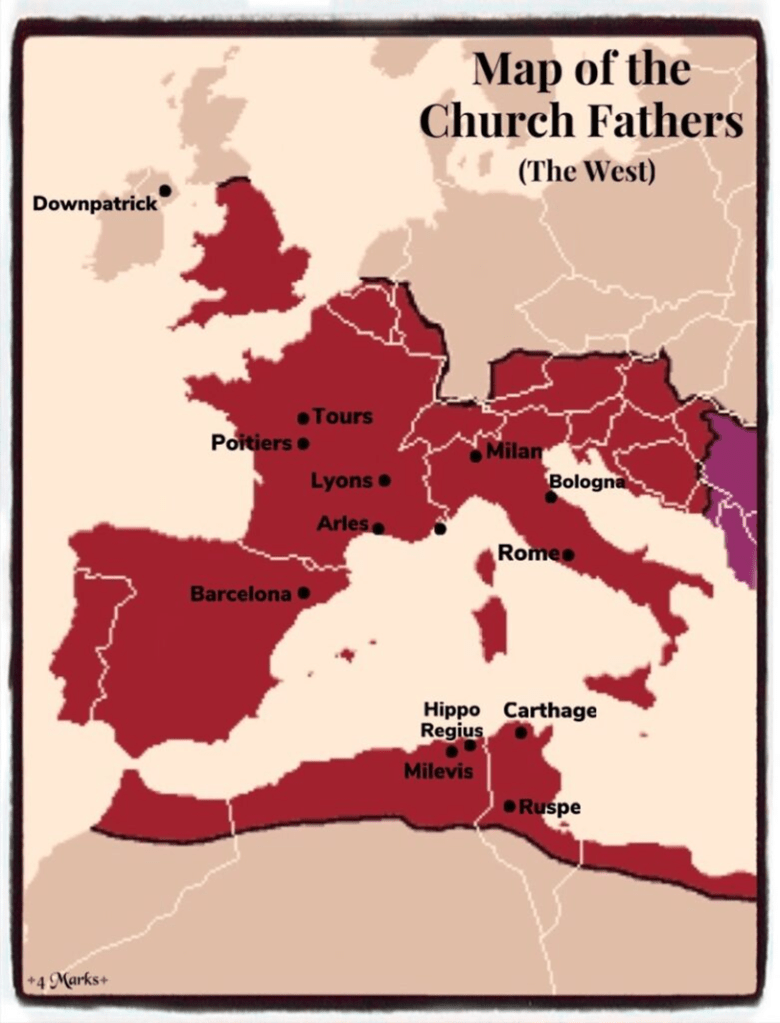
Irenaeus
Irenaeus planted the flag of an infant Christian orthodoxy into the extremely heterodox world of the ancient Roman and Greek Western culture. Schmidt does a good job of summarizing the competing cosmic and human allegiances that early Christians and seekers faced as they sought to make sense of the notion that “God became human so that humans might become God.” Irenaeus was wrestling with those Gnostics who wanted to make the case that Jesus came with a secretive or esoteric “gnosis,” knowledge, of which only a few might partake. All we have to do is look at our penchant for secret societies – Masonic lodges, initiation rites of various fraternities and sororities, and other “top secret” societies – in order to see where such motivations are born.
The incarnation of Jesus as the Christ of God is the central message of Irenaeus. He also believed that the local “episcopos,” Bishop, was the individual responsible for seeing that the teaching of the Gospel, and the message of salvation offered to all, remain unentangled with philosophical and theological disputes which might compromise the message of God’s love for all humanity. The Bishops of the early Church were the inheritors of the first apostle’s contact and instruction from Christ.
“To understand Irenaeus, we must recognize that modern Westerners, especially Americans, think in terms of the individual, whereas the ancients took a more corporate view of humanity.”
“The key player in this cosmic process {recapitulation of humanity in Christ} was the divine logos, usually translated – Word. The idea of the logos derives from the Jewish notion of a pre-existing Messiah and was taken up by Philo, an Alexandrian Jewish philosopher who lived at the time of Christ. Philo saw the logos as the preexistent mind or reason, the creative power that fashions the world, and the intermediary between God and humanity.”
Thoughts and Asides about Irenaeus:
ORIGEN OF ALEXANDRIA – 185 to 254 AD
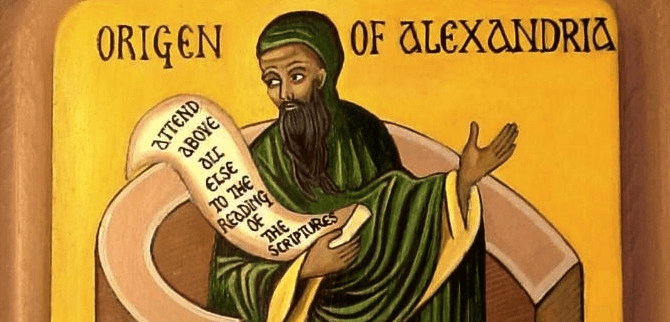
I have been reding Origen since discovering him in seminary, where I stumbled into the “Bridal Mysticism” that is associated with the exegesis of the Song of Solomon – The Song of Songs. Origen’s work on the The Song as a template for the union that is longed for between the individual soul and God is the foundational work for many subsequent commentators and spiritual seekers. Richard Schmidt points out that no churches, schools, streets, or cities are named for Origen because he never made the “A team” of the patristics. This is probably because he was heavily influenced by the neo-Platonists of his day, as well as undertaking mid-life castration as a physical sign of his surrender to the spiritual life; Origen liked to find God on the edges of consciousness and experience.
Origen was born very much an “insider” within the early Church, with a father who was eventually martyred for his faith. As a teen, Origen encouraged his father to remain firm in his faith, and over the course of his own life Origen would see martyrdom, self-offering, as the highest and chief calling of any follower of Jesus. Origen became a famous teacher and preacher in Alexandria, and eventually joined that circuit of ancient rhetoricians and speakers who toured the larger cities of the ancient world – he was a person of note within his own day. He eventually ended up in the Holy Land – living in Caesarea – where he studied, wrote, preached, and was ordained to the priesthood.
With the rise of Emperor Decius and the extreme persecution of Christians, Origen was imprisoned and treated roughly by the Roman authorities; this would eventually shorten his life, and he ended his days with a broken body. It may have been his persecution which added to the weight of his teaching amid early Christians. This was a very fluid time within the teaching and doctrine of the Church, and there were any number of theological and philosophical permutations making their way into Christian hearts and minds. As a Platonist, Origen tended toward the universal in his thinking; the carpenter, the man Jesus, the individual was an historical fact, however Origen found in Jesus the launch pad into cosmic and eternal considerations about the nature of the universe and life as a whole.
Jesus was both in time, as well as beyond time; a figure who cast a shadow within this frame of time and space as a mortal, but simultaneously a figure who could step through that fabric as no other human being know to mankind. Origen used the theological and philosophical ingredients associated with the divine Logos in his exploration and description of the significance that Jesus, born in Bethlehem, raised in Nazareth, was and is the only Son of God.
Jesus, The Son, The Logos, is the “spotless mirror” of the deity we call God the Father.
“The Father’s begetting of The Son is a continuous act of the divine will. It was this cosmic Christ who assumed bodily form in the person of Jesus.” {Schmidt 14}
https://www.modernreformation.org/resources/articles/origen-of-alexandria-to-be-and-to-be-called-a-christian {wonderful article by Blake Adams at “Modern Reformation”
Comprehensive Background:
Summary of Biography of Origen:
ANTHONY OF EGYPT {251-355}

Our venerable and God-bearing Father Saint Anthony the Great was born into a wealthy family in upper Egypt about 254 AD. Also known as Anthony of Egypt, Anthony of the Desert, and Anthony the Anchorite, he was a leader among the Desert Fathers, who were Christian monks in the Egyptian desert in the 3rd and 4th centuries AD. The Orthodox Church celebrates his feast on January 17.
Life of St. Anthony
Most of what we know about the life of St Anthony is in the Greek vita (Life of Antony) by Athanasius, circulated in Latin. Several surviving homilies and epistles of varying authenticity provide scant autobiographical detail.
Anthony was born near Herakleopolis Magna in Upper Egypt in 251 to wealthy parents. When he was eighteen years old, his parents died and left him with the care of his unmarried sister. In 285, he decided to follow the words of Jesus who had said: “If you want to be perfect, go, sell what you have and give to the poor, and you will have treasures in heaven; and come, follow Me.” (Matthew 19:21). Anthony gave his wealth to the poor and needy, and placed his sister with a group of Christian virgins, a sort of proto-nunnery at the time.
The moniker “Father of Monasticism” is misleading, as Christian monasticism was already being practiced in the deserts of Egypt. Ascetics commonly retired to isolated locations on the outskirts of cities. Anthony is notable for being one of the first ascetics to attempt living in the desert proper, completely cut off from civilization. His anchoritic (isolated) lifestyle was remarkably harsher than his predecessors. By the 2nd century there were also famous Christian ascetics, such as Saint Thecla. Saint Anthony decided to follow this tradition and headed out into the alkaline desert region called the Nitra in Latin (Wadi El Natrun today), about 95 km west of Alexandria, some of the most rugged terrain of the Western Desert.
Also note that pagan ascetic hermits and loosely organized cenobitic communities that the Hellenized Jewish philosopher Philo of Alexandria described as the Therapeutae in the first century, were long established in the harsh environments by the Lake Mareotis close to Alexandria, and in other less-accessible regions. Philo understood: for “this class of persons may be met with in many places, for both Greece and barbarian countries want to enjoy whatever is perfectly good.” (Philo, De vita contemplativa, written c. 10)
According to Athanasius, the devil fought St Anthony by afflicting him with boredom, laziness, and the phantoms of women, which he overcame by the power of prayer, providing a theme for Christian art. After that, he moved to a tomb, where he resided and closed the door on himself, depending on some local villagers who brought him food. When the devil perceived his ascetic life and his intense worship, he was envious and beat him mercilessly, leaving him unconscious. When his friends from the local village came to visit him and found him in this condition, they carried him to a church.
After he recovered, he made a second effort and went back to the desert, further out, to a mountain by the Nile, called Pispir, now Der el Memun, opposite Arsinoë in the Fayyum. There he lived strictly enclosed in an old abandoned Roman fort for some twenty years. According to Athanasius, the devil again resumed his war against Saint Anthony, only this time the phantoms were in the form of wild beasts, wolves, lions, snakes and scorpions. They appeared as if they were about to attack him or cut him into pieces. But the Saint would laugh at them scornfully and say, “If any of you have any authority over me, only one would have been sufficient to fight me.” At his saying this, they disappeared as though in smoke, and God gave him the victory over the devil. While in the fort he only communicated with the outside world by a crevice through which food would be passed and he would say a few words. Saint Anthony would prepare a quantity of bread that would sustain him for six months. He did not allow anyone to enter his cell: whoever came to him, stood outside and listened to his advice.
Then one day he emerged from the fort with the help of villagers to break down the door. By this time most had expected him to have wasted away, or gone insane in his solitary confinement, but he emerged healthy, serene, and enlightened. Everyone was amazed he had been through these trials and emerged spiritually rejuvenated. He was hailed as a hero and from this time forth the legend of Anthony began to spread and grow.
Then he went to the Fayyum and confirmed the brethren there in the Christian faith, then returned to his old Roman fort. Anthony wished to become a martyr and went to Alexandria. He visited those who were imprisoned for the sake of Christ and comforted them. When the Governor saw that he was confessing his Christianity publicly, not caring what might happen to him, he ordered him not to show up in the city. However, the Saint did not heed his threats. He faced him and argued with him in order that he might arouse his anger so that he might be tortured and martyred, but it did not happen.
When he went back to the old Roman fort, many came to visit him and to hear his teachings. He saw that these visits kept him away from his worship. As a result, he went further into the Eastern Desert of Egypt. He travelled to the inner wilderness for three days, until he found a spring of water and some palm trees, and then he chose to settle there. On this spot now stands the monastery of Saint Anthony the Great. On occasions, he would go to the monastery on the outskirts of the desert by the Nile to visit the brethren, then return to his inner monastery.
The backstory of one of the surviving epistles, directed to Constantine I recounts how the fame of Saint Anthony spread abroad and reached Emperor Constantine. The Emperor wrote to him, offering him praise and asked him to pray for him. The brethren were pleased with the Emperor’s letter, but Anthony did not pay any attention to it, and he said to them, “The books of God, the King of Kings and the Lord of Lords, commands us every day, but we do not heed what they tell us, and we turn our backs on them.” Under the persistence of the brethren who told him, “Emperor Constantine loves the church,” he accepted to write him a letter blessing him, and praying for the peace and safety of the empire and the church.
According to Athanasius, Saint Anthony heard a voice telling him, “Go out and see.” He went out and saw an angel who wore a girdle with a cross, one resembling the holy Eskiem (Tonsure or Schema), and on his head was a head cover (Kolansowa). He was sitting while braiding palm leaves, then he stood up to pray, and again he sat to weave. A voice came to him saying, “Anthony, do this and you will rest.” Henceforth, he started to wear this tunic that he saw, and began to weave palm leaves, and never got bored again. Saint Anthony prophesied about the persecution that was about to happen to the church and the control of the heretics over it, the church victory and its return to its formal glory, and the end of the age. When Saint Macarius visited Saint Anthony, Saint Anthony clothed him with the monk’s garb, and foretold him what would be of him. When the day drew near of the departure of Saint Paul the First Hermit in the desert, Saint Anthony went to him and buried him, after clothing him in a tunic which was a present from St Athanasius the Apostolic, the 20th Patriarch of Alexandria.
When Saint Anthony felt that the day of his departure had approached, he commanded his disciples to give his staff to Saint Macarius, and to give one sheepskin cloak to Saint Athanasius and the other sheepskin cloak to Saint Serapion, his disciple. He further instructed his disciples to bury his body in an unmarked, secret grave, lest his body become an object of veneration. He stretched himself on the ground and gave up his spirit. Saint Anthony the Great lived for 105 years and departed on the year 356. He probably spoke only his native language, Coptic, but his sayings were spread in a Greek translation. He himself left no writings. His biography was written by Saint Athanasius and titled Life of Saint Anthony the Great. Many stories are also told about him in various collections of sayings of the Desert Fathers.
Some of the stories included in Saint Anthony’s biography are perpetuated now mostly in paintings, where they give an opportunity for artists to depict their more lurid or bizarre fantasies. Many pictorial artists, from Hieronymus Bosch to Salvador Dalí, have depicted these incidents from the life of Anthony; in prose, the tale was retold and embellished by Gustave Flaubert.
Founder of monasticism
Saint Anthony and Saint Paul the Hermit are seen as the founders of Christian monasticism. Saint Paul the Hermit is lauded by Saint Anthony as the first hermit. The monastery of Saint Paul the Hermit exists to this day in Egypt. Saint Anthony himself provided the example that others would follow (see Saint Pachomius). Anthony himself did not organize or create a monastery, but a community grew up around him based on his example of living an ascetic and isolated life. Those who wished to follow him needed the company of others to survive the harsh conditions.
https://www.saintsophiadc.org/life-saint-anthony-great-anchorite-egypt-father-monks/ {Saint Sophia Greek Orthodox Cathedral 2815 36th Street, NW Washington, D.C.}
SAINT ANTHONY, THE FIRST DESERT FATHER
https://youtu.be/M2SA-8gQ7aw?feature=shared
GREGORY OF NYSSA {335~395}
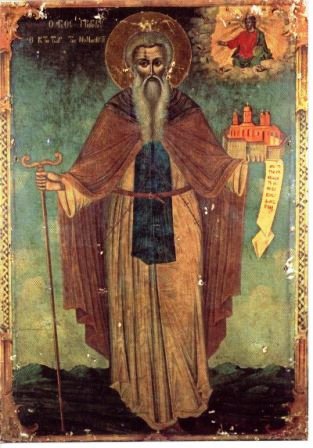
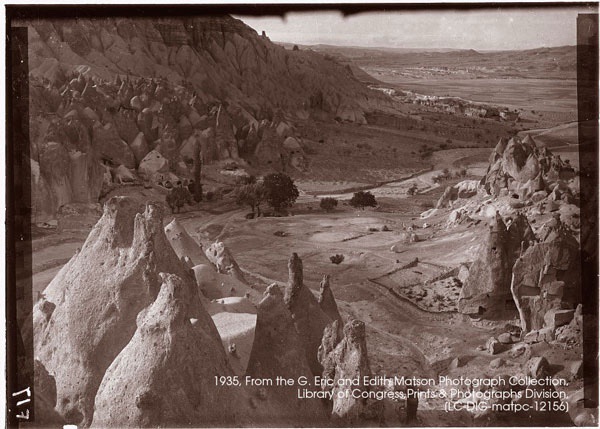
https://stgregs.info/parish-life/patron-saint-gregory-of-nyssa/
St. Gregory of Nyssa,
Our Father of Fathers
by Victor M. Rentel
St. Gregory of Nyssa was one of a group of illustrious 4th Century saints who left an enduring imprint on the Orthodox Church.
With St. Basil, the Great, St. John Chrysostom, and St. Gregory, the Theologian, St. Gregory of Nyssa created a rich legacy of theology, liturgy, and spiritual literature unsurpassed in any era of the Eastern Church. This body of work is vastly important for its interpretation of Eastern Christianity’s theology, liturgical texture, and the nature of God. Orthodoxy’s distinctive mysticism has its origins in this period with much owing to St. Gregory of Nyssa.
Like other saints, St. Gregory of Nyssa was a unique and gifted human being with extraordinary powers of observation and expression. His family was equally remarkable, an intellectual and spiritual citadel in the Church’s history. St. Gregory’s brother, St. Basil, the Great, not only wrote one of the core liturgies of the Orthodox Church, he created prayers that today remain commonplace in the lives of ordinary Orthodox believers, and he educated or served as an icon for clergy and bishops of his and later ages. Basil, with his brother Gregory, helped to establish our understanding of the Trinity and of the distinctive nature of Christ within the Trinity. Their saintly mother, Emmelia and renowned lawyer father raised nine children–five girls and four boys—of whom, one brother Nacratious was a lawyer and another, Peter was the Bishop of Sebasta, a small town on the Mediterranean coast.
If the other brother and four sisters, little is known. Macrina, Gregory’s older sister, was widely known and beloved for her devout and holy life, who ultimately was honored as a saint. She was Gregory’s confidant, sometimes intellectual partner, and deep spiritual influence, who probably influenced his ordination decision. St. Basil, in all likelihood, was the driving force in St. Gregory’s decision to pursue holy orders. St. Basil appears to have been the dominating intellectual and social force in Gregory’s life and probably in Peter’s life as well. In a letter to Peter, St. Gregory expressed his deep gratitude to their older brother Basil whom Gregory described as “our father and our master.” The letter conveyed great affection for Basil and for Peter as well.
Most scholars agree that St. Basil played a principal role not only in guiding Peter’s and Gregory’s life choices but equally in educating and raising his younger brothers.
St. Gregory was a reluctant cleric. He had trained for and started a career as a teacher of rhetoric, the study of effective pubic speaking and writing. His family, however, did not support his career choice and tried to convince Gregory to use his talents in the service of the Church. When he chose to become a teacher, his brother Basil, by then a powerful bishop, objected to and argued against St. Gregory’s choice with long and impatient letters to his younger brother. St. Basil initially failed to persuade his young brother of his mistake, but ultimately with Gregory’s friends and sister, Macrina, St. Basil persuaded Gregory to become a priest. Shortly thereafter, Gregory was elevated to Bishop of Nyssa.
St. Gregory’s large body of theological work and his many letters constitute an eloquent and intellectually distinctive contribution to Orthodox theology and spirituality. His Catechism is testimony to his profound grasp of Christian belief. In The Life of Moses, St. Gregory’s mystical portrayal of God–simultaneously audacious and humble and thoroughly brilliant—has no parallel in Christian thought. Similarly, his letters are models of elegant grace and beauty, some miraculously anticipating a style of writing and thought not to arise until 1400 years later in the Romantic era of western literature. He was a gifted writer and speaker who delighted in language and its power to persuade and invoke the senses while illuminating the intellect, a wholly unmatched attribute among writers of his period and unique among the early Church Fathers.
In 787 A.D., roughly four centuries after Gregory’s death, the Seventh General Council of the Church honored St. Gregory of Nyssa by naming him, “Father of Fathers.
St. Gregory of Nyssa, whose mystical rejoicing of the Trinity and consuming love for his fellow human beings, continues to touch our souls as, Father Gregory, the sublime catechist, reluctant cleric, and unlikely hero of the Church.
https://www.johnsanidopoulos.com/2011/01/saint-gregory-of-nyssa-father-of.html
AUGUSTINE OF HIPPO – CHAPTER 5
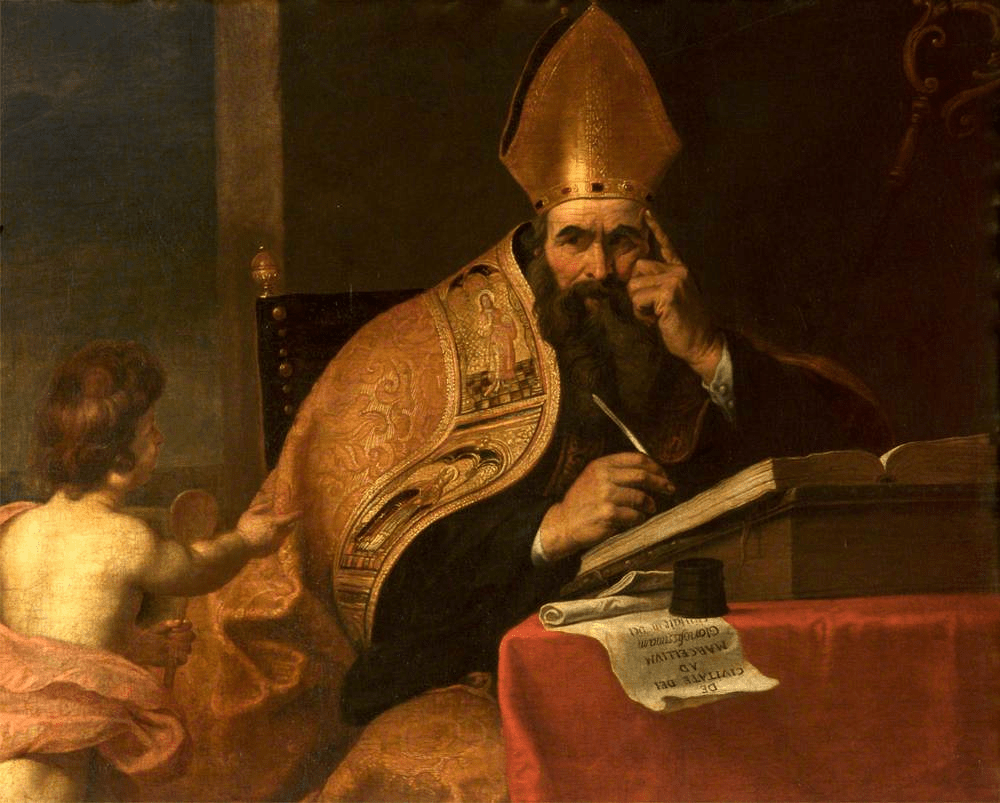
English: The Four Doctors of the Western Church, Saint Augustine of Hippo (354–430)
Augustine of Hippo. Chapter 5. The Birth of Western Spirituality:
“Our hearts are restless until they find their rest in You, O Lord.” There really is no one quite like Saint Augustine in the history of the Church. I have always thought of him as the “template” of a kind, a type, a genre of Christian seeker. From a young age he dives head-first into living the “Big Life,” achieves all that he sets out in his heart and imagination to attain, and then finds himself a bit spent and feeling empty on the other side of having gotten all the he desired. And so God finds him on the other side of his relatively easy and prosaic victories in the secular world.
Richard H. Schmidt does a good job in his introduction of giving us a glimpse of Augustine in his life and work. And I hope that our very limited consideration of Augustine’s work and thought might tempt you to read his “Confessions,” or “The City of God.” Both are a wonderful window into the life of faith. The first, the Confessions, giving color and voice to the interior journey of faith; and “The City of God” more or less offering a theological reflection regarding the consequences of that faith within the midst of a divided, secular, world.
SAINT PATRICK AND CELTIC CHRISTIANITY
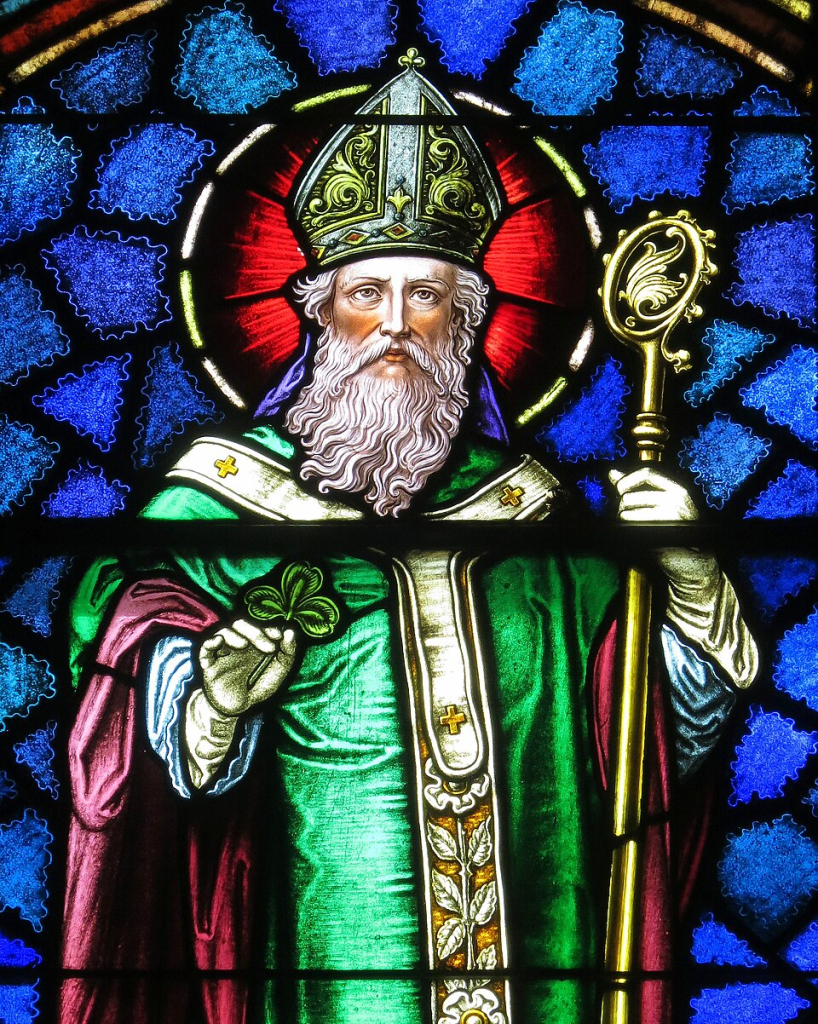
Patrick the Saint – A Short Biography
A FLEET OF 50 CURRACHS (longboats) weaved its way toward the shore, where a young Roman Brit and his family walked. His name was Patricius, the 16-year-old son of a civil magistrate and tax collector. He had heard stories of Irish raiders who captured slaves and took them “to the ends of the world,” and as he studied the longboats, he no doubt began imagining the worst.
With no Roman army to protect them (Roman legions had long since deserted Britain to protect Rome from barbarian invasions), Patricius and his town were unprepared for attack. The Irish warriors, wearing helmets and armed with spears, descended on the pebbled beach. The braying war horns struck terror into Patricius’s heart, and he started to run toward town.
The warriors quickly demolished the village, and as Patricius darted among burning houses and screaming women, he was caught. The barbarians dragged him aboard a boat bound for the east coast of Ireland.
Patricius, better known as Patrick, is remembered today as the saint who drove the snakes out of Ireland, the teacher who used the shamrock to explain the Trinity, and the namesake of annual parades in New York and Boston. What is less well-known is that Patrick was a humble missionary (this saint regularly referred to himself as “a sinner”) of enormous courage. When he evangelized Ireland, he set in motion a series of events that impacted all of Europe. It all started when he was carried off into slavery around 430.
Escape from Sin and Slavery
Patrick was sold to a cruel warrior chief, whose opponents’ heads sat atop sharp poles around his palisade in Northern Ireland. While Patrick minded his master’s pigs in the nearby hills, he lived like an animal himself, enduring long bouts of hunger and thirst. Worst of all, he was isolated from other human beings for months at a time. Early missionaries to Britain had left a legacy of Christianity that young Patrick was exposed to and took with him into captivity. He had been a nominal Christian to this point; he now turned to the Christian God of his fathers for comfort.
“I would pray constantly during the daylight hours,” he later recalled. “The love of God and the fear of him surrounded me more and more. And faith grew. And the spirit roused so that in one day I would say as many as a hundred prayers, and at night only slightly less.”
On The Mountain
Legend holds that Patrick rang a large bell (held in a reliquary, at the National Museum of Ireland) on the top of Eagle Mountain, now called Croagh Patrick. Depending on the legend, the bell scared away either Ireland’s snakes or its demons. Patrick’s other relic, a staff supposedly given to him by Jesus, was burned as an object of superstition in 1538.
After six years of slavery, Patrick received a supernatural message. “You do well to fast,” a mysterious voice said to him. “Soon you will return to your homeland.”
Before long, the voice spoke again: “Come and see, your ship is waiting for you.” So Patrick fled and ran 200 miles to a southeastern harbor. There he boarded a ship of traders, probably carrying Irish wolfhounds to the European continent.
After a three-day journey, the men landed in Gaul (modern France), where they found only devastation. Goths or Vandals had so decimated the land that no food was to be found in the once fertile area.
“What have you to say for yourself, Christian?” the ship’s captain taunted. “You boast that your God is all powerful. We’re starving to death, and we may not survive to see another soul.”
Patrick answered confidently. “Nothing is impossible to God. Turn to him and he will send us food for our journey.”
At that moment, a herd of pigs appeared, “seeming to block our path.” Though Patrick instantly became “well regarded in their eyes,” his companions offered their new-found food in sacrifice to their pagan gods.
Patrick did not partake.
The Prodigious Son Returns
Many scholars believe Patrick then spent a period training for ministry in Lerins, an island off the south of France near Cannes. But his autobiographical Confession includes a huge gap after his escape from Ireland. When it picks up again “after a few years,” he is back in Britain with his family.
It was there that Patrick received his call to evangelize Ireland—a vision like the apostle Paul’s at Troas, when a Macedonian man pleaded, “Help us!”
“I had a vision in my dreams of a man who seemed to come from Ireland,” Patrick wrote. “His name was Victoricius, and he carried countless letters, one of which he handed over to me. I read aloud where it began: ‘The Voice of the Irish.’ And as I began to read these words, I seemed to hear the voice of the same men who lived beside the forest of Foclut . . . and they cried out as with one voice, ‘We appeal to you, holy servant boy, to come and walk among us.’ I was deeply moved in heart and I could read no further, so I awoke.”
Despite his reputation, Patrick wasn’t really the first to bring Christianity to Ireland. Pope Celestine I sent a bishop named Palladius to the island in 431 (about the time Patrick was captured as a slave). Some scholars believe that Palladius and Patrick are one and the same individual, but most believe Palladius was unsuccessful (possibly martyred) and Patrick was sent in his place.
In any event, paganism was still dominant when Patrick arrived on the other side of the Irish Sea. “I dwell among gentiles,” he wrote, “in the midst of pagan barbarians, worshipers of idols, and of unclean things.”
Demons and Druids
Patrick did not require the native Irish to surrender their belief in supernatural beings. They were only to regard these beings in a new light as demons. The fear of the old deities was transformed into hatred of demons. If Christianity had come to Ireland with only theological doctrines, the hope of immortal life, and ethical ideas—without miracles, mysteries, and rites—it could have never wooed the Celtic heart.
Predictably, Patrick faced the most opposition from the druids, who practiced magic, were skilled in secular learning (especially law and history) and advised Irish kings. Biographies of the saint are replete with stories of druids who “wished to kill holy Patrick.”
Pilgrims
On the last Sunday of each July, between 25,000 and 30,000 pilgrims pass the saint’s statue and climb to the top of Croagh Patrick, commemorating the saint’s fasting there for 40 days and nights. Carbon dating of church ruins at the 2,710-foot summit has shown it dates from Patrick’s day, supporting the legend that says Patrick climbed it.
“Daily I expect murder, fraud or captivity,” Patrick wrote, “but I fear none of these things because of the promises of heaven. I have cast myself into the hands of God almighty who rules everywhere.”
Indeed, Patrick almost delighted in taking risks for the gospel. “I must take this decision disregarding risks involved and make known the gifts of God and his everlasting consolation. Neither must we fear any such risk in faithfully preaching God’s name boldly in every place, so that even after my death, a spiritual legacy may be left for my brethren and my children.”
Still, Patrick periodically avoided such confrontations by paying protection money: “Patrick paid the price of 15 souls in gold and silver so that no evil persons should impede them as they traveled straight across the whole of Ireland,” wrote one biographer.
Patrick was as fully convinced as the Celts that the power of the druids was real, but he brought news of a stronger power. The famous Lorica (or “Patrick’s Breastplate”—see I Rise Today), a prayer of protection, may not have been written by Patrick (at least in its current form), but it expresses perfectly Patrick’s confidence in God to protect him from “every fierce merciless force that may come upon my body and soul; against incantations of false prophets, against black laws of paganism, against false laws of heresy, against deceit of idolatry, against spells of women and smiths and druids.”
According to legend, it worked. The King, Loiguire, set up a trap to kill Patrick, but as the bishop came near, all the king could see was a deer. (Thus the Breastplate has also been known as the Deer’s Cry.)
There was probably a confrontation between Patrick and the druids, but scholars wonder if it was as dramatic and magical as later stories recounted. One biographer from the late 600s, Muirchœ, described Patrick challenging druids to contests at Tara, in which each party tried to outdo the other in working wonders before the audience:
“The custom was that whoever lit a fire before the king on that night of the year [Easter vigil] would be put to death. Patrick lit the paschal fire before the king on the hill of Slane. The people saw Patrick’s fire throughout the plain, and the king ordered 27 chariots to go and seize Patrick . . . .
“Seeing that the impious heathen were about to attack him, Patrick rose and said clearly and loudly, ‘May God come up to scatter his enemies, and may those who hate him flee from his face.’ By this disaster, caused by Patrick’s curse in the king’s presence because of the king’s order, seven times seven men fell. . . . And the king, driven by fear, came and bent his knees before the holy man . . . .
“[The next day], in a display of magic, a druid invoked demons and brought about a dark fog over the land. Patrick said to the druid, ‘Cause the fog to disperse.’ But he was unable to do it. Patrick prayed and gave his blessing, and suddenly the fog cleared and the sun shone. . . . And through the prayers of Patrick the flames of fire consumed the druid.
“And the king was greatly enraged at Patrick because of the death of his druid. Patrick said to the king, ‘If you do not believe now, you will die on the spot for the wrath of God descends on your head.’
“The king summoned his council and said, ‘It is better for me to believe than to die.’ And he believed as did many others that day.”
Yet to Patrick, the greatest enemy was one he had been intimately familiar with—slavery. He was, in fact, the first Christian to speak out strongly against the practice. Scholars agree he is the genuine author of a letter excommunicating a British tyrant, Coroticus, who had carried off some of Patrick’s converts into slavery.
“Ravenous wolves have gulped down the Lord’s own flock which was flourishing in Ireland,” he wrote, “and the whole church cries out and laments for its sons and daughters.” He called Coroticus’s deed “wicked, so horrible, so unutterable,” and told him to repent and to free the converts.
It remains unknown if he was successful in freeing Coroticus’s slaves, but within his lifetime (or shortly thereafter), Patrick ended the entire Irish slave trade.
Royal Missionary
Patrick concentrated the bulk of his missionary efforts on the country’s one hundred or so tribal kings. If the king became a Christian, he reasoned, the people would too. This strategy was a success.
As kings converted, they gave their sons to Patrick in an old Irish custom for educating and “fostering” (Patrick, for his part, held up his end by distributing gifts to these kings). Eventually, the sons and daughters of the Irish were persuaded to become monks and nuns.
From kingdom to kingdom (Ireland did not yet have towns), Patrick worked much the same way. Once he converted a number of pagans, he built a church. One of his new disciples would be ordained as a deacon, priest, or bishop, and left in charge. If the chieftain had been gracious enough to grant a site for a monastery as well as a church, it was built too and functioned as a missionary station.
Before departing, Patrick gave the new converts (or their pastors) a compendium of Christian doctrine and the canons (rules).
Self Doubt
Despite his success as a missionary, Patrick was self-conscious, especially about his educational background. “I still blush and fear more than anything to have my lack of learning brought out into the open,” he wrote in his Confession. “For I am unable to explain my mind to learned people.”
Nevertheless, he gives thanks to God, “who stirred up me, a fool, from the midst of those who are considered wise and learned in the practice of the law as well as persuasive in their speech and in every other way and ahead of these others, inspired me who is so despised by the world.”
Over and over again, Patrick wrote that he was not worthy to be a bishop. He wasn’t the only one with doubts. At one point, his ecclesiastical elders in Britain sent a deputation to investigate his mission. A number of concerns were brought up, including a rash moment of (unspecified) sin from his youth.
His Confession, in fact, was written in response to this investigation. Reeling from accusations, Patrick drew strength from God: “Indeed he bore me up, though I was trampled underfoot in such a way. For although I was put down and shamed, not too much harm came to me.”
If Patrick was not confident about his own shortcomings, he held a deep sense of God’s intimate involvement in his life. “I have known God as my authority, for he knows all things even before they are done,” he wrote. “He would frequently forewarn me of many things by his divine response.”
Indeed, Patrick recorded eight dreams he regarded as personal messages from God. And scattered throughout his Confession are tributes to God’s goodness to him: “Tirelessly, I thank my God, who kept me faithful on the day I was tried, so that today I might offer to him, the Lord Jesus Christ, the sacrifice of my soul. He saved me in all dangers and perils . . . . So, whatever may come my way, good or bad, I equally tackle it, always giving thanks to God.”
According to the Irish annals, Patrick died in 493, when he would have been in his seventies. But we do not know for sure when, where, or how he died. Monasteries at Armagh, Downpatrick, and Saul have all claimed his remains. His feast day is recorded as early as March 17, 797, with the annotation; “The flame of a splendid sun, the apostle of virginal Erin [Ireland], may Patrick with many thousands be the shelter of our wickedness.”
Ultimate Model
It is difficult to separate fact from fiction in the stories of Patrick’s biographers. It is historically clear, however, that Patrick was one of the first great missionaries who brought the gospel beyond the boundaries of Roman civilization. According to tradition, he had established bishops throughout northern, central, and eastern Ireland. Only Munster, in the south, was to remain pagan until a century after Patrick’s death.
Patrick was the ultimate model for Celtic Christians. He engaged in continuous prayer. He was enraptured by God and loved sacred Scripture. He also had a rich poetic imagination with the openness to hear God in dreams and visions and a love of nature and the created.
He is, then, most worthy of the appellation saint, as one “set apart” for a divine mission. As such, he became an inspiring example. Hundreds of Celtic monks, in emulation of Patrick, left their homeland to spread the gospel to Scotland, England, and continental Europe.
It is a legacy Patrick was proud of: “For God gave me such grace, that many people through me were reborn to God and afterward confirmed and brought to perfection. And so then a clergy was ordained for them everywhere.”
More resources:
The best starting place to learn about Patrick is with his own words. Few doubt his authorship of the autobiographical Confession and his angry Letter to Coroticus, available in several books, including a new translation by John O’donohue.
The works are also available in Saint Patrick’s World by Liam de Paor. Combining primary source documents with an informative 50-page “introduction,” it should be in the library of anyone interested in this topic.
If you’re interested in more detail, check out the biography In the Steps of St. Patrick by Brian De Breffny.
By Mary Cagney
[Christian History originally published this article in Christian History Issue #60 in 1998]
Mary Cagney, a former editorial resident at Christianity Today, has written a screenplay titled A Celtic King. The author of this piece, Mary Cagney, is a former editorial resident for the news department of Christianity Today, where she wrote several articles on the North Ireland peace process.
St. Patrick
“We rush through our days in such stress and intensity, as if we were here to stay and the serious project of the world depended on us. We worry and grow anxious; we magnify trivia until they become important enough to control our lives. Yet all the time, we have forgotten that we are but temporary sojourners on the surface of a strange planet spinning slowly in the infinite night of the cosmos.”
― John O’Donohue, Eternal Echoes: Celtic Reflections on Our Yearning to Belong
“Prayer shaped their consciousness, so that they became ever more aware that the Kingdom of Heaven is a constant and present reality, hidden within the veil of everyday life.”
― Ray Simpson, Celtic Prayers for the Rhythm of Each Day
Good Afternoon Friends,
We meet next Thursday, September 25th, in the Cathedral Library to continue our reading with Chapter 5, 6, and possibly 7. This will include St. Augustine, St. Patrick, and Benedict of Nursia. I do hope that you will take care to read Richard Schmidt’s introductions to each writer. Historical context matters in these readings, as these were individuals giving articulation to spiritual truths they received in the midst of living daily life. We will begin our conversation by addressing the questions at the end of each chapter – you may want to read with that in mind.
If you find yourself stymied by a particular quote or question, spend a moment on it, and then simply move on. There is so much spiritual “meat” in this book that you find your way like following breadcrumbs through a forest. Take what is useful and truthful, and then leave the rest for later.
I have updated the page on my blog, and will be doing so throughout, if you would like some thoughts and additional conversation on the chapters we are reading together.
You can find it here: https://thecarpentersnail.blog/god-seekers-book-group-group-notes/
You will notice that “GOD SEEKERS BOOK GROUP – GROUP NOTES” is at the top of my blog as a link.
Our next session will be September 25th, 5:30, in the Cathedral Library. Please feel free to come and go as works best for you.
Blessings and Godspeed,
Alston
BENEDICT OF NURSIA – WESTERN MONASTACISM
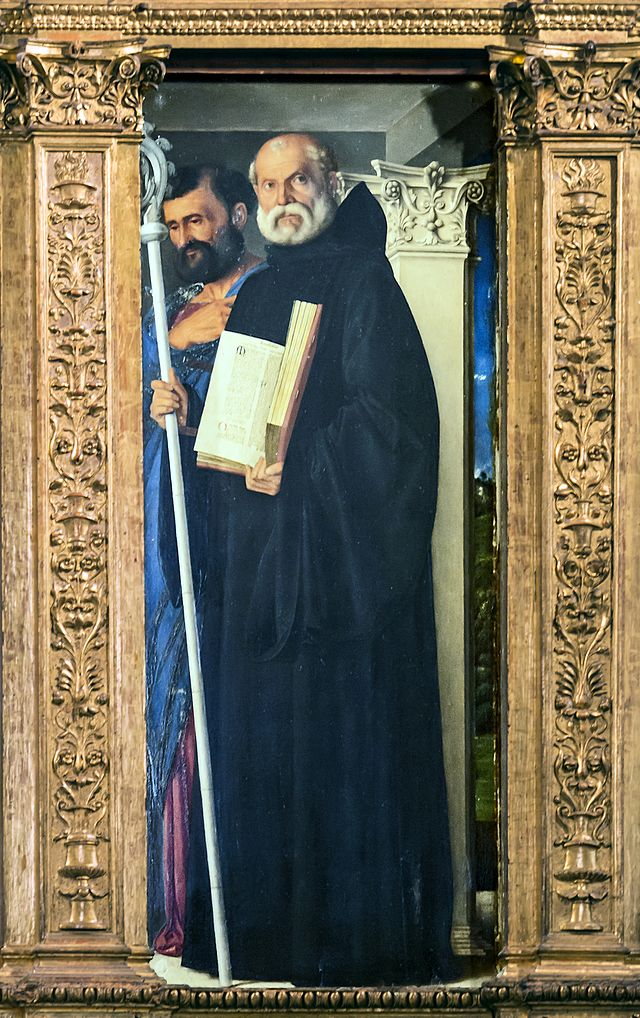
How Benedict’s Rule can guide your spiritual practice
Benedictine wisdom helps us become monks in the world.
Christine Valters Paintner, Published August 8, 2019
St. Benedict is a wise guide and presence in my life through the teachings he left in his Rule for monasteries. Benedict was born in Nursia, Italy and died at the abbey he founded in Monte Cassino (c. 480–547). All that we know of his life comes from Pope Gregory the Great, who wrote a biography about the monk and saint 50 years after Benedict’s death. Gregory describes how Benedict lived for three years in a cave in Subiaco as a hermit until others began to seek him out and formed a community around him. There are miracles associated with the saint as well. He is said to have performed several, including bringing a child back to life.
The Hildegard connection
I have been a Benedictine oblate for 15 years. To be a Benedictine oblate means to commit oneself as a layperson to live out the Rule of St. Benedict in the everyday world. Although Benedict wrote his Rule 1,500 years ago, what is perhaps most remarkable is how well its wisdom endures. Today it continues to guide the spiritual practice of thousands of communities around the world.
I first discovered the Benedictine way when I was in graduate school. In studying for my history of Christian spirituality exam I encountered St. Hildegard of Bingen, a 12th-century Benedictine abbess from Germany who was a preacher, theologian, visionary, musician, artist, herbalist, and spiritual director. The more I studied her, the more I wanted to learn about this Benedictine tradition in which she was so steeped.
I consider Hildegard to be the patron saint of my becoming an oblate. She opened the door for me into this contemplative way of life that so resonated with who I was and how I longed to pray. In Benedict’s Rule I discovered a beautifully balanced vision for the spiritual life, both in solitude and in community. Benedict did not believe in harsh, ascetic practices. He was critical of those who aimed for a kind of spiritual competition or went to extremes of fasting or other forms of self-denial.
Benedictine spirituality and disability
Two books by author and theologian Mary Earle for those living with chronic illness helped me fall even more in love with the Rule’s commitment to balance, moderation, and finding a healing rhythm to life: Beginning Again: Benedictine Wisdom for Living with Illness (Morehouse Publishing) and Broken Body, Healing Spirit: Lectio Divina and Living with Illness (Morehouse Publishing). I struggled with rheumatoid arthritis for much of my 20s. I still have the disease, but it is mostly controlled with medication. The Benedictine path helped me to claim the contemplative way, which I saw was not only truer to my nature but also more nourishing of a life lived with physical limitations.
In studying Benedict’s Rule I also discovered the practice of lectio divina, which means “sacred reading.” This practice is one of the oldest Christian contemplative ways of prayer. Traditionally used to pray with scripture and other sacred texts, lectio divina has inspired me to see all of life as a sacred text in which to listen for a holy word from icons, music, and nature.
There are three primary commitments in the Benedictine way that form the spiritual backbone for the rest of the spiritual practices—obedience, stability, and conversion.
Obedience, stability, and conversion
The root of the word obedience means “to hear” and is about making a commitment to listen for God’s voice in the world and respond when you hear the call. Obedience is a difficult concept for modern Western thinkers. Consider it as a way of deep listening for the holy in all dimensions of your life. The second part of this listening is a response: Am I willing to not only make the time and space to listen for God’s call, but to also respond with my full self?
Stability for monastics means making a commitment to a particular monastery for a lifetime. For those of us who are committed to monastic practices outside of the monastery walls, consider it as a commitment to be present to life circumstances even through challenges. This might apply to a marriage or friendship, to our work life, or simply to daily challenges. Can I stay present to the moment and how God is speaking even when I’m uncomfortable or in conflict? Or do I want to run in the other direction?
Then there is conversion, which for me essentially means making a commitment to always be surprised by God. Conversion is the counterpart to stability. It is the recognition that we are all on a journey and always changing. God is always offering us something new within us. How might my spiritual life transform by opening myself up to the new possibilities God is continually offering each moment?
Sacred hospitality
One of my favorite lines from Benedict’s Rule is: “All guests who present themselves are to be welcomed as Christ, for he himself will say: I was a stranger and you welcomed me.” I love this invitation to welcome that which feels the most strange and uncomfortable as the very face of the divine. The stranger might be outside of us but just as easily is within us. We each have parts of ourselves we try to push away. In the Benedictine monastic tradition, everything is considered sacred—all people, all things, and all of time. The stranger at the door is to be welcomed in as Christ. The kitchen utensils are to be treated just like the altar vessels. The hours of the day call us to remember the presence of God again and again so that time becomes a cascade of prayers.
In 2009 I traveled to Rome for the World Congress of Benedictine Oblates, where I met other oblates from around the world. We made pilgrimages to sacred sites connected with Benedict, such as the cave in Subiaco and Monte Cassino, the central monastery he founded high upon a hill. Monte Cassino is a large and flourishing place where many pilgrims seeking spiritual connection go. I still treasure my Benedict medal from there, which I wear daily around my neck as a symbol of my commitment.
Benedictine wisdom forms the heart of my daily spiritual practice, along with the teaching I do. I call it becoming a monk in the world, to learn how to embrace this way of being and offer it as a gift to a world always so busy and frenzied. In living this way I witness to an alternative way of being, one rooted in slowness and spaciousness, one inspired by what Benedict called the “inexpressible delight of love.”
This article also appears in the August 2019 issue of U.S. Catholic (Vol. 84, No. 8, pages 45–46).
CHAPTER 8 – SYMEON THE NEW THEOLOGIAN – EXPERIENCING THE SPIRIT
Anglican Spirituality Group – October 30th – 5.30 – Cathedral Library

Plato’s Allegory of the Cave
“If you know that all visible things are a shadow and all pass away, are you not ashamed of playing with shadows and hoarding transitory things? Like a child you draw water with a bucket full of holes; do you not realize it and take it into account, my dear friend? As though there were nothing more serious than appearance and illusion, as though reality has been taken from them?”
+ St. Symeon the New Theologian
Good Evening Friends,
I hope that you are doing well on this rainy night. Our next session will begin with a continuance of Chapter 7 – “Western Monasticism – Benedict of Nursia.” Benedict has always been a favorite of mine and Liza’s, and I could probably “go on” a bit about the Western Monastic tradition. There is much for us to gather from that tradition as we are each negotiating our journey through modernity. If you listen closely to psychological suggestions and advice for modern peace of mind, you will find that much of it has deep roots in the mixture of the contemplative and active life that is balanced in monasticism.
We will also visit about the life and thought of Symeon The New Theologian who comes to us from the Eastern and Orthodox world of medieval Christianity. I find him fascinating and compelling, with a grasp of what lies beyond “The Beyond.” In my own studies, I have always found that theologians and Christian thinkers sometimes have the greatest difficulty describing or offering quantification for the Holy Spirit. I am reminded of an old philosophical trope that was asked by Ludwig Wittgenstein who said, ““Describe the smell of coffee without using the word “coffee.”” It poses a nearly impossible challenge; I find descriptions of the Holy Spirit are similar. The only real explanation lay in the experience of the Holy Spirit itself.
And of course if we have time we will move onto Anselm of Canterbury – one the greats of our own Anglican tradtion.
You can notes and videos here:https://thecarpentersnail.blog/god-seekers-book-group-group-notes/
You will notice that “GOD SEEKERS BOOK GROUP – GROUP NOTES” is at the top of my blog as a link.
Our next session will be October 30th, 5:30, in the Cathedral Library. Please feel free to come and go as works best for you.
Blessings and Godspeed,
Alston
Symeon The New Theologian, Bishop Kallistos Ware, The Study of Spirituality, ed. Cheslyn, Wainwright, Yarnold
(Oxford University Press, 1986) pp. 235-242.
| § 1. Introduction: Byzantine Theology |
‘He became man that we might be made god’; he became ‘incarnate’ that we might be ‘ingodded’. So St Athanasius of Alexandria sums up the message of salvation in Christ (De Incarnatione, 54). The EasternOrthodox tradition has sought to give full emphasis to both parts of his statement. ‘He became man’: the implications of this were explored more especially by the Greek Fathers from the fourth to the seventh centuries. What does it mean to affirm that Jesus Christ is fully God, truly human, and yet a single undivided person? It was in response to this three-sided question that the first six Ecumenical Councils, from Nicaea I (325) to Constantinople III (680), developed the classic expression of Trinitarian theology and Christology. In the centuries that followed, the main focus of attention shifted from the first to the second part of Athanasius’ dictum: ‘. . . that we might be made god’. What are the effects of the divine incarnation in the life of the Christian? What is signified by the fulness of ‘ingodding’ or ‘deification’ (theōsis)? How is it possible for the human person, without ceasing to be authentically human, to enjoy direct and transforming union with God in his glory? These are the master themes of later Byzantine theology and spirituality.
Two writers in this period stand out with particular prominence: in the eleventh century, St Symeon the New Theologian, and in the fourteenth, St Gregory Palamas. Each is rooted in the past, but both are at the same time explorers, developing the earlier tradition in fresh ways.
From the ninth century onwards Greek Christianity tended to be strongly conservative, and all too often its spokesmen remained content with a barren ‘theology of repetition’. Typical of this outlook is the somewhat discouraging comment of the Byzantine scholar Theodore Metochites (d. 1332), ‘The great men of the past have expressed everything so perfectly that they have left nothing more for us to say’ (Miscellanea, preface: cited in S. Runciman, The Last Byzantine Renaissance. CUP, 1970, p. 94). There was in the Greek East nothing equivalent to the startling rediscovery of Aristotle and the dynamic evolution of scholasticism in the West during the twelfth and thirteenth centuries; in the East the patristic period of theology continued uninterrupted until 1453, and indeed beyond. But, throughout the twelve hundred years of Byzantium, alongside continuity there is also change; and the finest representatives of later Byzantine thought, such as Symeon and Palamas, succeed in combining loyalty to the past with creative originality. Later Byzantine spirituality is marked above all by three features:
1. A strong insistence upon the divine mystery and so upon the apophatic approach to God; he is utterly transcendent, beyond all concepts and images, beyond all human understanding.
2. A balancing sense of the nearness as well as the otherness of the Eternal; not only transcendent but immanent, God can be known here and now, in this present life, through direct personal experience.
3. A preference for the symbolism of light rather than darkness; mystical union with God takes above all the form of a vision of divine radiance, the dominant ‘model’ being Christ transfigured upon Mount Tabor.
| § 2. Biography of Symeon |
St Symeon the New Theologian (949-1022) exemplifies all three of these features, but more particularly the second. In a manner altogether exceptional in the Christian East — for there is in Greek patristic literature no autobiographical work equivalent to the Confessions of St Augustine -Symeon refers explicitly to his own personal experiences. Enthusiastic, unsystematic, he is a ‘theologian’, not in the modern academic sense, but rather according to the older understanding of the term: a man of prayer, of personal vision, who speaks about the divine realm, not in a theoretical fashion, but on the basis of what he has himself seen and tasted. The designation ‘new’ in his title, according to the most persuasive interpretation, implies a comparison first of all with St John the Evangelist or the Divine (in Greek, theologos, ‘the Theologian’), and then with St Gregory of Nazianzus, ‘ Gregory the Theologian’ as he is known in the Christian East. The name ‘New Theologian’ means, then, that St Symeon in the eleventh century renewed the tradition of mystical prayer to which St John bore witness in the first century and St Gregory of Nazianzus in the fourth.
Destined originally for a political career, at the age of fourteen Symeon the New Theologian passed under the influence of a monk at the monastery of Studios in Constantinople, also named Symeon, known as Eulabes, ‘the devout’. Profoundly marked by the example of his own spiritual father, in his teaching the younger Symeon stresses the vital need for living, personal direction in the spiritual life. He would have agreed with the Hasidic master Rabbi Jacob Yitzhak that ‘the way cannot be learned out of a book, or from hearsay, but can only be communicated from person to person’ (M. Buber, [ET] The Tales of the Hasidim [ New York, Shocken Books, 1947], vol. i, p. 286). The importance of the spiritual father is, indeed, a recurrent theme throughout later Byzantine spirituality: ‘Above all else’, say Kallistos and Ignatios Xanthopoulos (fourteenth century), ‘search diligently for an unerring guide and teacher’ (On the Life of Stillness, § 14).
When Symeon was aged about twenty and still a layman, he received the first in a series of visions of divine light. Seven years later he became a monk. For a quarter of a century he was abbot of the monastery of St Mamas in Constantinople; his last thirteen years were passed outside the city, in a small hermitage on the opposite shore of the Bosphorus. Thus the central and most creative period of his life was spent, not in seclusion, but as superior of a busy community in the heart of the imperial capital; he is an ‘urban Hesychast’, a mystical theologian who combines inner prayer with pastoral and administrative work. In his understanding of monastic life he blends the cenobitic approach of St Basil the Great and St Theodore the Studite with the more solitary, eremitic spirit of St John Climacus. During his life and after his death he aroused sharp controversy — in particular, because of the cult that he rendered to his spiritual father as a saint, without waiting for official approval, and because of his views on priesthood and confession — but the Byzantine Church ended by canonizing him.
| § 3. Awareness of Divine Indwelling |
Symeon displays an especially close affinity with the Spiritual Homilies attributed to Macarius. Whatever the truth about the supposed Messalian character of the Homilies (cf. p. 160), there is no good reason to attribute to the New Theologian the kind of Messalianism that might be suspected of heresy. What Symeon shares with the Homilies is above all an emphasis upon conscious, personal awareness of Christ and the Spirit. Christianity, so he is passionately convinced, involves much more than a formal, dogmatic orthodoxy, than an outward observance of moral rules. No one can be a Christian at second hand; the tradition has to be relived by each one of us without exception, and each should feel the indwelling presence of the Holy Spirit in a conscious, palpable manner:
| Do not say, It is impossible to receive the Holy Spirit;Do not say, It is possible to be saved without him.Do not say, then, that one can possess him without knowing it.Do not say, God does not appear to men,Do not say, Men do not see the divine light,Or else, It is impossible in these present times.This is a thing never impossible, my friends,But on the contrary altogether possible for those who so wish(Hymn XXVII, 125-32). | μὴ λέγετε ἀδύνατον λαβεῖν τὸ θεῖον πνεῦμα·μὴ λέγετε χωρὶς αὐτοῦ δυνατὸν τὸ σωθῆναι· (125)μὴ οὖν ἀγνώστως τούτου λέγετέ τινα μετέχεινμὴ λέγετε, ὅτι θεὸς οὐχ ὁρᾶται ἀνθρώποις·μὴ λέγετε, οἱ ἄνθρωποι φῶς θεῖον οὐχ ὁρῶσιν,ἢ ὅτι καὶ ἀδύνατον ἐν τοῖς παροῦσι χρόνοις·οὐδέποτε ἀδύνατον τοῦτο τυγχάνει, φίλοι, (130)ἀλλὰ καὶ λίαν δυνατὸν τοῖς θέλουσιν ὑπάρχει· |
If in this passage and elsewhere Symeon comes close to identifying the reality of grace with the conscious feeling of grace, as the Messalians were accused of doing, he does sometimes allow for a real yet hidden activity of the Spirit on an unconscious level (see, for example, Chapters, III, 76). The aim, however, is always to advance beyond this unconscious grace to the point of explicit awareness, at which we experience the Spirit ‘in a conscious and perceptible way’, with what he calls the ‘sensation of the heart’. In the passage quoted above, it is significant that Symeon vehemently repudiates any suggestion that the charismata granted to holy men and women in the past are no longer accessible to Christians in the present time. For him this was the worst of all heresies, implying as it does that the Spirit has somehow been withdrawn from the Church. We are in exactly the same situation as the first Christians, he protests; if grace is not as apparent among us today as it was once among them, the sole reason is the weakness of our faith.
| § 4. The Power to Absolve Sins |
Symeon applies this teaching about direct experience more especially to confession and absolution. Who, he asks in his letter On Confession, is entitled to ‘bind and loose’? The answer is surprising. There is one essential qualification, and one only, which enables a person to act as confessor and spiritual father, and that is a conscious awareness of the Holy Spirit:
Do not try to be a mediator on behalf of others until you have yourself been filled with the Holy Spirit, until you have come to know and to win the friendship of the King of all with conscious awareness in your soul (Letter i, 10: Holl, p. 119).
From this Symeon draws a double conclusion: negatively, that anyone who lacks this conscious awareness — even though he may be bishop or patriarch — should not, and indeed cannot, exercise the ministry of confession; positively, that lay monks who possess such awareness, even though not in holy orders, may be called to exercise this ministry.
Most Orthodox would hesitate to go the whole way here with Symeon. It is true that in the Christian East, from the fourth century up to the present, there have been many instances of lay monks acting as spiritual fathers. Symeon’s own ‘elder’, Symeon the Studite, was not a priest -although the New Theologian himself was — and many of the leading spiritual fathers on the Holy Mountain of Athos today are likewise lay monks; within Orthodoxy the ministry of eldership is at times exercised equally by nuns who act as spiritual mothers. But is this ministry of eldership or spiritual direction identical with the sacrament of confession, strictly defined? Although Symeon makes no distinction between the two, many other Orthodox would wish to do so. One point, however, emerges unambiguously from Symeon’s answer about confession: the high significance that he attaches to direct personal experience of God.
| § 5. Vision of the Divine Light |
This direct experience takes the form, in Symeon’s teaching, more especially of the vision of divine light. Here Symeon, speaking of himself in the third person, describes the first such vision that he received:
| WHILE he was standing one day and saying the prayer God be merciful to me a sinner (Luke 18:13), more with his intellect than with his mouth, a divine radiance suddenly appeared in abundance from above and filled the whole room. | ¨Ισταμένου οὖν αὐτοῦ ἐν μιᾷ καὶ τὸ « ̈̔Ο Θεός, ἱλάσθητί μοι τῷ ἁμαρτωλῷ» λαλοῦντος τῷ νοῒ μᾶλλον ἢ τῷ στόματι, ἔλλαμψις θεία πλουσίως αἴφνης ἐπέφανεν ἄνωθεν (90) καὶ πάντα τὸν τόπον ἐπλήρωσε. |
| When this happened, the young man lost all awareness of his surroundings and forgot whether he was in a house or under a roof. He saw nothing but light on every side, and did not even know if he was standing on the ground […] | Τούτου δὲ γεγονότος ἠγνόησεν ὁ νεανίας καὶ ἐπελάθετο εἰ ἐν οἴκῳ ἦν ἢ ὅτι ὑπὸ στέγην ὑπῆρχε. Φῶς γὰρ μόνον ἔβλεπε πάντοθεν καὶ οὐδὲ εἰ ἐπὶ γῆς ἐπάτει ἐγίνωσκεν. |
| He was wholly united to non material light and, so it seemed, he had himself been turned into light. Oblivious of all the world, he was overwhelmed with tears and with inexpressible joy and exultation | (95) […] ἀλλ’ ὅλως φωτὶ ἀΰλῳ συνὼν καὶ τῷ δοκεῖν αὐτὸς φῶς γενόμενος καὶ παντὸς τοῦ κόσμου ἐπιλαθόμενος, δακρύων καὶ χαρᾶς ἀνεκφράστου καὶ ἀγαλλιάσεως ἔμπλεως ἐγένετο. |.. (100) |
| Greek Text: B. Krivochéine and J. Paramelle, Syméon le Nouveau Théologien, Catéchèses [Sources Chrétiennes 96, Paris: Éditions du Cerf, 1963] |
(Catechesis XXII, lines 88-100).
Note how Symeon’s experience combines sorrow with joy. Before the vision he prays for mercy, and when the vision comes he sheds tears; yet they are tears not of penitence only but of rejoicing. The light that enfolds him is evidently far more than a metaphorical ‘light of the understanding’. It is an existent reality, and yet at the same time it is not a physical and created light, but spiritual and divine; as he affirms throughout his writings, the light is God himself. This divine light has upon Symeon a transforming effect; he is taken up into that which he contemplates, and is himself ‘turned into light’. Yet, though transfigured, he does not lose his personal identity, but is never so truly himself as when within the light. If the account of Symeon’s first vision might seem to suggest that the light is impersonal, elsewhere he insists upon the personal presence of Jesus within the divine radiance: the Lord speaks to him from the light, and the vision involves a dialogue of love between them. Symeon’s light mysticism is not just ‘photocentric’ but Christocentric.
Although Symeon almost always describes the mystical union in terms of light, not of darkness, he is at the same time an apophatic theologian, frequently applying negative language to God; the first of the three features mentioned above is present as well as the second and the third. ‘You are higher than all essence,’ he says to the Creator, ‘than the very nature of nature, higher than all ages, than all light . . . You are none of the things that are, but above them all’ (Hymn XV, 67-71). Yet, while ‘invisible, unapproachable, beyond our understanding and our grasp’ (XV, 75), God has at the same time become truly human and is known by the saints in a vision face to face. To express this double truth that God is at once transcendent and immanent, unknown yet well known, the fourteenth-century Hesychasts make use of the distinction between the divine essence and the divine energies: although beyond all understanding in his essence, God reveals himself and enters into personal communion with us through his energies. Sometimes Symeon likewise employs this distinction (e.g. Hymn XXIV, 11; XXXI, 6-7), but elsewhere he ignores it, stating that humans can partake even in the very essence of God (e.g. Hymn VII, 25-29). His usage is not consistent, and it would be misleading here to read back into his thought the more developed position of the later period. In general, however, he exercised an important influence on the fourteenth-century Hesychasts.
| § 6. Sacramental Theology and the Body |
Three other points call for mention:
First, an absence: there is no reference in Symeon’s authentic writings to the Jesus Prayer. Here again a difference should be noted between Symeon and the later Hesychasts.
Secondly, Symeon’s vision of the spiritual way, as well as being Christocentric, is also deeply sacramental. In particular, he refers to the Eucharist in strongly realistic terms: [But the metrical prayer commencing From polluted lips. . ., used by Orthodox before communion and commonly attributed to Symeon the New Theologian, is almost certainly not his work but that of his contemporary St Symeon Metaphrastes (‘the Translator’)].
| My blood has been mingled with your Blood,And I know that I have been united also to your Godhead.I have become your most pure Body, | καὶ μιγὲν τὸ αἷμά μου τῷ αἵματί σουἡνώθην, οἶδα, καὶ τῇ θεότητί σουκαὶ γέγονα σὸν καθαρώτατον σῶμα, (15) |
| A member dazzling, a member truly sanctified,A member glorious, transparent, luminous …What was I once, what have I now become!… | μέλος ἐκλάμπον, μέλος ἅγιον ὄντως,μέλος τηλαυγὲς καὶ διαυγὲς καὶ λάμπον […]ἐκ ποίου οἷος ἐγενόμην […] |
| Where shall I sit, what shall I touch,Where shall I rest these limbs that have become your own,In what works or actions shall I employThese members that are terrible and divine? (Hymn II, 13-29). | (25)τὸ ποῦ καθίσω καὶ τίνι προσεγγίσωκαὶ ποῦ τὰ μέλη τὰ σὰ προσανακλίνω,εἰς ποῖα ἔργα, εἰς ποίας ταῦτα πράξειςὅλως χρήσομαι τὰ φρικτά τε καὶ θεῖα· |
Thirdly, Symeon displays a profound reverence for the body, which he sees in Hebraic, biblical terms as an integral part of the human person — to be sanctified, not hated and repressed. This was something that he had learnt from his spiritual father Symeon the Studite, of whom he says:
| He was not ashamed of the limbs of anyone,Or to see others naked and to be seen naked himself.For he possessed the whole Christ and was himself wholly Christ;And always he regarded all his own limbs and the limbs of everyone else,Individually and together, as being Christ himself . (Hymn XV, 207-11) | οὗτος οὐκ ἐπῃσχύνετο μέλη παντὸς ἀνθρώπουοὐδὲ γυμνοὺς τινὰς ὁρᾶν οὐδὲ γυμνὸς ὁρᾶσθαι·εἶχε γὰρ ὅλον τὸν Χριστόν· ὅλος αὐτὸς Χριστὸς ἦν, (210)καὶ μέλη ἅπαντα αὐτοῦ καὶ παντὸς ἄλλου μέληκαθ’ ἓν καὶ πάντα ὡς Χριστὸν οὗτος ἀεὶ ἑώρα |
Here, as in the account of his first vision of the divine light and in his words of thanksgiving after Holy Communion, we see how for Symeon the total person, body and soul together, is hallowed and permeated by grace and glory. A monk and an ascetic, he yet has no sympathy for the platonizing or Gnostic outlook that depreciates the body, excluding it from the process of salvation. In Symeon’s eyes ascetic self-denial is a battle not against but for the body.
| § 7. Conclusion: Hymnody and Poetry |
Vivid, full of personal warmth, St Symeon the New Theologian is an unusually attractive writer. His spirituality is perhaps expressed most eloquently in the fifty-six Hymns of Divine Love written towards the end of his life, from which we have quoted more than once. A theologian poet, in the long line extending from St Ephrem the Syrian, through Dante, St John of the Cross, Milton and Blake, up to T. S. Eliot and Edwin Muir in our own century, he exemplifies the close link existing between theology and poetry. Often it is the poets who are the best theologians of all. It would be good for the Church if we paid them greater heed.
TEXTS AND TRANSLATIONS
There is a critical Greek text, with French tr., in SC (9 vols. so far; one to follow); the main writings exist also in ET.
i. Chapters [Theological, Gnostic and Practical Chapters], ed. J. Darrouzès and L. Neyrand, SC 51 (2nd edn, 1980); ET P. McGuckin, Cistercian Studies Series 41 (Kalamazoo, 1982).
ii. Catecheses or Discourses, ed. B. Krivochéine and J. Paramelle, SC 96, 104, 113 (1963-5); ET C. J. de Catanzaro, CWS XXI.
iii. Theological Treatises, ed. J. Darrouzès, SC 122 (1966); ET McGuckin (see i above).
iv. Ethical Treatises, ed. J. Durrouzès, SC 122, 129 (1966-7).
v. Hymns, ed. J. Koder and J. Paramelle, SC 156, 174, 196 (1969-73); also ed. A. Kambylis (Berlin, 1976); ET G. A. Maloney (Denville, N.J., Dimension Books, no date).
vi. Letters: to appear in SC. For Letter 1 (On Confession), see K. Holl, Enthusiasmus und Bussgewalt beim griechischen Mönchtum: Eine Studie zu Symeon dem neuen Theologen (Leipzig, Hinrichs, 1898), pp. 110-27 (Greek text only).
vii. Life of St Symeon by Nicetas Stethatos: Greek text and French tr. I. Hausherr and G. Horn, Orientalia Christiana 12 (45) (Rome, 1928).
STUDIES
Krivochéine B., Dans la lumière du Christ. Saint Syméon le Nouveau Théologien 949-1022, Vie — Spiritualité — Doctrine. Chevtogne, 1980.
Maloney G. A., The Mystic of Fire and Light: St. Symeon the New Theologian. Denville, N.J., Dimension Books, 1975.
Völker W., Praxis und Theoria bei Symeon dem neuen Theologen. Wiesbaden, Steiner, 1974.
Jung and the spiritual path:
Although I could not recommend the works of Carl Jung as a substitute for the kind of literature we are reading together, I will admit that I find his work a helpful and useful “travel companion” in the midst of my own discoveries of God at work in the midst of embracing my own pain and experiences of non-illumination. Through the years I have also met a number of clergy and laity who found their largest on-ramp into the literature of the Christian mystics has come through the explanations and invitations offered by Jung. Not wanting to sound irreverent, but it is something like the way I love the music of the Grateful Dead, Van Morrison, Pat Metheny, and many, many others, all of whom seem to help open windows and moments of transport that come in the midst of our traditional Anglican music in worship. Rather than canceling one another, or eclipsing one another, I find a complementarity is at play so that both become richer with my experience. I hope that you will find the video below helpful; especially if you have found your life touched by the reality of narcissistic forces at work in others or yourself. Please excuses the ads – the mosquitoes of the modern modes of communication.
ANSELM OF CANTERBURY
Christian Biographies is dedicated to bringing Informative and Accessible Introductions on Christians who have impacted the faith throughout the past 2000 years. Whether you’re a student looking to start research or just someone into history; these videos help you start in the right place.
The life of a most pious Christian saint, who died on April 21st, 1109.
Richard Cavendish| Published in “History Today Volume 59 Issue 4 April 2009
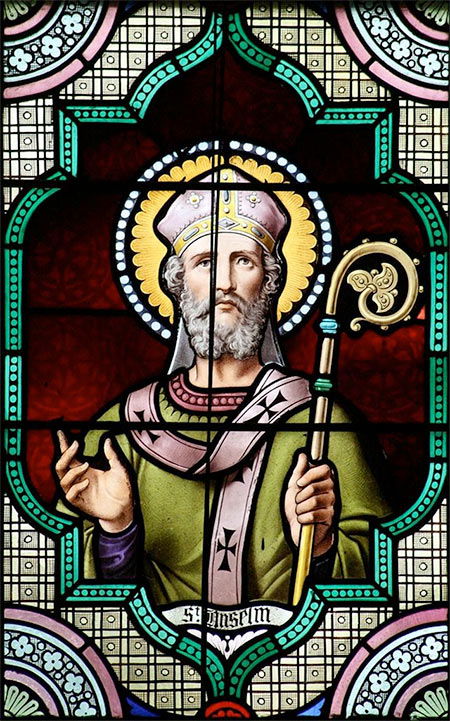
Anselm of Canterbury is one of the most important and influential figures of the medieval world, best known for his ontological ‘proof’ of the existence of God. He spent most of his adult life at the Benedictine abbey of Bec in Normandy, where he gained a widespread reputation as a brilliant theologian.
Born to a wealthy family in the Piedmont area of northern Italy, he had entered the abbey in his 20s in 1060, drawn there by the intellectual reputation of the prior, Lanfranc of Pavia. Three years later, Anselm succeeded him as prior and was unanimously, though on his part reluctantly, elected abbot in 1078. Anselm detested administration, considering it a distraction from the true purpose of life: to worship, study and think. ‘I want to understand something of the truth which my heart believes and loves,’ he wrote. ‘I do not seek thus to understand in order to believe, but I believe in order that I may understand.’ A man of the most profound piety, he is reported to have said that, if he had a choice between committing a sin and being condemned to suffer the agonies of hell, he would choose hell.
In 1093 Anselm accepted the See of Canterbury, again reluctantly, and once more in succession to Lanfranc. It embroiled him in years of dispute with two successive English kings, William Rufus and Henry I, largely over the question of how far he and other prelates and abbots owed obedience to the king rather than to the pope. Anselm wanted the church freed of secular control. He tried to resign his see, but the pope would not permit it. He spent several years in exile in Italy, where he completed his most famous work, Cur Deus Homo? (Why Did God Become Man?). The wrangle with Henry was at last settled by compromise at the Synod of Westminster in 1107.
Anselm’s final years were lived at peace in England but, according to the biography written by his pupil and close friend Eadmer, a monk of Christ Church, Canterbury, his health was failing and, too ill to ride a horse, he had to be carried about in a litter. Eadmer had been writing his life of the archbishop for some time when Anselm discovered what he was doing. At first he helped Eadmer with it, but on reflection he insisted that the biography be destroyed because he modestly considered himself too unworthy for future ages to place any value on an account of his life. Eadmer was dismayed, as he greatly admired Anselm and had put much work into the project. He destroyed the pages the archbishop had seen, but fortunately for future ages, only after secretly making a copy of them. At the end of the book he asks his readers ‘to intercede for this and for my other sins’. Medievalist R.W. Southern described the biography as ‘the first intimate portrait of a saint in our history, by an observant pupil and ardent disciple’.
Anselm became so ill that he came to dislike all food, but he ate as best he could to try to keep his strength up. For six months he grew steadily weaker and had to be carried into church every day for Mass. It tired him dreadfully and Eadmer and others tried to dissuade him from doing it, in vain until five days before he died. ‘From this time therefore,’ Eadmer says, ‘he lay continuously on his bed, and though speaking with difficulty, he exhorted all those who had the good fortune to come to him, to live each in his own station for God’. By the Tuesday after Palm Sunday he could no longer speak, but he was able to raise his right hand and make the sign of the Cross when asked for a blessing. He finally passed away at dawn the next day. He was in his mid-70s.
His body was washed and anointed with balsam from a jar which, although it was almost empty, poured out a limitless supply, to the astonishment of Eadmer and others present. Eadmer reports another marvel when the body in its archbishop’s robes was put in a stone coffin that was too shallow for it. There was much argument about what to do until one monk took the pastoral staff of the Bishop of Rochester, who was performing the burial service, and drew it along the top of the coffin. It now turned out to be deep enough, and the body was duly interred.
Anselm presumably died in Canterbury, though Eadmer does not actually say so. He was buried there and by the 1160s, the time of another famously ‘difficult’ Archbishop of Canterbury, Thomas Becket, pilgrims in numbers were visiting Anselm’s shrine in the cathedral.
Stanford Encyclopedia of Philosophy: Anselm of Canterbury: https://plato.stanford.edu/entries/anselm/
Anselm: A Spiritual Scholastic – How Anselm Teaches Us To Integrate Mind and Heart, Kyle R. Hughes · September 5, 2025 · Volume 17, Issue 2
Ask your average theology student or medieval history buff what they know about St. Anselm of Canterbury (d. 1109), and if they can recall one thing about him it is likely the fact that he developed the “ontological argument” for the existence of God. For many, that scary word “ontological” immediately signals that this argument, and therefore this saint of old, must have little relevance for the real world in which we undertake our pilgrim journey of faith. Anselm, we suspect, may be little more than an intellectual navel-gazer, an early example of a medieval scholastic who had nothing better to do than debate trivial matters such as the number of angels that can dance on the head of a pin.
More than an Austere Academic
On further reflection, however, this caricature of scholasticism in general, and of Anselm in particular, is highly misleading. As we will see in this article, Anselm was not merely an intellectual, but a deeply spiritual and emotional thinker whose scholastic approach was deeply rooted in prayer and in the relationship he cultivated with God therein. In particular, we will analyze how Anselm prayerfully frames his ontological argument for God’s existence in his Proslogion through an emphasis on “faith seeking understanding,” demonstrating his commitment to loving God with both his heart and his mind. As a result, we will have a more complete—and more accurate—understanding of Anselm as well as the sensibility of medieval scholasticism more generally.
Anselm’s Proslogion (ca. 1078) is unquestionably one of the most important philosophical texts of the Middle Ages. 1 Yet Anselm did not see himself as merely engaging in a purely academic exercise. In the work’s preface, Anselm writes that this work was written “from the point of view of someone trying to raise his mind to the contemplation of God, and seeking to understand what he believes.” 2 His argument for God’s existence, in other words, proceeds from within the frame of reference of one who already believes in God. To use Anselm’s famous phrase, his theological perspective is fides quaerens intellectum, faith seeking understanding, insofar as faith precedes, motivates, and controls the search for greater depth of knowledge of God.
One possible misunderstanding at this point would be to assume that faith is itself a purely intellectual category. Anselm, however, does not allow for such a possibility. As the above quotation indicates, Anselm perceived his work to be meaningful only for one who desires to “contemplate” God. By contemplation, Anselm is referring to that earthly experience of the soul that rests in the love of God in a way that foreshadows the beatific vision of the next life. In speaking of the beatific vision, traditionally understood to be the ultimate end of humanity, we enter the deep waters of great mystery. Still, in speaking of “seeing God,” we are trying to put into words how the beatific vision, “in its perpetual gaze on God in Christ, centers like nothing else on enjoying him.” 3 The great Gothic cathedrals of the Middle Ages were, after all, designed to similarly lift our eyes upward; the cathedral’s pillars and vaults refocus our gaze toward the divine as an earthly manifestation of our heavenly destiny.
Faith and Love as Precursors for Knowledge
Anselm’s theological perspective is fides quaerens intellectum, faith seeking understanding, insofar as faith precedes, motivates, and controls the search for greater depth of knowledge of God. In any event, precisely because this ultimate communion with God involves intimate knowledge of one another and our transformation into the image of Christ, there is no sense in which we can separate out our “heads” from our “hearts.” Rather, it is only when faith is joined with love that our hearts and minds are sufficiently aligned for the task of doing theology. Faith, we might say, is inherently relational and therefore cannot be abstracted as a merely intellectual enterprise.
Anselm quickly moves to reinforce these themes. Following upon the preface, and before moving into the ontological argument proper, Anselm inserts an extended, poetic meditation in which he bounces back and forth from addressing his own soul to addressing God. He begins by exhorting his own self towards greater faith and love as a precondition for the task ahead:
Come now, little man,
turn aside for a while from your daily employment,
escape for a moment from the tumult of your thoughts.
Put aside your weighty cares,
let your burdensome distractions wait,
free yourself awhile for God
and rest awhile in him.
Enter the inner chamber of your soul,
shut out everything except God
and that which can help you in seeking him,
and when you have shut the door, seek him.
Now, my whole heart, say to God,
‘I seek your face,
Lord, it is your face I seek.’ 4
With the culminating quotation of Ps 27:8, Anselm identifies the contemplation of God as the ultimate telos of human existence, and something that can be experienced even now in this mortal life. This will be difficult work, Anselm tells us, as it requires shutting out all cares and distractions, indeed every tumultuous thought, and yet seeking the face of God in Christ leads to freedom, rest, and life.
Blinded by Sin
Drawing on this same language, Anselm next directs his prayer to God, signaling that the words of the psalmist have now become the cry of his own heart:
O Lord my God,
teach my heart where and how to seek you,
where and how to find you.
Lord, if you are not here but absent,
where shall I seek you?
But you are everywhere, so you must be here,
why then do I not seek you? 5
Here we see Anselm employing some basic theological reasoning, observing that our difficulties in seeking God come not from God’s absence or hiddenness but rather, as he goes on to explain in the following verses of his poem-prayer, the result of human sinfulness that broke our original communion with God. Now, as a consequence of sin, our blindness hinders us from seeing what is true, our quest for goodness leads us only deeper into turmoil, and we cannot see God’s beauty amidst this present darkness. But the image of God in us is only marred, not destroyed, and so through God’s great work of redemption we regain the capacity, in this life, to taste God’s truth, goodness, and beauty, even as we await the full consummation of these things in the life to come. As Anselm concludes:
Lord, I am not trying to make my way to your height,
for my understanding is in no way equal to that,
but I do desire to understand a little of your truth
which my heart already believes and loves.
I do not seek to understand so that I may believe,
but I believe so that I may understand;
and what is more,
I believe that unless I do believe I shall not understand. 6
A Unified Telos
The universal human quest for truth, goodness, and beauty finds its end in God himself, calling forth our whole selves, our souls and bodies, to be “living sacrifices, holy and acceptable to God” (Rom 12:1). This, then, is the beating heart of Anselm’s theology and spirituality: that faith and love compel us to deeper knowledge of God, such that the inclination of our heart and our mind are bent towards their eternal resting point. There is, therefore, “a deep unity in Anselm between prayer and life and thought.” 7 This “scholastic spirituality” holds together the whole human person as moving towards a singular end: the eternal contemplation of the truth, goodness, and beauty of God. Thus, the man who in his philosophical writings “appears to be the prototype for the model of pure, neutral rationality” is the same man who “is far ahead of his time in creating an intensely personal and passionate spirituality in his prayers, meditations, and letters of spiritual direction.” 8 Our inability to see how these two “opposites” cohere is a failure of our imagination, not a flaw in Anselm’s approach or in the greater medieval tradition more broadly. It is, rather, the case that the intellectual Anselm and the devotional Anselm are engaged in the same project: “union of the self with God.” 9 The beatific vision motivates us both to know God and to love him. The universal human quest for truth, goodness, and beauty finds its end in God himself, calling forth our whole selves, our souls and bodies, to be “living sacrifices, holy and acceptable to God” (Rom 12:1).
While some of us may more naturally come at faith primarily from a place of intellectual inquiry, and while others may prioritize emotional connection with God, Anselm reminds us that these are not opposing dispositions but actually two streams feeding into a common river of faith. In an increasingly post-Christian landscape, let us raise up a new generation of men and women who, like Anselm, strive with hearts and minds to taste the truth, goodness, and beauty of King Jesus. For perhaps, in an era of compartmentalization and fragmentation, it might be the witness of those who have integrated the mind and the heart into a singular pursuit of God that will shine most brightly.
Endnotes:
1 On the Proslogion, see further Eileen C. Sweeney, Anselm of Canterbury and the Desire for the Word (Washington, DC: The Catholic University of America Press, 2012), 147–69. For a brief introduction to Anselm’s life and legacy, see Benedicta Ward, Anselm of Canterbury: His Life and Legacy (London: SPCK, 2009).
2 Anselm, Proslogion pref. All translations of the Proslogion are taken from The Prayers and Meditations of Saint Anselm with the Proslogion, trans. Benedicta Ward (Penguin Classics; London: Penguin, 1973).
3 See further Hans Boersma, Seeing God: The Beatific Vision in the Christian Tradition (Grand Rapids: Eerdmans, 2018), 5. For scriptural background, see, e.g., Job 19:26–27; Ps 23:1; Matt 5:8; John 17:24; 1 Cor 13:12; 2 Cor 3:18; 1 John 3:2.
4 Anselm, Proslogion 1.1–14 (trans. Ward).
5 Anselm, Proslogion 1.15–21 (trans. Ward).
Kyle R. Hughes Kyle R. Hughes (PhD, Radboud University, Nijmegen) is the author of several books on patristic theology and Christian education, including Scripting the Son: Scriptural Exegesis and the Making of Early Christology and Teaching for Spiritual Formation: A Patristic Approach to Christian Education in a Convulsed Age. He is Director of Catechesis at Christ the King Anglican Church (Marietta, GA) and regularly teaches for several Anglican seminaries.
BERNARD OF CLAIRVAUX
Ryan M. Reeves (PhD Cambridge) is Assistant Professor of Historical Theology at Gordon-Conwell Theological Seminary.
The Spirituality of St. Bernard of Clairvaux
Dennis Martin
From Love of Self To Love of God To Love of Self for God
The legacy of Saint Bernard of Clairvaux to 20th-century Christians, as multifaceted as it is, lies most significantly in his profound human psychology of self-esteem and self-awareness grounded in the mercy and love of God.
Bernard would be amused to find us talking about the characteristics of his spirituality, for his whole effort was directed at faithfulness to the traditional spirituality he had learned in school and at the monastery. This traditional medieval theology taught that men and women were created in the image and likeness of God, but that this image has been corrupted, tarnished, and distorted—but not destroyed—by sin. Because God shared our human nature in Jesus Christ, we can begin the journey from the “land of unlikeness” toward the “land of likeness,” toward the complete integration and reformation of the divine image from which we have fallen.
The journey will be complete only in heaven, but those who devote themselves to it with special intensity can, by the sheer grace and mercy of God, experience a fleeting foretaste of its heavenly destination on earth.
Top of Form
Monks and nuns give themselves to this reformation under the guidance of the monastic rule and the leadership of experienced spiritual directors. Precisely because they recognize their own limits and weaknesses, monks and nuns place the direction of their lives in the hands of others, who draw on the wealth of collective experience—tradition—to act as guides on the journey from the land of unlikeness.
Bernard belongs to this tradition. He was nourished and shaped by the language of the Bible. Monks understood their lives as a tasting of the sweetness of God’s Word as it came to them through “chewing on,” “rechewing” (ruminating), and “digesting” the honey of the Holy Scriptures and the writings of the past commentators on Scripture, the Church Fathers.
Guido II, head of the Carthusian monastic order (c 1176–1180) describes the process of reading (placing the grape of scripture in one’s mouth), meditating, or studying it in a variety of ways (crushing and chewing it), being drawn by the hint of its sweetness to beg God in prayer for an experiential encounter with the text, and finally, knowing Scripture’s Author in the loving embrace called contemplation. Contemplation, later called “mystical union,” is simply the experience of the love of God: the experience of God loving us, which in turn is what our love of God consists of.
Bernard is but one of the remarkable group of monastic authors from Benedictine, Cistercian, Carthusian, and other traditions, whose collective legacy places the 12th century alongside the fourth and 16th centuries as a truly outstanding epoch in Church history. Among Bernard’s Cistercian contemporaries, we should acknowledge Aelred of Rievaulx (1109–1167), whose writings, such as The Mirror of Charity, and On Spiritual Friendship, breathe a warm, humane, wise spirit that unfailingly moves the reader to a love of God and to human friendship.
We should also mention William of St. Thierry (c1085–1148), whose Golden Epistle, and The Nature and Dignity of Love, are only two of the profound explorations of the human soul and spirit from the 12th century. The insights into human psychology, and into the life of the spirit hidden in the mystery of Christ that are found in these writings can be studied and digested with profit by 20th-century Christians, if they are willing to slow down to thoughtfully read, ponder, chew, and savor these books until their wisdom melts in the mouth.
Though Bernard was very capable of writing “speculative,” or rational theology, such as his On Grace and Free Will, his favorite and more typical style of writing is running commentary on and explication of Scripture, rich with allusions, and with rhetorical, poetic imagery. This is perhaps best seen in his Sermons on the Song of Songs. However, even his meditative explications of themes from the spiritual life, as in On Loving God, and The Steps to Humility and Pride, are full of scriptural allusions and quotations. We shall look briefly at his outline of spiritual growth in On Loving God, and the first portion of his Sermons on the Song of Songs.
The Progress of Love
In On Loving God Bernard outlines a journey from self-love to self-love that meets us where we are and takes us where God wants us to go. [See the following article for an excerpt from On Loving God.] He begins with self-love because that is where we find ourselves as human beings, indeed, self-hatred is unnatural. From love of self for selfish reasons, we can, by God’s grace, begin to love God for the sake of God’s goodness to us in the wonderful world of nature, in the daily blessings God’s providence provides for us, and in the salvation God has given us in Christ.
Loving God for the sake of what he has done for us is, however, less than perfect. The next step is to love God for God’s sake alone. Simply because God is, we love him. Most of us would stop here; if we ever reached the point where we loved God for God’s sake alone, we would consider ourselves to have arrived at love of God. But Bernard does not stop here.
The final step is love of ourselves for God’s sake. While this is not the main point of the treatise, it is profoundly significant. One of the characteristics of Bernard’s spirituality is the movement from fear to confidence, from false self-esteem to healthy self-esteem. In harmony with the entire Christian tradition, Bernard insists that we find confidence in ourselves because of what God has done for us, first, by creating us in his image, and second, by redeeming us from our failure. Even natural self-love is by the grace of our creation in God’s image, and we are able, again by grace, to move from selfish self-love to self-love for the sake of God our creator and redeemer.
In this process we move from 1) a cringing fear of God, such as that of slaves who obey the master out of fear of punishment, to 2) hopeful obedience to God out of expectation of a reward, such as that of a hired servant, to 3) the disciplined obedience of a student to a teacher, to 4) the respectful obedience of a son who knows he is an heir, and finally to 5) the full loving devotion of a bride to her bridegroom (Sermons on the Song of Songs, sermon 7). The bride asks for a kiss from the bridegroom out of confidence, no longer out of fear. She has kissed his feet in repentance, kissed his hand in spiritual growth as the bridegroom guides her toward maturity, and now in confidence, she kisses his mouth and joins him in the sweet embrace of love (sermons 1–8).
A Holy Fragrance
In sermons 10 to 12 Bernard outlines another threefold process of spiritual growth, using the three perfumes that emanate from the breath of the bride and the bridegroom (Song of Solomon 1:1–2). The first perfume, or ointment, is that of repentance, or sorrow for sins. The second is that of devotion, of confident praise and worship of God. The third is that of compassion and mercy. The first one, signifying contrition and brokenness over our sins, is pungent and painful. The second adds the healing and soothing process of growth. Significantly, this second phase, in many ways the one that occupies most of our lives as wayfarers on earth, is essentially that of worship and praise of God. Healing comes through worship. For monks and nuns this took place in the disciplined daily round of liturgical prayer and praise-filled contemplative reading, as outlined above [see also Van Engen’s article: The Bread of God’s Book]. Bernard’s spirituality is grounded in the worship life of the church and is fed by the Eucharist.
The third perfumed anointing is the overflowing of mercy and compassion that comes from maturity in the spiritual life. It flows out of one’s own experience of pain and sorrow, and out of God’s healing goodness and mercy. It yields mercy toward and love of one’s neighbors—both friends and enemies. The closer we draw to God, the more we know of the loving embrace of God, fleeting as it may be here on earth. The more we know this embrace, the more we live in mercy and compassion. Our sinful wills are healed by God’s seeking of us, and in being sought and loved, we love God, our neighbor, and ourselves.
We cannot take ourselves too seriously, since we took our first steps in this process by a candid, honest, genuine self-awareness and sorrow for our sins. Yet neither can we denigrate ourselves because the process of repentance and self-discovery is made possible by, and makes possible, the healing of the sin-ravaged image and likeness of God as it is bathed in the compassion and mercy of God. It is out of this mercy, love, and compassion of God that we can confidently know who we are, and offer back to God the love he has shown us. It overflows in love and service to those around us, who, like ourselves, carry that image of God indelibly imprinted on their innermost spirit.
All of this occurs in the Church. No matter how far we progress in spiritual maturity, we remain aware of our shortcomings and failures. Are any of us worthy of the praise given to the bride? Individually, we are not.
“Yet there is one who truthfully and unhesitatingly can glory in this praise. She is the Church, whose fulness is a never-ceasing fount of intoxicating joy, perpetually fragrant. For what she lacks in one member, she possesses in another according to the measure of Christ’s gift (Eph 4:7) and the plan of the Spirit who distributes to each one just as he chooses (1 Cor 12:11)… although none of us will dare arrogate for his own soul the title of bride of the Lord, nevertheless we are members of the Church which rightly boasts of this title and of the reality which it signifies, and hence may justifiably assume a share in her honor. For what all of us simultaneously possess in a full and perfect manner, that each one of us undoubtedly possesses by participation. Thank you, Lord Jesus, for your kindness in uniting us to the Church you so dearly love, not merely that we may be endowed with the gift of faith, but that like brides we may be one with you in an embrace that is sweet, chaste, and eternal, beholding with unveiled faces that glory which is yours in union with the Father and the Holy Spirit for ever and ever. Amen.” (Conclusion of Sermon 12, Sermons on the Song of Songs)
Like all God’s servants, Bernard was human and failed his God and his Church at times. He would be the first to insist that he not take himself too seriously. His legacy to 20th century Christians, as multifaceted as it is, lies most significantly in the profound human spiritual psychology of self-esteem and self-awareness grounded in the mercy and love of God.
Bernard’s ideas and writings are accessible almost 900 years later because they are universal in style, humaneness, and natural imagery, and are simple and biblical in content. In such an essay as this we can merely introduce a corner of Bernard’s richness, yet from any corner of his thought we are led back always to the center, to the love of God.
Dennis Martin is a professor in the Associated Mennonite Biblical Seminaries (Goshen Biblical Seminary and Mennonite Biblical Seminary) in Elkhart, Indiana.
Copyright © 1989 by the author or Christianity Today/Christian History magazine.
The Bread of God’s Book – John Van Engen – Saint Bernard and Holy Scripture
Everything Bernard of Clairvaux was involved in—promoting the monastic life, preaching crusades, condemning heretics, advising popes, intervening with kings—sounds so fully “medieval” that it seems strange that Protestant pastors of the Reformation era would respond favorably to this zealous 12th century Catholic monk. The reason lies mostly in Bernard’s emphasis on the Bible. From the time of his entrance into the monastic life around 1113 until his death 40 years later, Bernard spent more than half of each waking day reading, singing, and meditating on Holy Scripture.
Life Around the Word
Holy Scripture was the focal point of Bernard’s life. This was not unique to him; he shared this practice with thousands of other devout monks. Bernard belonged to the Cistercians, an order of reformed Benedictine monks dedicated to the restoration of the ancient discipline in complete solitude and isolation. Their lives were devoted to prayer, and they assembled in choir eight times each day. Their days began long before sunrise.
For Benedictines prayer meant, and still means, the saying or chanting of Scripture, especially the Psalms. Some biblical verses and stanzas were chanted every day of their lives. But at the very least all 150 Psalms were recited aloud once a week, in a recurring pattern that shaped their whole inner life.
Top of Form
The Psalms, though the heart of Benedictine prayer, only marked the beginning. All medieval churchmen learned to read (which means, learned to read Latin) by way of the Bible. The language of Scripture was therefore imprinted upon their earliest memories, and they could hardly express themselves apart from the language of Scripture. Everything they wrote, from treatises and sermons to letters and poems, echoed the Bible at every turn, much as the language of the King James Bible influenced subsequent English literature.
Beyond the cycle of prayers and psalms, Cistercian monks said or attended mass each morning. This meant that the readings assigned to each day of the year by the church, one from the Old Testament, one from the Gospels, and one from the Epistles, would likewise become second nature to them.
Monks assembled in the refectory for their main meal around noon. They sat in silence while one monk read to them, often from a devotional book or a saint’s life. Sometimes Scripture was read here too, but in any case Scripture was quoted, paraphrased, and echoed all through the chosen devotional texts. What time remained to monks between mass, meals, and the cycle of prayer, they were expected to spend in work and meditation.
Work also proceeded in silence, whether in fields, gardens, or workshops. In an age when books were generally rare, expensive, and cumbersome, these people developed a keen and large capacity for memorization. What monks heard and sang continuously in public worship, they pondered all through the day in their hearts. Scriptural phrases and images sank into the innermost recesses of their lives, and accompanied them in their everyday thoughts.
Cistercians monks were encouraged to spend part of each day in private reading and meditation. This inevitably involved reflection on Scripture. They might read a book of the Bible on their own—Bernard was specially noted for reading the whole Book through from beginning to end repeatedly—or they might make their way slowly through some Bible commentary or devotional work by a Father of the Church.
Finally, before retiring in the evening, the monks followed a course of nighttime readings. Here whole books of the Bible were read in sequence, Isaiah at Advent, Jeremiah at Lent, and so forth. Again, there was almost no part of the day when a conscientious Cistercian monk was not reading, singing, or reflecting on Holy Scripture.
Preacher and Teacher
But what contemporaries found most astounding and attractive about Bernard was his facility to preach and teach Scripture. His Latin prose echoed Scripture in every line. His style was as elegant, playful, and moving as any medieval Latin ever written. The sheer beauty of it was part of the attraction for later readers, including such self-conscious stylists as John Calvin.
In nearly all of his extant writings, including some 500 letters, Bernard employed Scriptural phrases and images. But in certain works his task was clearly and specifically to interpret Scripture. He preached regularly to his monks and sometimes to the people. Some one hundred of his sermons have come down to us, most of them on the Gospel or Epistle texts prescribed for feast days in the church. A few were delivered on special occasions, such as a series preached in Paris in 1140 to convert students to the monastic life, and a related Lenten series on Psalm 91. Bernard’s most famous interpretation of Scripture, however, is found in his 86 sermons on the opening chapters of the Song of Songs, preached between 1135 and 1153.
Bernard had an exceedingly high view of Scripture. The Bible contained the very words of Christ or, as he put it more often, of the Holy Spirit, who spoke directly to him and to all the faithful. While God spoke through his apostles and therefore his later ministers as well, it was one of the peculiar joys of the monastic life, as Bernard understood it, that dedicated monks could hear Christ speaking directly to them in the words of Holy Scripture. It was indeed the Spirit himself who spoke; yet only the “spiritual” could truly hear and take it in. Bernard often quoted to his monks his version of a Pauline text (I Corinthians 2:13): These were not human words but the Spirit teaching spiritual things to spiritual persons.
Bernard’s Bible was the Latin translation of Jerome known as the Vulgate. He knew neither Greek nor Hebrew and never troubled himself over that. He was confident that the words, as he read and learned them, were shaped by the Holy Spirit in a particular way and for a particular purpose.
Cistercian monks were concerned about the text of the Bible, and undertook to prepare beautiful handwritten copies, free of textual errors and confusions. Some of these huge folio volumes in two columns still exist. (Handy printed versions, fitting into one hand were unknown as yet, and would probably have been considered somehow vulgar, or worse.) These were weighty and precious tomes, resting on a lectern or bookshelf and possibly chained to it, another sign of the great wealth represented by just one of these handwritten books. If monks were to carry Holy Scripture around—and Bernard certainly expected that they would—it was to be in their memories; he would also have said, in their hearts.
Bernard accepted the authoritative text of Scripture, and was convinced that every word bore a special meaning. But he assumed rather than argued the doctrine of inspiration, in the strict Protestant sense. The form of inspiration that concerned him was that by which the Holy Spirit, the author of the text, moved mysteriously in the heart of a believer to make that text plain. By this “in-breathing,” God spoke directly to those who meditated upon His Word. In this way too, Christ came, not just once in the flesh, but daily in the Spirit to save souls.
For this experience of spiritual inspiration through Scripture, Bernard had numerous choice expressions, mostly borrowed from Scripture itself. This was to exult in the Lord, to overflow in the spirit; Scripture was the font of life pouring forth its streams of water. More daringly, this experience was to bear Christ in your very womb, in your soul. A Spiritual man would know in this way the ardor which the bride feels toward her bridegroom.
The work of interpreting Scripture, it should be evident, was at the very heart of the religious life in Bernard’s view. But this assumes that Scripture is susceptible to this kind of interpretation, that it has the power of the Spirit moving within its text. To understand how that might work, we must put into context Bernard’s views on exegesis.
Interpreting God’s Word
Bernard learned to understand Scripture, first of all, by reading the Fathers of the Church. Though he wished for each of his monks a personal experience of “inspiration” through Scripture, he insisted equally—against Peter Abelard, for instance—that monks should follow in the footsteps of the Fathers. Their interpretation was to remain authoritative, their insights the well-springs of the spiritual life.
Bernard read widely in the Church Fathers, but two figures in particular, as scholars have reconstructed it, largely shaped his reading of the Bible: Origen and Gregory the Great. Origen, who was a Greek father of the mid-third century, is known to moderns as the father of “allegory,” and to medievals as the ingenious interpreter of difficult Old Testament books. His writings taught Bernard always to look for the spirit hidden within the letter of the text. Gregory the Great was the great monk-pope from about 600. He taught Bernard to find in that spirit especially the moralia, a Latin term which in this context meant not so much “the moral” as “the inner spiritual life”—that which pertains to the truly contemplative.
Bernard found great delight in exploring the mysteries of Scripture, but his fascination was not primarily intellectual in character. Indeed he repudiated, for both himself and his monks, all approaches of that kind to Scripture. To penetrate the mysteries of Scripture was to be an experiential matter. By way of the Spirit, the spirit within the letter recalled the deepest mysteries of God, and touched inexpressibly the innermost parts of spiritual men.
This is what counted as true understanding: not an intellectual experience of the text’s meaning, but a spiritual experience of God himself by means of the text. This was for Bernard the highest delight, the ultimate goal, of the monastic life, and it was to this end that Bernard preached Scripture to his monks each day.
The Kiss of the Bridegroom
Perhaps the best way to pull all this together is in Bernard’s own words. He set out his views plainly in the famous opening sermons on the Song of Songs, especially the third and fourth. In his second sermon he explained the “kiss” of verse one, the union of bride and bridegroom, which he referred first to Christ’s union with human flesh and then to the subsequent union between the Incarnate and His faithful people, His bride and body.
In the next sermon Bernard turned, in his own words, to the “book of human experience.” What can it possibly mean, especially for monks, he says, to open a book of the Bible beginning with the words: “May he kiss me with the kisses of his mouth!” This cannot be truly understood, he says, except by those who have experienced it, who have been kissed by the mouth of Christ. For the sake of his charges, Bernard undertakes to explain it.
Kisses come in three forms, he noted, drawing on common scenes from his own day, the kiss of the feet, the kiss of the hand, and the kiss of the mouth. Initially, none of us should presume anything more than to kiss the feet, a form of supplication. The Word is a two-edged sword penetrating to the marrow of the heart, and conscientious souls, on hearing it, can only do penance, pleading for mercy and hoping for forgiveness. This is to kiss the Bridegroom’s feet.
Second, we may kiss the hand. This is to be raised up and supported, following penance, so that we may gain confidence and assurance through fitting works of mercy and piety. Without these we will fall back into the mire, and soon be pleading again for mercy at his feet. But with works of mercy we will grow in grace and confidence, our love will become more ardent, and we can enjoy the kiss of the hand.
After the kiss of the hand we may begin to long for the kiss of the mouth. God is spirit, and the Spirit of God dwells before His face. To enjoy the kiss of the mouth is to experience what it means become one in spirit with God himself, to have His spirit enter into the depths of our being. This, Bernard notes, is a rare experience and a fleeting one in this life, but it is the goal of the pure in spirit who hope to see God.
To understand the full meaning for Bernard of the kiss of the mouth we must recall earlier remarks. The essential way in which God communes with the pure in spirit is through His Word. Patient meditation on the Word in silence, reflection on that which the monks carried around with them in their heads and hearts, was the means by which their spirits and the Spirit moving the text of the Word could be joined. This, for Bernard and his followers, was the ultimate experience of the religious life.
John Van Engen is a Professor of History in the Medieval Institute at the University of Notre Dame in Notre Dame, Indiana.
Copyright © 1989 by the author or Christianity Today/Christian History magazine
THE MENDICANTS – SAINT FRANCIS OF ASSISSI – CHAPTER 11
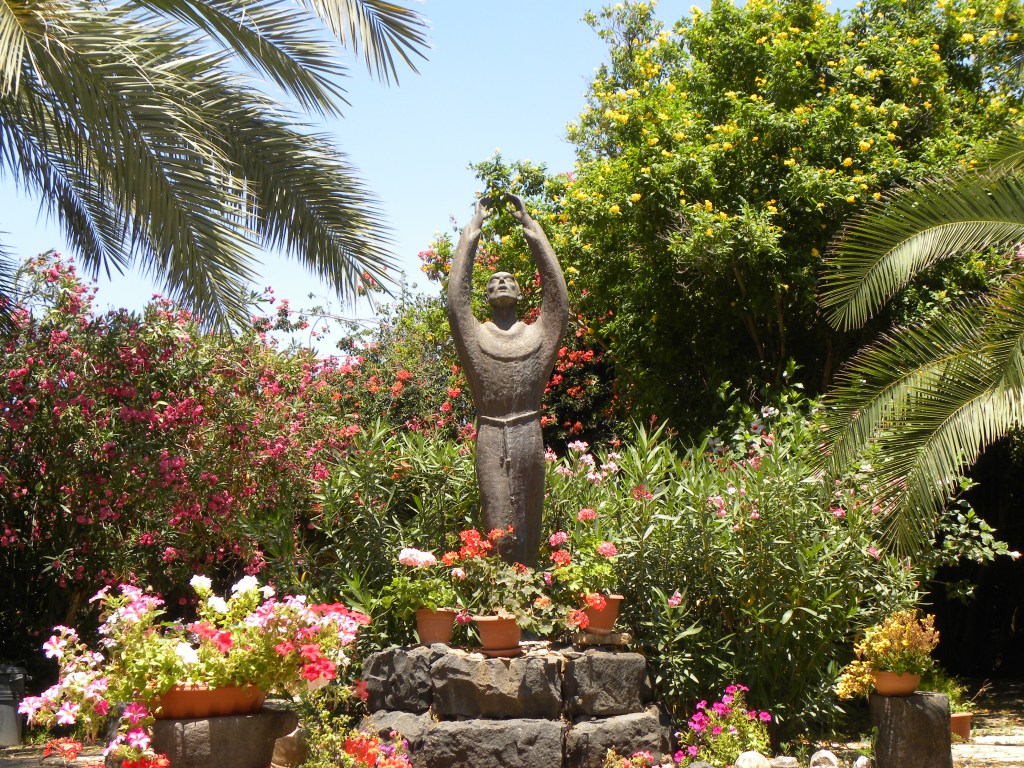
St. Francis in his Garden at Capernaum
The Spirituality of Saint Francis of Assisi
“Spirituality” is a very slippery term in contemporary discourse, so let me stipulate at the head of this modest essay that the way the term is used here is very traditional: spirituality is living in the Spirit rather living in the flesh (see Romans 8:1–17), with all of the attendant consequences that Paul derives from that antinomy.
This living in the Spirit has a decidedly Trinitarian cast to it, best expressed in the traditional words of the Sign of the Cross: living spiritually “in the name of the Father, the Son and the Holy Spirit.” Spirituality, at least as it is understood in the Catholic tradition, also means that there are many modes by which one lives out this living in the Spirit or, to phrase it somewhat differently: There are many ways to follow the One who says “I am the Way.” That same tradition holds up everything from the way of monasticism to the way of married life.1
One way of living in the Spirit has been exemplified by Francis of Assisi (1181?–1226), who became a kind of model for others who wished to learn from and be illuminated by his life. His life has become so exemplary that he is often admired by many who are not Catholics. Such admirers make up a significant body of pilgrims who come to Assisi to visit his tomb and to learn from the art and architecture inspired by him. Unfortunately, that admiration is often based on romanticized stories written about him (such as the fourteenth-century Fioretti di San Francesco d’Assisi—a classic collection of popular legends about the life of Saint Francis) with the sad result that he is often perceived as a medieval Doctor Doolittle who speaks with animals or (largely as a result of a nineteenth-century study by the liberal Protestant scholar Paul Sabatier) as a proto-evangelical, quietly but persistently standing against the pretensions of the medieval Roman church.
The enigma of Francis is far deeper than such stereotypes. He was neither a medieval nature lover (away with the concrete statues for sale at WalMart Garden Centers!) nor a proto-protestant. A close scrutiny of his own writings reveals a few things with abundant clarity. These can can be summarized in a basic proposition: Francis was a totally orthodox medieval Catholic, who, unlike the heretical movements of the time, fully embraced the reforms of the Fourth Lateran Council and insisted that his followers live more catholico (“after the Catholic manner”): go to confession regularly, receive the Eucharist, affirm the honor due priests and prelates, accept the real presence of Christ in the Eucharist, preach only with the permission of bishops, and so on. It is not without significance that Francis went to Rome to have his way of living affirmed by the pope.
The issue then becomes this: how did this totally medieval Christian become such a luminary within the Christian pantheon? The answer to that question is at the core of these reflections.
The Conversion(s) of Francis
We possess a number of writings from Saint Francis, but only once, in his Testament, does he make an overtly autobiographical statement: “The Lord granted me, Brother Francis, to begin to do penance in this way: while I was in sin, it seemed very bitter to me to see lepers. And the Lord himself led me among them and I had mercy upon them. And when I left them that which seemed bitter to me was changed into sweetness of soul and body; and afterwards I lingered a little and left the world.”2
That laconic statement encapsulates a number of events in Francis’s life that may be found in the early legenda: the year he spent in prison as a teenager after an abortive war with neighboring Perugia, his wanderings on the outskirts of Assisi working manually to repair churches, his adoption of a hermit’s garb of rough dress, simple shoes, and a staff. This was a commonplace way of life in medieval Europe—taking up the way of penance. It was only when he heard the Gospel passage where Jesus says that the way of perfection consisted in giving away everything to “come follow him” did Francis understand that this was the path for him. In other words, Francis passed from a way of life in the world to taking up the way of penance as a hermit, and finally discovering that the “perfect” way of following Jesus was to be found in a life of complete poverty.
SAINT FRANCIS OF ASSISI
St.-Francis-of-Assisi-Illustration-by-D.KlitsieSt. Francis of Assisi was founder of the Order of Friars Minor, often known as the Franciscans. Eschewing the privilege into which he was born, he chose a life of poverty in which he—and ultimately his followers—urged medieval townsfolk to embrace the simplicity of the gospel. He is sometimes pictured with the symbols of a skull or a loaf of bread to signify transcendence over death through faith in Christ, the Bread of Life.
A word needs to be said about the Franciscan concept of poverty. The communal sharing of goods was a long-standing aspect of the monastic way of life—an attempt to live out literally the example of the primitive church described in the Acts of the Apostles. Francis had a different approach: he took literally the saying of Jesus to give everything away to follow Jesus without the support of human goods. The most original insight that Francis had was that this concept of poverty was not to be seen as an economic choice but a Christological one. Francis wanted to follow the poverty and the self-emptying of Christ as described in the great kenosis (emptying) hymn of Philippians 2.
To understand Francis’s concept of poverty not as asceticism with respect to the material but as a profound insight into the mystery of the Incarnation is to shed light on many of the key interests of Francis. He had a great love for the nativity of Christ because he saw in the birth of a child in a stable a fundamental truth about the coming of the Word into humanity. For Francis, the nativity of Jesus was a kenotic moment. It is for that reason that he so fixed on the crucifixion, because the naked Christ, dying on a cross, was a counterpoint to his birth in a stable. His earliest biographers frequently cited the old patristic axiom (most likely originating with Jerome) of “nakedly following the naked Christ.” Dante caught this truth perfectly when, in his praise of Francis in the eleventh canto of Paradiso, he says that while Mary stood at the foot of the cross, “Lady Poverty” climbed up to embrace the dying Christ.3
The humility of Christ who “emptied himself” in the Incarnation provided Francis a lens with which to understand the real presence of Christ in the Eucharist. In one of his admonitions, recorded by his early disciples, Francis said:
therefore all those who saw the Lord Jesus according to his humanity and did not see and believe according to the Spirit and the Godhead that he is the true Son of God were condemned. And now in the same way, all those who see the sacrament of the body of Christ, which is sanctified by the words of the Lord upon the altar at the hands of the priest in the form of bread and wine and who do not see according to the Spirit and the Godhead that it is truly by most holy body and blood of Christ are (likewise) condemned.
Another way by which Francis sought to underscore the poverty inherent in the Incarnation was the saint’s identification with the poor. He interpreted the life of Jesus in terms of the hidden life in Nazareth and in the subsequent ministry to lepers, prostitutes, Samaritans, humble fishermen, and so on. It is for that reason that Francis called his followers “minor brothers and sisters,” distinguishing them from the maggiori (“majors”) comprised of the mercantile class of his own father and the aristocrats like the family of his friend Saint Clare.
The Lesson(s) of Francis
We should not look back on Francis through the rose colored lenses of romanticism. To engage deeply with his life is to see a man who was consumed totally in the desire to live a radical life following Jesus—a life shining forth the radical poverty of the Incarnation and the conviction that everything from creation to our redemption comes as sheer gift.
The other lesson that Francis teaches us is that the Bible is not a book to be read but a text to be performed. Just as we never discover the authentic Mozart by reading his scores but by performing or hearing them performed, so we never plumb fully the Word of God until it becomes the “score” by which we lead our lives.4
There was also a prophetic element in the life of Francis. To the luxurious pretensions of medieval churchmen, he exemplified the simple way of Jesus. To the poor, he identified with the dignity of everyone made “in the image and likeness of God.” To the emerging mercantile class, with their proto-capitalist desire for profit, he lived in such a way as to show the snares of wealth. To the medieval Cathars, who despised the material life, he hymned the goodness of God’s creation; to the smug pretensions of the medieval church, he pointed to the cross; to the class system of his day, he insisted that all should be called brothers and sisters.
Francis said, it is alleged, “Preach, and if necessary, use words.” He demonstrated by his life that the gospel is ever open to a new reading while always remaining the same and ever challenging to those who confront it with serious openness. To be a “Franciscan” does not require that someone accept a robe and cord and go barefoot in the world. To be a Franciscan is to learn those terrifying words of Jesus who offers to us simplicity, humility, poverty, and the cross. To be a “Franciscan” is to learn how to embrace a profound gospel paradox, namely, that the exquisite joy of the gospel is to be found in its utterly serious demands.
ENDNOTES
- I have explored spirituality as a way of life more fully in Lawrence S. Cunningham and Keith Egan, Christian Spirituality: Themes from the Tradition (New York: Paulist, 1996).
- All quotations are from Francis and Clare: The Complete Works, ed. Regis Armstrong (New York: Paulist, 1982).
- Paradiso 11.71–72. The French mystic Simone Weil thought those lines to be among the most beautiful in all of poetry.
- This theme of performance is more fully developed in Lawrence S. Cunningham, Francis of Assisi: Performing the Gospel Life (Grand Rapids: Eerdmans, 2004)
This article was published in Theology, News & Notes, Fall 2009, “Winds of the Spirit: Traditions of Christian Spirituality.”
Lawrence J. Cunningham is the John A. O’Brien Professor of Theology Emeritus at the University of Notre Dame. His scholarly interests include systematic theology and culture, Christian spirituality, and the history of Christian spirituality. He authored “A Brief History of Saints” (2005) and “Francis of Assisi: Performing the Gospel Life” (2004) and coauthored “Christian Spirituality” (1997).
GREGORY PALAMAS – HESYCHASM – CHAPTER 12

Schema-Archimandrite Iliy (Nozdrin) at the St. Petersburg Theological Academy; 29 May 2017
Gregory Palamas is a name that frequently appears in the study and reading of the history and doctrine of the Eastern Orthodox Church.* Multiple authors quote his writings, and others cite theologians who have used Palamas’s work to defend their theology. This oft-quoted theologian desired a life of quiet retirement for prayer, but his career as a monk and priest involved him beyond his desires into politics and intrigue. He would receive honors, but his teachings would also be condemned. His life was a series of ups and downs, with an imprisonment and capture by invaders.[1]
Throughout his life, Gregory was writing. Through these diverse writings, readers can understand his theology, which made Gregory Palamas “as central a figure in the East as Thomas Aquinas is in the West,”[2] even acquiring the name “Palamism” to his theology. Gregory was influential during his time and Palamism continues to influence the Eastern Church. In order to understand the whole Eastern Church, it is essential to study the life, theology, and influence of Gregory Palamas.
The Life of Gregory Palamas
Gregory Palamas was born into a noble Anatolian family, most likely from Constantinople[3] whose situation helped establish his career early in life but also set him up for the political ups and downs that would follow him throughout his life. Gregory’s father was a member of the Senate in the royal court.[4] As a result, Gregory was well-educated in Aristotelian principles, including rhetoric.[5] His education would serve him well throughout his life.
At a young age, Gregory saw the monks from Mount Athos[6] and became personally attracted to monasticism. First, he studied in Constantinople under Theoleptos, the Metropolitan of Philadelphia, until 1316, when he went to live at Mount Athos.[7] At Mount Athos, Palamas had his first experience with the hesychast tradition of mystical prayer.[8] He studied ascetic literature and practiced a strict monastic life.[9]
This early time at Mount Athos set the pattern for Gregory’s life; he would follow the hesychast tradition and ascetic practices throughout his life. “In 1325, St. Gregory was chosen by the monks of Athos to go to the Holy Land to represent them in a pilgrimage. When he arrived in Thessalonica, he found out that he could not continue his journey because of the Turkish blockade.”[10] In Thessalonica, Palamas lived a solitary prayer life except for prayer celebrations on Saturday and Sunday.[11]
“At a young age, Gregory saw the monks from Mount Athos and became personally attracted to monasticism.”
After Thessalonica, Palamas lived the classical hesychastic life at Berrhoea in a hermitage;[12] until due to the plundering of northern barbarians, the monks left Berrhoea and returned to Mount Athos. In about 1335, Gregory was chosen to be the abbot of the Monastery of Esphigmenou. He began to publish writings that drew him “into the arena of theological controversy, ecclesiastical strife, and political turmoil.”[13]
Gregory’s writings caught the attention of Barlaam,[14] a Greek monk from Calabria. Barlaam, influenced from Western philosophy, stated the doctrine of God’s unknowability in an extreme form, which Gregory criticized.[15] Barlaam in turn attacked the contemplative practices of the hesychasts. Gregory’s “fellow monks called upon him to go to Thessalonica and defend their views against Barlaam the Calabrian.”[16] This task would not be simple.
Palamas traveled to Thessalonica in 1338 to meet with Barlaam and resolve their dispute. “As hopes of resolution faded, Palamas composed the first of the Triads, a three-part series consisting of three treatises in each part.”[17] Monks from Mount Athos supported Gregory’s writing in a statement known as “Hagioritic Tome” during a synod in 1340-1341.[18]
“Barlaam, influenced from Western philosophy, stated the doctrine of God’s unknowability in an extreme form, which Gregory criticized.”
The dispute then led to four councils in Constantinople (in 1341, 1344, 1347, and 1351). “Three of these councils excommunicated Barlaam and affirmed Gregory’s theology; the one in 1344 supported Barlaam and condemned Gregory, but it was overturned by the last two.”[19] Palamas’s life was in a series of ups and downs being played out in councils observed by bishops, patriarchs, and Emperor Andronicus III, who attended them.[20] During this time, political concerns[21] also caused a six-year civil war, and Palamas’s political opponents imprisoned him for four years, after which he was set free.[22]
While traveling, Palamas was taken prisoner by Muslim forces and held captive in Asia Minor.[23] Even though he was held captive, he still had some freedom and could visit the Christians in the area.[24] After Palamas was ransomed, he was honored by the new emperor[25] and appointed as archbishop of Thessalonica[26] in 1347.[27] But Palamas could not take possession of his position until 1350 due, once again, to political problems.[28] Palamas’s experience of captivity, being ransomed, and then honored by an emperor demonstrates the ups and downs that followed Gregory Palamas throughout his life.
In 1352 Gregory’s health began to fail.[29] When he could, Gregory spent his energy in the care of his flock. “He delivered his homilies, which are evidence of his great ability to pastor. But because of the political circumstances, the religious conflicts, and the great unrest of the times, he could not be always with his beloved flock.”[30] Gregory Palamas cared for the people he served but was disrupted from this care by the unrest in the land where he lived.
“Gregory Palamas cared for the people he served but was disrupted from this care by the unrest in the land where he lived.”
The traditional date of Gregory Palamas’s death is November 14, 1359, although some scholars place the year 1357.[31] Gregory’s followers and friends worked to have Gregory canonized, and Gregory would be proclaimed a saint by the Synod of Constantinople in 1368.[32] “His feast was also celebrated on the Second Sunday of Great Lent as a reminder that his doctrine was not simply that of an individual, but that of the whole Eastern Church”[33], thus establishing Gregory’s importance to the Eastern Church and Eastern theology.
What Is Hesychasm?
Because of the controversy with Barlaam, Gregory is most well-known for the theology surrounding hesychasm. During his life, Gregory Palamas supported the hermits who practiced hesychasm and he practiced hesychasm himself. The roots of hesychasm go back to early Egyptian monks who lived at the time of Athanasius,[34] who engaged “in continuous prayer and contemplation.”[35]
Geffert and Stavrou write that the term “hesychast,” which originally referred simply to a desert ascetic such as Evagrius Ponticus (345-399), came to indicate a person who sought inner peace, quietude, and mystical union with God through prayer.”[36] The Greek word hesychia means “quietude,” “stillness,” or “tranquility.”[37] The term meaning stillness was used by the Desert Fathers and then by John Chrysostom, St. Gregory of Nyssa, and St. Basil the Great.[38] The first hesychasts sought quiet, stillness, and union with God in prayer.
The term came to mean more, particularly at Mount Athos. “Hesychast writings circulated throughout Eastern Christendom under the names of various authors, including the pseudonymous ‘Macarius,’ whose work found an especially receptive audience on Mount Athos.”[39]
“Because of the controversy with Barlaam, Gregory is most well-known for the theology surrounding hesychasm.”
Before Gregory, there were hesychast writings, but they didn’t appear in written documents until the late-thirteenth and early-fourteenth centuries.[40] “The chief texts embodying the hesychast teaching on prayer are collected in the Philocalia of St Nicodemus of the Holy Mountain.”[41] Nicephorus the Hesychast and Gregory of Sinai also described hesychasm. Even though it was not written about in documents for many years, the method was widely known.[42]
Beyond quiet prayer, hesychasm came to be defined by a specific prayer technique easily identified by the participants’ posture, whose goal was to unite the heart with the intellect. For those living in monastic communities, the “exercises were taken as a complete way of life.”[43] Those who practiced hesychasm would adopt a posture and attitude of prayer.
“[I]t was felt that the heart was the leader of the body and that the intelligence must descend into the heart. By making one’s breathing coincide with the prayer until it became an unconscious repetition, one advanced spiritually to the vision of God.”[44]
The breathing of hesychasm was closely linked with the “Jesus Prayer.” The Jesus Prayer typically took the form, “Lord Jesus Christ, Son of God, have mercy on me.”[45] This prayer seems simple, but “[c]onducted properly, the Jesus Prayer could be prayed with every breath and with every beat of the heart: physiology intertwined with psychology and spirituality.”[46]
“Beyond quiet prayer, hesychasm came to be defined by a specific prayer technique easily identified by the participants’ posture, whose goal was to unite the heart with the intellect.”
The bodily posture taken by the hesychasts is head bowed and eyes fixed on the place of the heart. The physical elements of the prayer were not essential but were considered an accessory to “secure what they termed ‘the union of the mind with the heart,’ so that their prayer became ‘prayer of the heart.’”[47] The goal was to use the psychosomatic method “for placing a man literally “in attention,” ready to receive the grace of God—provided, of course, he deserve it by “observing the commandments.””[48]
Hesychasm is said to be for contemplation of the divine light. “Saint Symeon the New Theologian (d. 1042) contended that “contemplation of the divine light” is attainable by the ascetics after a “purification” of the soul has taken place.”[49] Therefore, contemplation of the divine light was not available to everyone, but only after purification through prayer. “The Hesychasts held this Light to be identical with the Light that surrounded the Lord at His Transfiguration on Mt. Tabor, and to be none other than the uncreated energies of the Godhead.”[50] The divine energies would become a central part of the controversy with Barlaam.
Barlaam VS Palamas on Hesychasm
Barlaam objected and saw this type of prayer as an “obstacle to a true ‘intellectual’ encounter.”[51] Barlaam distrusted the mystical bent of the hesychasts and the fact that the hesychasts put reason and philosophy as a secondary or irrelevant concern. Barlaam was not a pure scholastic[52] but was among a group intent on developing pro-Western thought among Eastern Christians.[53]
As stated previously, Gregory wrote Apodeictic Treatises on the Procession of the Holy Spirit against Barlaam,[54] embarrassing him. Barlaam began to use sarcasm to characterize the monks of Athos.[55] Barlaam “rejected the hesychasts as omphaloscopoi, or “naval gazers,” considering them, as described by John Meyendorff in Byzantine Theology: Historical Trends and Doctrinal Themes, “intellectually unqualified fanatics.” The breathing tutorials, in particular, struck Barlaam as nonsense, as did the suggestion that the body (not only the mind) could be transfigured by the divine light.”[56] Palamas responded, relying on Gregory of Nyssa’s distinction between God’s essence and God’s energies, using Nyssa’s work to show himself Orthodox and hesychasm compatible with Orthodox Christianity.[57]
“Palamas responded, relying on Gregory of Nyssa’s distinction between God’s essence and God’s energies, using Nyssa’s work to show himself Orthodox and hesychasm compatible with Orthodox Christianity.”
A council in 1341 in Constantinople went on to rebuke Barlaam. Barlaam thus left Byzantium in disgrace to live in Italy. Gregory Palamas’s victory came again when later councils endorsed Palamas’s theology.[58] Palamas theology would receive further endorsement posthumously in 1368 when the Eastern Church canonized him.[59]
Gregory Palamas and God’s Essence–Energies
The controversy with Barlaam over hesychasm centered around deeper theologies of God’s knowability and divine “energies.” There is no modern Western theological equivalent to what Palamas meant by “energies.” Some equate it to deifying grace, but it also encompasses foreknowledge, mercy, justice, God’s healing truth, wisdom, love, and divine will. According to Aristotelian roots, Gregory’s use of the word suggests that energies are what God does in the world.[60] To the Eastern Church, the essence of God is unknowable, but the energies are the power of God at work in the world.”[61]
Closely tied with hesychasm is the question, “Is God knowable?” as well as the theology known as “apophatic theology.” “Apophaticism literally means a ‘turning away from speech’ and implies that experience of the divine in quiet stillness (hesychasm) is far more revelatory than deductive logic.”[62]
For the East and the hesychasts, experience revealed more than reason:
“In the [East]… apophatic theology is regarded as fundamental. Here it is seen as an affirmation that God cannot be an object of knowledge at all; this doctrine is given classic expression in the teaching of St. Gregory Palamas that God’s essence is unknowable, while He makes Himself known to us through His energies.”[63]
“The controversy with Barlaam over hesychasm centered around deeper theologies of God’s knowability and divine ‘energies.’”
The idea is that reason cannot make God known, nor can God be known in his essence. God can only be known through the experience of his energies. John Meyendorff, in Byzantine Theology, explains:
“Knowledge of God is an experience given to all Christians through Baptism and through their continuous participation in the life of the Body of Christ in the Eucharist. It requires the involvement of the whole man in prayer and service through love for God and neighbor, and then it becomes recognizable not only as an ‘intellectual’ experience of the mind alone but as a ‘spiritual sense,’ which conveys a perception neither purely ‘intellectual’ nor purely material.”[64]
In answering Barlaam’s objections, Palamas divided God’s essence from his energies. For Gregory, God’s essence is unknowable. But through quiet prayer and solitude (hesychasm) and participation in the Christian life, God would make himself known via the experience of his divine energies. Palamas expressed in the Triads that “God is unapproachable in his essence but experienced in his energies.”[65] “For Palamas insists that experience of the divine energies is the direct experience of God in the soul, not a merely symbolic experience.”[66] Hence, hesychasm brings one into the experience of divine energies through intertwining physiology, psychology, and spirituality.
“In answering Barlaam’s objections, Palamas divided God’s essence from his energies.”
Hesychasts claimed to have “witnessed a vision of light, a vision of the uncreated light of God.”[67] This is something Barlaam could not accept. As Gregory C. Higgins explains,
“Using the same categories that were central to the debate between Arius and Athanasius, Barlaam and Palamas both agreed that all of reality can rightly be classified as either created or uncreated. Barlaam denied that anyone could see a vision of uncreated (that is, divine) light in this life. To do so, argued Barlaam, would mean that humans could peer into the very essence of God. Barlaam would allow that the monks might be experiencing the light of reason or perhaps a vision of an angel, but not God.”[68]
As Robert Letham states:
“For Barlaam, God’s essence is unknowable. His energies are created, and so what is left to man is a dialectical knowledge that stops short of a knowledge of God himself in his essence. Direct knowledge of God is not possible to the human mind. He can be known only indirectly by contemplation of his works in nature. Barlaam was strongly intellectualist and believed it necessary to mortify all passions, rather than to transform them and devote them to the service of God, as Palamas maintains.”[69]
Barlaam’s objections to the hesychast’s claim of seeing a “vision of God” were scripturally based. He would refer to Exodus 33:20, which states no one can see the face of God and live.[70] In response, Gregory would clarify that, it was never said that we could see God’s essence through hesychast practices, only his energies.
“Gregory would clarify that, it was never said that we could see God’s essence through hesychast practices, only his energies.”
Gregory’s division of the energies and essence of God became important theologically for the Eastern Church. As Higgins writes:
“The distinction between God’s essence and his energies by Palamas became important because it affirmed that the monks at Mt. Athos and others in Christian tradition had actually experienced God. They didn’t just know about God as the rationalists would explain, but they knew God because they had participated in his energies. ‘Palamas believed that Maximus the Confessor (580-662) said it best: “The person who has been deified by grace will be in every respect as God is, except for His very essence.”’”[71]
Gregory concluded that God has three elements that belong to him: essence, energy, and the triad of the divine hypostases. Gregory confirmed the Cappadocian view of the Trinity as three hypostases (persons) with one shared essence.[72]
Gregory Palamas and Deification
For Palamas and the East, deification is central to the Christian message. Deification is defined simply as “becoming God.” Palamas sees deification given to all Christians through baptism and participation in the Eucharist.[73] In Greek patristic and Eastern Orthodox theology, deification is the transforming effect of grace.
“The only explicit biblical support for the notion of deification is provided by 2 Pet. 1:4 (‘that you might be partakers of the Divine nature’), but it is closely allied to the Pauline doctrine that through the Spirit we are sons of God (cf. Rom. 8) and to the Johannine doctrine of the indwelling of the Holy Trinity (cf. Jn. 14–17).”[74]
In Patristic literature, Irenaeus developed the idea that God shared our life in the incarnation, and we are destined to share the divine life and become what he is. Clement of Alexandria would link this idea with the belief that grace can overcome the effects of the fall. And Saint Athanasius referred to man as “partakers of Him.”
Gregory’s work retained the language from Patristic literature and in him the doctrine received definitive formulation in the East. “Although the language of deification is less prominent in W[estern] theology, it remained in liturgical prayers and in the teaching of the mystics where it led to suspicions of pantheism.”[75] Western theologian suspicions aside, Palamas’s theology built on the Church Fathers to prove its orthodoxy.
“Gregory’s work retained the language from Patristic literature and in him the doctrine received definitive formulation in the East.”
Palamas taught that God’s energies can be called deity without implying the existence of multiple gods.[76] The argument for the existence of multiple gods was a challenge Gregory faced due to his claims about God’s energies and our deification. The mystical tradition of the church “has conceived of the work of the Spirit in terms of deification by which we are made not only more godly but more godlike. Dionysius the Pseudo–Areopagite (c. 500) envisaged deification as including the whole process of sanctification.”[77]
For Gregory, deification was our participation in God’s energies. It was through this participation that we became deified.[78] Yet “deified” means more like God but not a god. For Gregory, deification includes sanctification. Robert Letham explains:
“The incarnation is crucial for this. In becoming flesh, the Son of God united himself with human nature. It became God’s humanity, filled with the divine energy. In union with Christ, we in our humanity are transformed, body as well as soul. A real knowledge of God is possible in Christ through communion with his uncreated energies.”[79]
This communion can occur during the practice of hesychasm, bringing the body, mind, and soul together. Communion also occurs through the practice of the Eucharist.
Palamas was careful to affirm that God’s essence was eternal and unoriginated. By contrast, he stated that God’s energies could have both a beginning and an end. “All the divine energies are uncreated, but not all are without a beginning. These are those energies that are directed toward created things. Since creation had a beginning, so do those energies of God related to creation. Here the distinction between the energies and the essence of God is most clear.”[80]
“Palamas was careful to affirm that God’s essence was eternal and unoriginated. By contrast, he stated that God’s energies could have both a beginning and an end.”
But Gregory did claim that the energies were uncreated. Barlaam contended that God created divine energies; therefore, there would be a gulf between the created energies and God, of whom we have no direct knowledge.[81] To Palamas,
“Barlaam’s claim that the energies of God were created attacks the divine nature of Christ, and from there the Trinity. Because of this, Palamas would argue that Barlaam was worse than a Monothelite or a Manichee. To Palamas, the human nature of Christ is an energy, ‘and so his (human) energy was assumed into union by a divine energy.’”[82]
One can see Barlaam’s philosophical background in his stance. Letham states, “Barlaam had dared to cast doubt on the visionary experience of God as light attested to by the monks of Mount Athos, claiming that the best humans can hope for is the kind of illumination vouchsafed to the philosophers of old.”[83]
Palamas would respond to Barlaam with Gregory of Nazianzus and argue that it is impermissible to “identify the eternal glory of God, which is visible in some way, with his essence in which we cannot participate.”[84] We may participate in God’s visible eternal glory, but we cannot participate in his essence.[85] Again, Palamas is separating God’s energies from his essence. Meyendorff explains,
“God is totally inaccessible in His essence, both in this life and in the future; for only the three divine hypostases are ‘God by essence.’ Man, in ‘deification,’ can become God only ‘by grace’ or ‘by energy.’”[86]
Man can participate in God’s energies but not his essence. Gregory would claim that the light the disciples saw during Christ’s Transfiguration (Matthew 17:1-13) was the divine energies, or the uncreated light, of God.[87]
“Gregory would claim that the light the disciples saw during Christ’s Transfiguration was the divine energies, or the uncreated light, of God.”
Gregory Palamas and the Divine Light
Jesus’ Transfiguration plays a central role in Palamas’s understanding of Christ. Tradition states that the Transfiguration occurred on Mount Tabor (or Thabor).[88] Palamas would argue that in the Transfiguration, Christ’s appearance did not change; rather, the apostle’s perception of Christ changed, and they saw the light of divinity.[89]
“The disciples saw with their eyes the divine energy which cannot be seen with human eyes alone because their eyes were also illumined with divine grace to receive the revelation that began in the flesh and ended in the very heart of God himself.”[90]
Through grace, the disciples saw the divine energy with their human eyes. “The radiance of the transfigured Christ, reasoned Palamas, was nothing less than the glory of the uncreated light of God.”[91] In other texts, the light is associated with Revelation 21:23, which states, “For the glory of God is its light, and its lamp is the Lamb.”[92] To Palamas, the uncreated light is Christ.
Palamas taught that the light that the apostles saw at the transfiguration was the same light the monks at Mount Athos experienced, the reality of deification through hesychasm.[93] “In Palamas’s estimation, the monks on Athos who experience the uncreated light are ‘sons of that day which no darkness can dim’…Because Christ joined his divine nature to our human nature, we too can experience the light that the apostle beheld at the transfiguration.”[94]
“Palamas taught that the light that the apostles saw at the transfiguration was the same light the monks at Mount Athos experienced, the reality of deification through hesychasm.”
We too can experience the light because the Holy Spirit resides in Christians.
“For Palamas, deification is intimately and inseparably tied to participation in the sacraments, especially baptism and Eucharist. The Body of Christ, the church, embodies the light that radiated from the body of Christ on Mt. Tabor. For this reason, Palamas referred to the church as ‘a communion of deification.’”[95]
Participation in the sacraments starts with baptism and develops through the Christian life. According to Higgins, “The Christian life of deification that began in baptism, developed through a life of prayer and liturgical participation, finds its fulfillment in the kingdom that radiates with the glory of God.”[96] Through prayer, which is diligent and unrelenting, similar to the hesychasts, one may have a mystical experience of God’s energies.
The Legacy of Gregory Palamas
As has been seen, through Gregory’s battle with Barlaam, Palamas became the chief exponent of hesychasm.[97] His words are still used today, partly because of the amount he wrote and the accessible manner in which he wrote. George C. Papademetriou’s work on Gregory of Palamas[98] lists the writings of Gregory, each with a short description; the listing takes twelve pages and lists over sixty works and collections. This listing does not list each homily but includes them in the collections.
Most of Gregory’s writings are occasional pieces and not systematic or academic.[99] For example, he wrote works such as Triads from historical circumstances during the hesychast controversy to defend the hesychast position and argue against Barlaam.[100] Gregory was not a systematic theologian per se; rather, his writings were in response to perceived heresies.[101] Even so, through works like Triads, a theological position develops. We have sixty-three homilies from his time as bishop, which are pastoral in nature and give an accessible view of Palamas’s ideas.[102]
Gregory Palamas is considered a Father of the Eastern Church but not of the Western Church. The lack of consideration in the West is because the Western Church adds the requirement of antiquity (i.e., that the person’s teachings have been embraced for many centuries) in addition to shared characteristics of the orthodoxy of doctrine, brilliance of mind, holiness of life, and ecclesiastical approval.[103] Papademetriou summarizes what Palamas brought to Eastern Orthodoxy: “The contribution of Palamas to Orthodox theology lies in his bold formulation of the mystical element of Christianity, his participation in the hesychastic controversy, and his defense of the traditional biblical interpretation of the Christian experience of truth.”[104] The Eastern Church appreciates Gregory Palamas for his contribution with his writings and his contribution to the Christian experience.
“Gregory Palamas is considered a Father of the Eastern Church but not of the Western Church.”
Interestingly, although Palamas was trained in philosophy, he seemed unconcerned about philosophy. Instead, he turned his interest to problems of Christian existence.[105] “For…Palamas, right beliefs are the foundation of Christian discipleship. [He] would contend, for example, that without a proper understanding of the nature of Christ, authentic Christian spiritual practices would not flourish.”[106] Palamas connected Christ to the daily lives of people.
“Palamas also worked at providing nothing less than a grand vision of the Christian life. Beliefs about God, creation, sin, Christ, prayer, morality, and afterlife were not treated as separate and distinct concepts but as blended elements in a panoramic view of the Christian life.”[107]
All of these beliefs are ones that modern believers still wrestle with regarding Christian existence. Palamas did not expect Christians to search for answers alone, but would look to the monks as “living examples of ideal Christians living in their midst.”[108] Christians would follow their examples in a life of prayer and solitude as an opportunity to experience the divine energies.
Gregory Palamas has remained influential throughout the centuries. For example, “In the seventeenth century, when the weakened Byzantine Church was under the yoke of the Turks and influenced by strong Latinizing movements, leading churchmen turned once again to the example and the texts of St. Gregory.”[109] “In the eighteenth century in Greece, St. Nicodemus of Athos published the great collection of hesychastic texts called the Philokalia, which contained important spiritual works of Gregory.”[110] Gregory was one of many in the Philokalia that has been translated into multiple languages.
“Gregory Palamas has remained influential throughout the centuries.”
Gregory’s works would support the Eastern Church in times of trouble.
“Father John Meyendorff has argued that Palamas’s influence is responsible for turning the Orthodox church strongly toward mystical awareness of the person—a factor that would work to its advantage in having to face more than six hundred years of subjugation under Islam, or murderous communists who killed Orthodox spiritual leaders, closed or burned schools, and suppressed normal intellectual life and culture in Eastern Christianity.”[111]
The mystical awareness is part of the Eastern Church and part of the reason it survived hard times and persecution.
The Western Church followed the work of the scholastics and Thomas Aquinas, seeking to understand God’s nature through reason, logic, and Aristotelian philosophy.[112] It is said that, by contrast, “Eastern theologians assert that the Christian’s goal is not to know God in an intellectual fashion (a delusional venture) but to be with God and become like God.”[113] One can see the influence of Gregory in this Eastern stance. The Eastern perspective does not mean the rational deductive process was eliminated from Eastern/Byzantine theology; it was just the lowest and least reliable level of theology.
“The true theologian was the one who saw and experienced the content of his theology; and this experience was considered to belong not to the intellect alone (although the intellect was not excluded from its perception), but to the ‘eyes of the Spirit,’ which place the whole man—intellect, emotion, and even sense—in contact with divine existence.”[114]
True theology came from experience.
“The Eastern perspective does not mean the rational deductive process was eliminated from Eastern/Byzantine theology; it was just the lowest and least reliable level of theology.”
How one experienced or knew God was the crux of the issue for Palamas and Barlaam and started the theological controversies of the fourteenth century (1377-1340).[115] And Gregory’s victory, and the subsequent victory of Palamism in the fourteenth century, was a victory for “a specifically Christian, God-centered humanism for which the Greek patristic tradition always stood, in opposition to all concepts of man which considered him as an autonomous or ‘secular’ being.”[116] Palamism in the following generations would come to be known as a rejection of secular humanism. Eastern thinkers would characterize it as a debate between intellectualism, which would follow Thomism and use Thomism to refute Palamism,[117] and a God-centered humanism, which followed Palamism.
Despite Gregory Palamas’s standing in the Eastern Church, not all have approved or agreed with Palamas. Western theologians attacked him in his own time. Later at the Council of Ferrara-Florence, the conservative Palamites were divided on the issue of knowledge. “Although they had formally ascribed to Palamism at their episcopal consecrations, several important members actually were Barlaamites, and therefore skeptical on the issue of whether true knowledge of divine truths is actually attainable.”[118]
Western theologians today struggle with Palamas’s essence-energies theology.[119] Some more recent Greek Orthodox theologians have reacted to Palamas and attacked Palamism as Neoplatonism.[120] The attacks have caused journal articles to be published for and against Palamas as a Neoplatonist. Despite those who question Palamism, the Eastern Church stands with Gregory Palamas.
“Some more recent Greek Orthodox theologians have reacted to Palamas and attacked Palamism as Neoplatonism.”
One must study Gregory Palamas’s life, theology, and influence to understand the Eastern Church and its history. His life was a series of ups and downs, but he was dedicated to a spiritual life of solitude and prayer that would allow him to experience God. His writings give an understanding of the theology of the Christian experience, divine energies, and knowing God that has become part of the mystical experience of the Eastern Church.
In addition, past and modern authors refer to Palamas’s writings to understand Orthodox theology concerning anthropology, Christology, Pneumatology, deification, the sacraments, and the Theotokos. It is common for authors to refer to Gregory’s writings or to those who have referenced Gregory. In some theological understandings, Gregory Palamas provides the link from more modern times to more ancient fathers, such as the Cappadocians.
*This article was originally published as part of the Master of Arts in Church History/Historical Theology program at Lincoln Christian University.
Andi Grant
Andi Grant has been at Summit Christian College since 2005 and has been a professor since 2008. She is a graduate of Summit Christian College, Cincinnati Christian University, and Lincoln Christian University. Andi’s favorite role in ministry is to see someone grow and mature over the years. As a professor, it has been a great joy for her to continue meeting past students and connecting with them as they apply the knowledge they learned and continue to grow in ministry. Andi and her husband, Ted, have been married since 1998 and have two sons and two granddaughters. With another couple, Andi and Ted co-founded Ten Minas Ministries, a retreat center for pastors and Christian leaders, preventing pastor burnout. Andi also serves as Communications Coordinator for the 10Two Project, working to call, create, and care for ministers.
JULIAN OF NORWICH
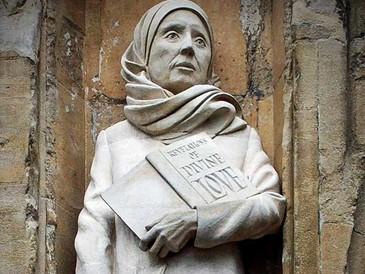
In the flourishing late medieval town of Norwich, a small room known as an anchorite’s cell is built onto the parish church of St. Julian. A number of medieval churches had such “cells” attached.
The anchorites who lived in these cells were usually female (often called anchoresses) and had taken vows to spend their lives in solitude and prayer. While they attempted to withdraw from the world, they lived in the heart of the community and thus often became centers of pilgrimage and sources of spiritual advice.
The most famous of the late medieval anchorites lived in this cell next to St. Julian’s Church; she succeeded in obliterating her original identity so completely that we know her only as “Lady Julian of Norwich” after the parish church. Yet “Julian” (c. 1342–c. 1416) was not only a famous spiritual advisor in her own day—people traveled miles to see her—but is known to posterity as one of the greatest spiritual writers in Christian history.
Her fame rests on a single book, existing in a longer and a shorter version: the Showings or Revelations of Divine Love (c. 1395). This book, written down by a male cleric, records a series of visions Julian received during a severe illness.
look toward the cross
Julian’s visions, like many others in the late Middle Ages, focus on a graphic portrayal of the physical sufferings of Christ. But what makes Julian’s book so remarkable is the vivid and radical way she draws out the implications of Jesus’s sacrificial love for the nature of God. At one point, tempted by a “friendly suggestion” in her heart to look away from the cross that appears in her vision, she responded by saying to the crucified Jesus, “You are my heaven.”
This is why Julian refers to Jesus as “mother,” a move that endears her to modern feminists. (Like many other elements of her spirituality, this wasn’t entirely new; medieval mystics from the twelfth century on often referred to Jesus this way.) For Julian this wasn’t a rejection of traditional masculine language, but rather a dramatic way of highlighting Jesus’s nurturing love as central to God’s character. One of her most memorable metaphors, summing up her spirituality—literally—in a nutshell, is her vision of the whole universe as “a little thing like a nut” held in the protecting and nurturing hand of God.
Julian has been understood as a universalist based on her repeated statement that her visions revealed “nothing about hell” and her insistence that “all shall be well, and all manner of things shall be well.” She always said that she adhered to church teaching on damnation, but she clearly struggled with reconciling this teaching with the unconditional love of God; the closest she came to resolving this tension was claiming that God will “do a deed” at the end of time that will be unimpeded by human sin.
I first encountered Julian’s writings in a college class on medieval mysticism, and they have been one of the most powerful spiritual influences on me ever since. I find in Julian a rich, imaginative, and profoundly orthodox presentation of the heart of the Christian faith, all the more compelling because she is so thoroughly medieval even as she transcends so radically the flaws and limitations of much of medieval popular piety.
When modern “progressives” tell me that God is all love, they are saying what their culture requires them to say if they are to be respectable believers at all. But when a medieval ascetic, shut up in a tiny cell attached to a stone church, has lurid visions of the discolored body of Christ on the cross, and on the basis of those visions tells me that the self-giving, all-forgiving love of Jesus is the ultimate truth about the universe . . . then I dare to believe that it just might be true.
By Edwin Woodruff Tait
[Christian History originally published this article in Christian History Issue #127 in 2018]
Edwin Woodruff Tait, contributing editor, Christian History. A shorter version of this article appeared in CH #116.
DYING” JULIAN SPOKE WITH CHRIST IN VISIONS
“All shall be well, and all manner of thing shall be well.” Julian of Norwich
All shall be well
Julian of Norwich is an anchoress—a woman who has set herself apart for God and lives isolated in a cell. Like her contemporaries of 1373, she is Roman Catholic and believes that the last rites give special sanctifying grace and strengthen a sick person bodily and spiritually at death. Recognizing her need for a deeper love of Christ, she has appealed to God for three things:
• a stronger understanding of Christ’s passion
• a sickness unto death while still young, allowing her to experience all that a body and soul experience in death (including attack by devils and administration of the last rites) but without actual death—so that she might learn to live more mindful of God
• three “wounds:” absolute contrition, kind compassion, and steadfast longing toward God.
It seems her unusual prayer is being answered. Julian has indeed become deathly ill. Everyone around her despairs of her life. She also believes she is dying. The last rites are administered to her.
Then a wonderful thing happens: Julian experiences what a future generation might describe as a near-death experience. At the crisis of her sickness, between four and nine one afternoon, she receives fifteen “showings,” or revelations. She reports that heaven opens to her, she beholds Christ in his glory, and she sees the meaning and power of his sufferings. She also sees Christ’s mother, Mary, exalted and beloved.
In her thirteenth showing, Julian receives a comforting answer to a question that has long troubled her:
“In my folly, before this time I often wondered why, by the great foreseeing wisdom of God, the onset of sin was not prevented: for then, I thought, all should have been well. This impulse [of thought] was much to be avoided, but nevertheless I mourned and sorrowed because of it, without reason and discretion.
“But Jesus, who in this vision informed me of all that is needed by me, answered with these words and said: ‘It was necessary that there should be sin; but all shall be well, and all shall be well, and all manner of thing shall be well.’
“These words were said most tenderly, showing no manner of blame to me nor to any who shall be saved.”
In this she recognizes the compassion she had prayed for. She is impressed with her need to be joyful in all circumstances, however adverse, and for no particular reason, except this: that all things will ultimately be put right by Christ. She comes to such a sense of the awfulness of sin that she reckons the pains of hell are to be chosen in preference to it. Indeed, to one who recognizes the horror of sin, sin itself is hell. “And to me was shown no harder hell than sin. For a kind soul has no hell but sin.”
The following night Julian will receive a final, sixteenth showing while she sleeps. In it Satan and his hosts assail her, but God gives her grace, and she fixes her eyes on the crucified Christ and trusts that because of his suffering and victory over sin he can protect her, and he delivers her from the demonic jeers and mutterings.
She recovers to live thirty-three years longer. Soon after her recovery, Julian records a short account of her revelations. Twenty years after her visions, having meditated long upon them, she will add additional thoughts as to their meaning. Both the short and the long accounts will be widely disseminated in manuscript form and, after the invention of the printing press, will be published in many editions.
Centuries later, Christians will still read her Showings with interest and wonder to what extent Julian of Norwich actually penetrated the mysteries of the unseen world.
—Dan Graves
MARTIN LUTHER, 1483-1546: CHAPTER 14
Martin Luther on Prayer
Martin Luther (1483-1546)
1. Introduction
Martin Luther is a character larger-than-life. He is the “stuff” that legends are made of.[1] On account of his rhetorical style and flare for the dramatic over-statement, stories of things that Luther said or did have typically been amplified as they are passed down through time. An example of this is the following statement, attributed to Luther, though not found in his writings: “I have so much to do that if I didn’t spend at least three hours a day in prayer I would never get it all done.”[2] Even if modern writers are sometimes given to exaggeration and this saying is not derived from Luther’s own pen, there is indeed extensive evidence to suggest that Luther was a powerful man in prayer, with great convictions on how Christians should pray.
Rather than focusing primarily on what others have concluded about Luther’s theology of prayer, it seems appropriate to begin studying Luther’s view of prayer as it is borne out in his own writings. More specifically (since his writings are seemingly inexhaustible), this paper will seek to examine Luther’s theology of prayer from his letters.[3] This seems appropriate since one is able to see more clearly in his dealings with family and friends exactly how his beliefs fleshed themselves out in practice. While he is able to theoretically discuss prayer in many other literary contexts, it is in his everyday dealings with other Christians as recorded in his letters where his doctrine becomes duty.
Luther’s theology of prayer will be shown to be one which is bibliocentric, which views prayer as being of great importance, which is very human, and also practical. Each section will provide evidence of the characteristic as developed in his letters, and then as it is affirmed by other writers.
2. Luther’s Theology of Prayer
A. Luther’s theology of prayer is bibliocentric.
Prayer is so central to Luther’s conception of the Christian life and ministry that it is naturally the first thing to come to his mind when writing his good friend Philip Melancthon in Wartburg, May 12, 1521.[4] Having pictured the German church of his day as the fulfilment of Psalm 89.47, Luther returns to prayer for the church and Melancthon’s ministry, thus demonstrating that their only recourse when encountering spiritual enemies and spiritual hardship as pictured in the Word of God is prayer. After encouraging his friend with several exhortations alluding to pastoral charges from 1 and 2 Timothy, Luther moves seamlessly back into prayer, instructing Melancthon to “Return, therefore, this service so that we carry this burden together”[5] (ie. “Pray for me as well”), an allusion to Galatians 6.2. This is just one of innumerable examples of how Luther weaves from Scripture to prayer and then back again naturally, thus showing his prayers’ dependence on Scripture.
One continues to notice just how much Luther is familiar with and dependent on the biblical text in his prayers in subtle allusions. Another example is his request for his friend George Spalatin to pray for him, that his faith in the Lord will not fail; a verbal reference to Luke 22.32.[6] In another letter to the same friend, Luther prays for Wittenberg, saying, “May Christ complete that which he has begun” (ie. a work of grace), praying the faithful statement of Paul from Philippians 1.6.[7] Luther again refers to this verse in a letter of encouragement to the ministers in Lübeck, this time offering it as a prayer to the Father of mercies (a reference to 2 Cor 1.3), requesting that they be delivered from the evil one (cf. Mt 6.13).[8]
In examining the ways in which prayer and the Bible are inextricably connected in Luther’s thought, it is noteworthy that whereas this paper began with prayer and must connect it with Scripture, both Piper and McGrath begin with Luther’s emphasis on Scripture and must connect it with prayer.[9] Piper shows how, for Luther, prayer was not something merely informed by Scripture, but rather, Scripture is often informed by prayer as well!
That the Holy Scriptures cannot be penetrated by study and talent is most certain. Therefore your first duty is to begin to pray, and to pray to this effect that if it please God to accomplish something for His glory–not for yours or any other person’s–He very graciously grant you a true understanding of His words. For no master of the divine words exists except the Author of these words, as He says: ‘They shall be all taught of God’ (John 6:45). You must, therefore, completely despair of your own industry and ability and rely solely on the inspiration of the Spirit.[10]
In another place, Luther would say of listening in prayer, “the Holy Spirit preaches here…. Many times I have learned more from one prayer than I might have learned from much reading and speculation.”[11] It is essential to note, however, that Luther is not setting prayer over against study of Scripture, but is rather arguing on the assumption that prayer will already be based on Scripture, thus allowing the Holy Spirit to give insight into his Word.[12]
Luther’s biblically-informed doctrine of prayer allowed him great faith in praying. He could pray with great confidence, knowing that God (in Psalm 62) is called one who listens to prayers.[13] Since the sovereign Lord of the universe–he is sure–hears him when he prays, he can pray with great faith. This scriptural understanding that God hears prayer also contributes to the great importance of prayer in Luther’s life and thought.
B. Luther’s theology of prayer recognizes the great importance of prayer.
That Luther understood the importance of prayer is nowhere more obvious in his letters than in his stubborn consistency in requesting that others pray for him. Often, Luther simply requests that people pray for him without adding any specific details. It is worth noting as well, that even when these requests were general, Luther would include them in the closing of his letter so that the reader would be sure to remember.[14] Other times, however, he requests prayer specifically for overcoming sin in his life. To Luther, the prayers of his friends and brothers are essential in his battle against the flesh.[15]
At still other times, Luther shows the extent of his own neediness of the preserving grace of God extended to him for his own persevering in grace. For example, to Melancthon he writes, “Only pray for me that my faith in the Lord does not fail.”[16] Similarly, to Spalatin, he requests prayer that “Christ does not desert me in the end.”[17] Still yet there are occasions when Luther feels the need to request prayer for simple obedience. This is why he could write to Nicholas Hausmann in 1538 and make this request of his brother: “Pray diligently to the Lord for me, therefore, that I might be able to do what is good in his eyes.”[18] All these occasions of Luther writing to his Christian brothers to ask for prayer on his behalf show clearly that he recognizes the great importance of prayer.
Plass records Luther’s emphasis on the importance of prayer: “There is need every hour without ceasing to pray everywhere with tears of blood to God, who is so terribly angry with men. And it is true that it has never been more necessary to pray than at this time, and it will be more so from now on to the end of the world.”[19] The importance of prayer is also developed in Luther through his insistence that it be carried out with great fervour even though it is hard work:
There is no work like prayer. Mumbling with the mouth is easy… but with earnestness of heart to follow the words in deep devotion, that is, with desire and faith, so that one earnestly desires what the words say, and not to doubt that it will be heard: that is a great deed in God’s eyes.[20]
Dawn cites him again, this time commenting on Paul’s words to be “instant in prayer:” The word ‘instant’ is a call to order and vigilance that everyone … must hear and fear. For it means that praying must be a constant effort … a labor that is harder than every other labor … for it requires a subdued and broken mind and a high and triumphant spirit. … Christians must practice prayer frequently and with diligence. For ‘to be instant’ does not only mean ‘to be constantly engaged in something’ but it means also ‘to press on,’ ‘to quicken one’s pace,’ ‘to demand earnestly.’ So then, as there is nothing that Christians must do more frequently than praying, so there is also nothing that requires more labor and effort and, for this reason, is more effective and more fruitful.[21]
These passages combined show clearly that Luther placed great emphasis on the importance of being intentional in prayer. Since there is such a great need for prayer, the Christian is to continue to work at it, even when it is hard.
But is prayer hard for all people? Luther’s acknowledgement that prayer can be (and most often is) quite difficult is perhaps not what the average reader would expect from someone as well-versed in the Bible and with such a high-priority-of-place for prayer and such a “spiritual giant” as Luther. This all contributes to the distinctive element of humanity and humility in Luther’s teaching on prayer in his letters.
C. Luther’s theology of prayer allows for the humanity of the pray-er.
While it would be easy to suspect a man of Luther’s spiritual magnitude and theological fortitude to come off as condescending and idealistic when discussing prayer, nothing could in fact, be further from the truth. Luther, in his letters, repeatedly admitted to having struggles in prayer. In a fascinating letter to his friend Melancthon in 1521, Luther writes that he is upset at his friend for ascribing to much piety too him. In his words, his friend’s estimation of his spiritual vitality “shames and tortures” him because he does not measure up.[22] Luther confesses at length:
I sit here like a fool and hardened in leisure, pray little, do not sigh for the church of God, yet burn in a big fire of my untamed body. In short I should be ardent in spirit, but I am ardent in the flesh, in lust, in laziness, leisure, and sleepiness. … Already eight days have passed in which I have written nothing, in which I have not prayed or studied.[23]
This picture of Martin Luther is not the one typically given of the bold, brazen-eyed, unstoppable reformer, but since it is a self-portrait one may easily assume its veracity. Thus it can clearly be seen that while Luther saw a profound need for Christians to always be constantly praying biblical prayers, he recognized the presence of profound weaknesses even in his own prayer life.
A peculiar aspect of his “humanity” as it relates to his prayer-life is that of his thoughts with regard to music. Since music and theology both function to “chase the devil away,” there is no reason why prayer should not be combined with music. To this end, he writes a letter to Louis Senfl, a leading composer of his day asking for music to be written for one of his favourite psalms, so that he might pray it better.[24] Whereas Luther has acknowledged that prayer is indeed difficult, he also attempts to introduce very practical ways to make it easier, while no less important or productive.
In a particularly touching letter to Justus Jonas, Luther recounts another time of his “weakness” or “humanity” in prayer. Shortly after the death of his young daughter, Magdalen, Luther tells his friend that he knows he should be able to thank God for the fact that she has gone and the manner in which she has gone to be with her real, eternal Father. Yet even though he is aware that he should be able to pray thus, still he and his wife cannot do so without crying and grieving. As a result, he adjures his friend, “You, therefore, please give thanks to God in our stead!”[25]
Since Luther was so well acquainted not only with the biblical ideal of prayer, but also with his own weaknesses due to sin and basic humanity, he was most qualified to humbly teach “commoners” and “laity” about prayer. As R. Kent Hughes’ citation of Luther shows, he insisted that people earnestly seeking to please God in their prayers should seek to be sincere, not overly pious: “Look to it that you do not try to do all of it, do not try to do too much, lest your spirit grow weary. Besides, a good prayer mustn’t be too long. Do not draw it out. Prayer ought to be frequent and fervent.”[26]
Likewise, Russell notes that “the famous professor does not presume upon his own status or ‘talk down’ to Peter” (his barber, who had written him, requesting instruction on how to pray). Rather, “Luther shows a sense of mutuality and respect for the questioner and, by extension, all Christians who would pray.”[27] In other words, Luther is quick to associate himself with the “laity” who are struggling, not the elite who have everything to teach and nothing to learn. “The reformer writes as a fellow believer, offering a method of prayer that he has found helpful and instructive–realizing that others may certainly be better at it than he is.”[28]
With this idea of his own humility and humanity in mind, Luther seeks to establish a model of prayer which is ultimately practical. Prayer, for Luther, is for the purpose of accomplishing something, not merely for mumbling words. He tries to make this true in his own life, as well as teaching it to others.
D. Luther’s theology of prayer is intensely practical.
Luther’s theology of prayer is shown to be practical first in the nature of the requests for prayer that he makes. While many would be too shy or afraid to make such a request, Luther is vehement in his admonitions to his brothers to pray for his constipation. The situation is first described in a letter to Melancthon, but then is repeated several times in various letters to Melancthon (again), Spalatin (repeatedly), and Nicholas von Amsdorf with requests for prayer.[29] While this may seem like a superfluous thing to mention, this chronic ailment was extremely severe at times and caused Luther no great difficulty. His continual requests for prayer make plain his unshakeable belief that prayer is an ultimately practical tool for any and every problem and hindrance in the Christian’s life.
Luther’s confidence in the practicality of prayer also shines through in his brief request to Nicholas Hausmann in 1538.[30] At this time Luther is facing many vexations and at a loss to know how to deal with them, so he asks for prayer: “Pray diligently to the Lord for me, therefore, that I might be able to do what is good in his eyes.”[31] And Luther is quite confident of what will result from those prayers: “As I have asked you, do pray for me, for I am confident that your prayers accomplish much with God.”[32] In other places Luther felt free to ask for prayers for other practical things such as continual headaches.[33] It was because of this perspective of prayer that he could write, “Pray confidently, for all is under control, and God will help us.”[34]
Luther’s theology of prayer is not only shown to be practical by what he requests prayer for, but also in the way that he instructs others to pray. A classic example comes from Plass who recites an event wherein Luther is relating to some friends how he sometimes warms himself into the fervour of prayer when his heart is otherwise cold:
He told them that he would dwell in his mind upon the ingratitude and godlessness of the enemies of the Gospel. These considerations, he assured his auditors, would so thoroughly arouse and incense him that he would burst forth into an ardent prayer to the Lord, beseeching Him to hallow His name, establish His kingdom, etc.[35]
Where this method may seem somewhat unorthodox, it remains intensely practical; it is something that his students may do in order to help “warm their hearts” to prayer, and that was the goal of Luther’s teaching.
It is from this same goal (to be of practical help to the Church of God) that Luther wrote A Simple Way to Pray which is thoroughly basic. He walks the believer through all the initial steps of how he should pray, beginning with the reading of Scripture. Then, “when your heart has been warmed by such recitation to yourself and is intent upon the matter, kneel or stand with your hands folded and your eyes toward heaven and speak or think as briefly as you can.”[36] In this manner Luther goes on to describe in great detail just how the believer can have a more effective and God-honouring prayer life. This is in no way intended in a legalistic manner, but simply to educate believers on how to pray biblically in very practical ways.
3. Conclusion
Prayer, for Luther, is rooted in the Bible and of utmost importance. But this does not necessitate legalistic enforcement of a set of standards. Rather, Luther recognizes that prayer is hard work and he is not nearly as successful at it as he would like to be. With this in mind, the godly reformer seeks to instruct those around him in a gentle, humble, constructively practical manner so that prayer will really begin to change the lives of God’s people–just like it is supposed to.
It goes without saying that a study of this length has not even begun to scratch the surface of Luther’s full theology of prayer. Nevertheless, what has been shown here is sufficient to function as a hearty rebuke to most modern Christians (this author included!). Prayer seems to be the one area of the Christian life in which every single believer struggles. Perhaps that is because many Christians are biblically illiterate. Perhaps it is because many Christians do not really value prayer as a discipline of great importance. It might be because Christians are easily discouraged at their failures or because they simply do not know how to pray, practically speaking. Whatever the case, the modern Christian has much to learn from this great forefather of the faith when it comes to understanding and practicing prayer.
Works Referenced
Dawn, Marva J. Morning by Morning: Daily Meditations from the Writings of Marva J. Dawn. Grand Rapids: Eerdmans, 2001.
Hughes, R. Kent. Disciplines of a Godly Man, rev.ed. Wheaton: Crossway, 2001.
McGrath, Alister E. Christianity: An Introduction. Oxford: Blackwell Publishing, 1997.
Pelikan, Jaroslav and Helmut T. Lehmann, eds. Luther’s Works: American Edition. 55 vols. Philadelphia: Fortress Press, 1955-1975.
Piper, John. The Legacy of Sovereign Joy: God’s Triumphant Grace in the Lives of Augustine, Luther, and Calvin. Wheaton: Crossway, 2000.
Plass, Ewald M. This is Luther. St. Louis: Concordia Publishing House, 1948.
Rice, John R. Prayer: Asking & Receiving. Murfreesboro: Sword of the Lord, 1942.
Russell, William R. Praying for Reform: Luther, Prayer and the Christian Life. Minneapolis: Augsburg Press, 2005.
_______________________________________________________________________________
[1] For example, John R. Rice tells this story of the reformer at prayer: “Once as he prayed, Satan became so real to him, taunting, tempting, interfering, that Martin Luther threw the ink bottle at him! And the splash on the wall has long been shown to visitors to remind us of how real was prayer to Martin Luther.” From Prayer: Asking and Receiving (Murfreesboro: Sword of the Lord, 1942), 280.
[2] As cited in Marva J. Dawn, Morning by Morning (Grand Rapids: Eerdmans, 2001), 242. A variant appears on page 280 of John R. Rice’s Prayer: “Martin Luther said that he had so much work to do for God that he could never get it done unless he prayed three hours a day!” Neither author cites a source for this saying.
[3] As found especially in volumes 48-50 of Luther’s Works: American Edition, 55 vols., Jaroslav Pelikan and Helmut T. Lehmann, eds. (Philadelphia: Fortress Press, 1955-1975).
[4] Works, 48:215ff.
[5] Ibid., 216.
[6] Ibid., 289.
[7] Ibid., 308.
[8] Works, 49:262. Luther uses some of these references as refrains in his prayers included in letters; cf. his use of 2 Cor 1.3 again in later letter to Justus Jonas (Works, 50:238).
[9] John Piper, The Legacy of Sovereign Joy (Wheaton: Crossway, 2000), esp. 106ff; Alister E. McGrath, Christianity: An Introduction (Oxford: Blackwell Publishing, 1997), 53f.
[10] As cited in Piper, Legacy, 106-107.
[11] As cited in William R. Russell, Praying for Reform (Minneapolis: Augsburg Fortress, 2005), 75.
[12] All this is to say nothing of the fact that Luther’s Personal Prayer Book, Booklet for Laity and Children, and A Simple Way to Pray are specifically centred around the concept that one should be praying sections of the Bible. Luther begins the latter work, addressed to his barber, in this manner: “First, when I feel that I have become cold and disinterested in prayer because of various tasks or thoughts (for the flesh and the devil always impede and obstruct prayer), I take my little Book of Psalms….I say quietly to myself the Ten Commandments… some words of Christ or Paul, or some Psalms, just as children do” (as cited in Russell, Praying for Reform, 71-72, emphasis my own). Unfortunately, this cannot be dealt with at length here, however, since the present focus is Luther’s doctrine of prayer as it is developed in his letters.
[13] Works, 49:355.
[14] For just a few examples, see Works, 48:228, 256, 268, 273, 276, 312, 315, etc.
[15] For example, ibid., 357.
[16] Ibid., 289.
[17] Ibid., 324.
[18] Works, 50:176.
[19] Ewald M. Plass, This Is Luther (St. Louis: Concordia Publishing House, 1948), 187.
[20] Ibid., 186.
[21] Dawn, Morning by Morning, 242.
[22] Works, 48:257.
[23] Ibid.
[24] Works, 49:426.
[25] Works, 50:238.
[26] R. Kent Hughes, Disciplines of a Godly Man, (Wheaton: Crossway, 2001, rev.ed.), 104.
[27] Russell, Praying for Reform, 19.
[28] Ibid.
[29] Cf. Works, 48:217, 219, 255, 257, 268, 276, 291, 316.
[30] Works, 50:174ff.
[31] Ibid., 175-176.
[32] Ibid., 176.
[33] Works, 49:400 n.7.
[34] Ibid.
[35] Plass, Luther, 186.
[36] Russell, Praying for Reform, 73.
On Luther’s Relationship to Mysticism
Did Luther Abandon the Mystical Tradition?
Jordan Cooper
Nov 27, 2024
The question of Martin Luther’s relationship to mystical theology is one that has not been definitively answered in Luther scholarship. Proposed answers to the question continue to divide readers of both the reformer and the late German medieval mystical tradition as represented in the Rhineland Mystics. In contrast to what is sometimes assumed, this divide in attitudes toward mystical theology within the Lutheran tradition is not only the product of the rise of Luther scholarship as a distinct discipline in the late nineteenth and early twentieth centuries. While much modern discussion of this question arises from Ritschl’s condemnation of mystical theology in his Justification and Reconciliation (1870-1874), and the following debates that occurred during the Luther renaissance surrounding the writing of Karl Holl, similar debates about the veracity of the mystical tradition and its compatibility with Lutheran soteriology are nearly as old as the Reformation itself.
The most obvious place where such a divide makes itself known is in the diversity of responses to Johann Arndt’s True Christianity, first published in 1605. Rather than early the Lutheran dogmatics textbooks which were the most widely read books among most Lutheran pastors of his age, Arndt spent the majority of his own reading in the writings of mystics like John Tauler, the unknown writer of the Theologia Germanica, and Thomas A Kempis. For Arndt, there was profound continuity between these authors and the theology contained within the Lutheran Confessions— after all, Luther himself cited the German mystics as his primary influences. While Johann Gerhard defended Arndt (he helped get the work published), others were concerned that Arndt had internalized salvation, moving away from the forensic approach to justification that characterizes Lutheran doctrine. Though the debate is not only about Luther as an individual theologian, much of it does surround the question of Luther’s relationship to mystical theology, and whether or not mysticism is, in its entirety, to be identified with the enthusiasm Luther unhesitatingly condemns.
Luther’s Definitions of Mysticism
One of the difficulties of discussing this issue is that “mysticism” as a concept is not so clearly defined. Much modern discussion on the question relies on Ritschl’s characterization of the movement (which is not a positive one), which is sometimes set in direct opposition to the scholastic approach of the medieval schoolmen. Among the many problems with this is that sometimes the scholastic theological method and mystical piety are found within the same figures. Among the Lutherans, Johann Gerhard is a prime example of the merging of both approaches. Further, it is unquestionably true that Luther, and Lutherans more generally, reject certain forms of mystical piety. Luther repeatedly critiques Pseudo-Dionysius, for example, as early as 1516, and then later reiterates these same critiques against the radical Anabaptists in Against the Heavenly Prophets (1525) among other similar writings. The Lutheran Orthodox then level the same criticisms in their responses to the Weigelians and Schwenkfeldians in the seventeenth century, and then toward the radical pietists in the eighteenth century. The question is whether these condemnations are of mysticism as such, or of a certain type of mysticism. I contend for the latter.
In his 1937 essay, “Luther und die Mystik,” Erich Vogelsang makes a distinction between three different types of mysticism which receive diverse responses from Luther: Dionysian, Roman, and Germanic.1 It is the first of these which receives the most criticism from Luther, for its focus on unmediated union with God, neglecting both the external word and the incarnate Word for communion with the Deus nudus. As Bengt Hoffman summarizes, “It is hazardous to seek unity with God outside the Word made flesh.”2 The second type of mysticism, the Romanic, has something of a mixed reception from Luther in Vogelsang’s estimation. The two primary sources Luther cites (very often with approval) as representative of this school are Bernard of Clairvaux and John Gerson. It is from this Latin mysticism that Luther derives the bridal imagery which is central to his conception of the great exchange, in which Christ shares is righteousness with his bride (the soul), while the bride shares her sin with the bridegroom (Christ).3 As Vogelsang argues, as much as Luther speaks positively about these authors, he believes that they miss the essential element of suffering and anguish within Christian experience (that which is associated with the work of the law). It is in the third group of mystics, the Germanic, that Luther finds the most commonality.
Luther’s love for the German mystical tradition is undisputed in his earlier years. He first published the Theologia Germanica in 1516, and then released a fuller text in 1518. Until about 1520, both John Tauler and the Theologia Germanica are cited frequently by the reformer. In his 1518 preface to the work, Luther contends that “Next to the Bible and Saint Augustine no other book has come to my attention from which I have learned—and desired to learn—more concerning God, Christ, man, and what all things are.”4 For early Luther, this book was proof that the theology of Wittenberg was not novel, but was a continuation of the German mystical theological tradition which preceded him.
What is disputed is how far these works impact the theology of the later Luther. One approach contends that there is a decisive break with the Rhineland mystics when Luther encounters the radical reformers in the mid-1520s who use the writings of mystics to defend their claims of immediate personal revelation. For some scholars, the polemical writings of Luther in this area demonstrate a move away from mysticism, as the critiques of the Schwärmer would similarly apply to mystical piety as a whole.
Challenging the Break
The argument toward this supposed break with Luther’s earlier thought relies on a couple assumptions here. First, that Luther’s theology is not substantially formed by the end of 1518, such that a move toward a focus on the external Word (and his doctrine of justification) only occurs in the 1520s. Second, it takes Luther’s critiques of the Schwärmer as representative of his attitude toward mysticism as such. This view tends to assume that Luther does not strongly differentiate between the various strains of mystical piety which Vogelsang outlines. Out of these two assumptions then arises the contention that Luther only speaks positively about these authors in his earlier writing, and that once his fully-formed Reformation soteriological system is put together, he completely abandons these writers.
While the first of these assumptions merits a response, it is a bit too complex for an article like this, so for the time being I will leave the question aside (perhaps the topic of a later article). The second is more easily delt with. It is important to note that Vogelsang’s argument regarding Luther’s reception of these strains of mystical thought do not depend merely on the occasional statement of the reformer toward representatives of each school, but are based on notes taken by Luther himself in the margins of these texts. From the years 1515 to 1518, Luther spent a significant amount of time in these sources, and when doing so, he had a habit of writing “sic” (yes) when he agreed with something he read, and “non” (no) when he disagreed. Dionysius’s writings are full of “non” in the margins (though not exclusively), Gerson’s works have a mixture of “non” and “sic,” and Tauler’s works have entirely positive notations.
What this demonstrates is that as early as 1516, Luther had developed his opposition to Dionysian mysticism for its Christless piety. In other words, Luther condemns Pseudo-Dionysius in the same year in which Luther published the Theologia Germanica. Luther’s later condemnations of the Schwärmer do not automatically necessitate a blanket condemnation of mysticism, as Luther’s critiques of the enthusiasts are largely reiterations of his much earlier opposition to Pseudo-Dionysius which he did not apply to Tauler or the Theologia Germanica.
To be clear, it is true that Luther cites both of these sources far less often later in his career. Though many of his foundational distinctions and ideas arise from these authors, they do not contain a fully formed doctrine of justification by faith, and tend to be less focused on the Sacraments than Luther is. Further, Luther departs quite significantly from the entire late medieval mystical tradition in his contention that the unio mystica is not something to be achieved as the end of a threefold process of purgation, illumination, and union. It is instead the very beginning of Christian piety—a gift delivered freely in faith. While one’s experience of union may increase, the union itself is a Baptismal reality, delivered to all who receive the Sacrament. The question is whether these shifts in Luther’s thought are a development of this earlier theology, or a departure from it. I contend the former.
It is noteworthy that Luther never speaks negatively about the Theologia Germanica or John Tauler, even later in life. As Heiko Oberman shows, while Tauler is not mentioned often in late Luther, he is named occasionally, and is always cited positively.5 Oberman also shows that the same is true of Gerson, who Luther continues to recommend reading throughout his life, though urges students to do so “cum judicio,” (with judgment). The same is true of Bernard. This would all be quite unusual for Luther if there was such a strong departure, as Luther was never one to shy away from expressing his distaste for a theologian or text that he considered errant.
Conclusion
There is plenty to say (and has been said) about the particulars of German mysticism and exactly which elements of the Theologia Germanica and Tauler were formative for Luther. To say that Luther was—in some sense—a mystic is not to say that there is some kind of 1:1 correlation between Luther’s spirituality and those figures who came before him. Instead, it is simply to say that there are elements of mystical piety and theology that were formative in Luther’s Reformation discovery, and that those elements remained a part of his theology throughout the entirety of his career. Further, those mystical elements remain an essential part of the Lutheran heritage even unto the present day, whether the roots of these things are recognized or not. This necessitates using precision in our language and ridding ourselves of the idea that mysticism is always identical with its Dyionisian and enthusiastic varieties. There is a Christocentric contemplative mysticism that is not only allowable in a Lutheran framework, but is essential to it.
1
Erich Vogelsang, “Luther und die Mystik,” in D. Th. Knolle, ed., Luther Jahrbuch 1937.
2
Hoffman, Bengt. Theology of the Heart: The Mysticism of Martin Luther, (Minneapolis: Kirk House, 1997), 212.
3
Writers like Franz Posset have demonstrated strong continuity between Bernard and Luther in a number of areas. See: Pater Bernhardus: Martin Luther and Bernard of Clairvaux. (Kalamazoo, MIL Cistercian Publications, 2000).
4
The Theologia Germanica of Martin Luther. Translated by Bengt Hoffman. (New York: Paulist Press, 1980), 54.
5
Oberman, Heiko, “Simul Gemitus et Raptus: Luther and Mysticism,” in The Dawn of the Reformation: Essays in Late Medieval and Early Reformation Thought, (Edinburgh: T.&T. Clark, 1986), 126–34.
IGNATIUS OF LOYOLA, 1491-1556 – CHAPTER 15
Josep Serra i Porsón
https://share.google/szUHRNCw1bCOLfbYb
ABOVE: THE MYSTICISM
OF IGNA OF IGNATIUS OF L TIUS OF LOYOLA
Brian O’Leary, SJ
Consultant in Ignatian Spirituality
Dublin, Ireland
ABOVE: IGNATIAN MYSTICISM
By JOHN R. SACHS
IGNATIAN MYSTICISM — IS THERE SUCH A THING? Indeed, were one to think of sixteenth-century Spanish mysticism, it would probably be St John of the Cross or St Teresa of Avila who would come
to mind. While the figure of Ignatius (and perhaps even more the history of the order he founded, in the enormous diversity of its works and in its decidedly unmonastic styles of living and praying) may call to
mind many other images, anyone who reads his Autobiography and Spiritual diary immediately recognizes that Ignatius was indeed a mystic, blessed in many extraordinary ways. Indeed the process of his own
purification, illumination and transforming union by God forms the very foundation for the Spiritual Exercises, which lie at the heart of Jesuit spirituality and ministry. This great mystic of the Church has left a vibrant legacy to all believers. All individual charisms are given by God for the life of the Church as a whole. The ultimate significance of lguatius’ experience of God does not consist chiefly in the range of unusual affective or cognitive phenomena (visions, ecstasies, divinely infused knowledge, tears etc.) that marked his experience but in the way that his experience speaks to and illumines the basic life of faith in a new and radical way.
 The Carpenter's Nail