

Take not the seat of the scorner, nor give yourselves up to a mere curiosity in religion. Go not where Christ is preached, to laugh and be amused. Go not to hear, day after day, truths of unutterable solemnity, only that you may know how various are the modes in which that may be said, against which you are determined to close your heart.
________
PHILIPPIANS, CHAP. I. v. XVIII.
WHAT THEN? NOTWITHSTANDING, EVERY WAY, WHETHER IN PRETENCE OR IN
TRUTH, CHRIST IS PREACHED; AND I THEREIN DO REJOICE, YEA, AND WILL REJOICE.
When St. Paul was sent a prisoner to Rome, he was followed by the anxious fears of his fellow-christians. But the time of his great departure was not yet at hand. He was to be delivered from his bonds, and to toil in the West before that second imprisonment which was ended by his death. The prospect of his freedom was now beginning to open; and he could see also that the things which had happened unto him had fallen out rather unto the furtherance of the Gospel. These were glad tidings which he hastened to send to the warm hearted Christians of Philippi. They were sent by Epaphroditus, the messenger whom the Philippians had first sent to relieve the wants of the Apostle.
The manner in which the evil of his suffering had wrought for good, was this, or like this. He had drawn the attention of men, so that he, with the cause of his imprisonment, was mentioned every where, even in the palace of the Emperor. When such attention had been fixed on himself and his doctrine, his brethren [3/4] in the city, warmed by his example, and glad that the truth was no longer hidden, spoke the word with much more boldness. But even amongst those who preached the Gospel, all spoke not in its spirit. Some preached Christ even of envy and strife; and some also of good-will. “The one,” says St. Paul, “preach Christ of contention, not sincerely, supposing to add affliction to my bonds; but the other of love, knowing that I am set for the defence of the Gospel.” They who preached Christ of contention, must have been either such as opposed the great doctrine of St. Paul, by urging that the law of Moses must also be kept, or else such as even in declaring the truth, were full of personal ill-will towards the Apostle of the Gentiles. He says, that they preached “not sincerely,” but it seems to be rather meant of the purity of their doctrine, than of that which we commonly name sincerity. They might be sincere, so far as not to be hypocrites; and yet not speak the pure and sincere word, which an upright heart, open before God, would have received and welcomed. He says, that they supposed to add affliction to his bonds. I cannot well imagine that they had any such deep and dangerous scheme, dangerous for themselves, as that of making him more odious to the heathen, by spreading his doctrine abroad. It seems to me that, somewhat mingling their Jewish errors with the Gospel, and thus depriving it of its simple pureness, in which he had preached it, they felt a certain triumph, which, they knew, must add to his affliction. He would see them freely spreading the doctrines which he had opposed, but could now oppose no longer. They thought of this with pleasure; and thus preached Christ even of envy and strife.
[5] Such was the occasion of the text. There were errors in doctrine, and errors in spirit, or both. What then? Notwithstanding, he rejoiced that Christ was preached, in pretence or in truth, in whole or in part.
My brethren, it cannot be otherwise than that in times like ours, such a text should be applied while it is read. The unity of the Church has suffered wounds, deep, ancient and severe. There is a strife of opposite opinions, not between two parties, but between many. That is taught which we cannot believe true, and which cannot be true, since the truth can never consist in sentiments contrary to each other. That is upheld and practiced in the preaching of the Gospel, which we cannot believe just, and holy, and expedient. Still Christ is preached; and it is not ours to say, or to think, that he is preached in pretence only. Blessed be God, that we must not say it, nor think it! But we have duties to be reconciled while we look upon the acts of others. We have to contend earnestly for the faith once delivered to the saints. We have also to keep the unity of the spirit in the bond of peace. The purest faith and the broadest charity are to be wedded together in our hearts. It may be easy to preserve a distant coldness. It may be easy to enclose ourselves in an iron bigotry. It may be easy to speak with sharp blame and scornful ridicule. On the other hand, it is easy to give up all reasons of difference, and embrace with like regard, whatever claims the form of piety. But this is only with the sacrifice of Christian feeling on one side, or of Christian knowledge on the other. We are called to a higher if a harder task. We must prove all things, and hold fast that which is good. We must abide in the truth, and yet love. We [5/6] must love, and yet abide in the truth. No judgment of man must turn us aside, from acknowledging the fruits of the spirit, or from maintaining the truth as it is in Jesus, with a sound mind. To aid us in this, let us consider these words of St. Paul; “every way, whether in pretence or in truth, Christ is preached; and I therein do rejoice, yea, and will rejoice.”
We shall observe,
First, that the Apostle perceives, and does not conceal, the errors of these teachers of the Gospel.
Secondly, that he notwithstanding sees, and does not conceal, that Christ is preached.
Thirdly, that he rejoices that Christ should be preached, even amidst errors.
I. In the first place, he perceives, and does not conceal, the errors of these teachers of the Gospel. He had no wish to close his eyes against that which certainly existed. He would not buy the pleasure of a more joyful hope by deceiving himself. He saw and said that there was envy and strife. His own heart was wounded, and not without intention. The Gospel lost much of its simple power, in the hands of those who preached it in such a spirit. Even if they had taught no error in doctrine, yet they might at any time expose the truth to shame by the spectacle of their own feelings.
The cause of Christ can never suffer from the candid expression of an honest and enlightened judgment. It is not needful, at all times, to press forward our doubts, since the matter may be of little importance, or may be beyond our influence. Nor is it well to indulge the habit of fixing our eyes upon the faults, however slight, by which a good man or a good work may be disfigured. But it would be only a trifling with ourselves, [6/7] to strive not to see that which is clear; and if we could succeed in being blind, the end might be most unhappy. The Gospel may be preached by one whom we cannot but believe to be a hypocrite. To scorn the Gospel for his sake, would be one error. To rely on him, as if for the Gospel’s sake, would be another. We must not hastily believe evil of any man; but, once believing it because it is proved to us, we cannot, except at the sacrifice of reason and of duty, trust in him as if he were blameless. The Gospel may also be preached, and with much success, while measures are employed, which we must view as imprudent, or irreverent, or disorderly. We cannot give the name of order to confusion. We cannot call that language reverent, which we would not dare to take upon our own lips in the house of God. We cannot judge that prudent, which seems more likely to stir a wild and ignorant and short alarm, than to plant the truth in a wise and deep and lasting faith. The Gospel may be preached, too, by those who either despise all discipline in the Church of Christ, or at least burst from the restraints which have been fixed by rightful authority. Whitefield and Rowland Hill cast off obedience to their superiors in the Church, and broke the promises which they had made at their ordination. They were honored and successful preachers in their day. They were, doubtless, men of a high and heavenly piety. They saw not what they did as it must appear to the common judgment of men, and as it would have appeared to them, had many others followed in their footsteps. But shall the minister of the Church praise them as without a serious fault? How, then, could he judge rightly of his own duty and his own promises? The Gospel may be preached by [7/8] those who are partly in error. It must be so; for, where there is a real difference of statement, and each party holds the difference to be important, there is error on one side or on both. Even if the difference were not important, the belief that it is important would be error. There is a difference between those who baptize infants, and those who deny such baptism; between those who think it impossible, by the decree of God, that certain men should be saved, and those who hold that all were redeemed by the blood of Jesus. The difference is not, on either side, allowed to be of little moment. If one opinion or practice be true or right, the other is not; or, if both were equally true or right, both parties would be wrong in judging the difference important. We cannot blind ourselves to the difference; and we ought not to blind ourselves to the value of truth. So, too, the Gospel may be preached, as at Rome, in an envious spirit of strife. Then, we are no more bound than was St. Paul, to persuade ourselves that no other spirit is there, except that of holy zeal and love of the souls of men. He perceives, and does not conceal, the errors of those teachers of the Gospel. He has thus taught us, that though the Gospel be preached, even with the happiest fruit, yet we are not therefore to close our eyes, either to the open unworthiness of the preacher; or to the blame which may attend his manner or method of preaching; or to the disregard of the good order and government of the Church of Christ, of which he may be guilty; or to his errors in doctrine; or to his spirit of envy, strife or vain-glory.
Found here: http://anglicanhistory.org/usa/gburgess/hartford1841.html
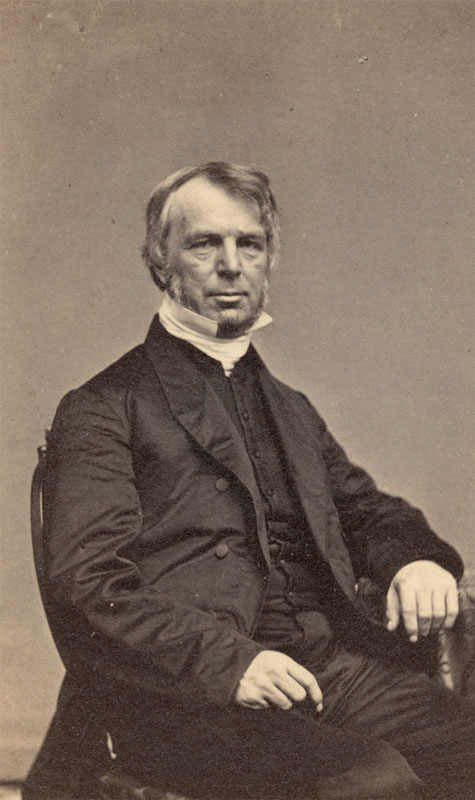
A SERMON, PREACHED AT CHRIST CHURCH, HARTFORD, ON THE EVENING OF THE FOURTH SUNDAY AFTER THE EPIPHANY, January 31, 1841. BY GEORGE BURGESS, A. M. RECTOR OF CHRIST CHURCH. HARTFORD. BELKNAP AND HAMERSLEY. 1841.

 The Carpenter's Nail