

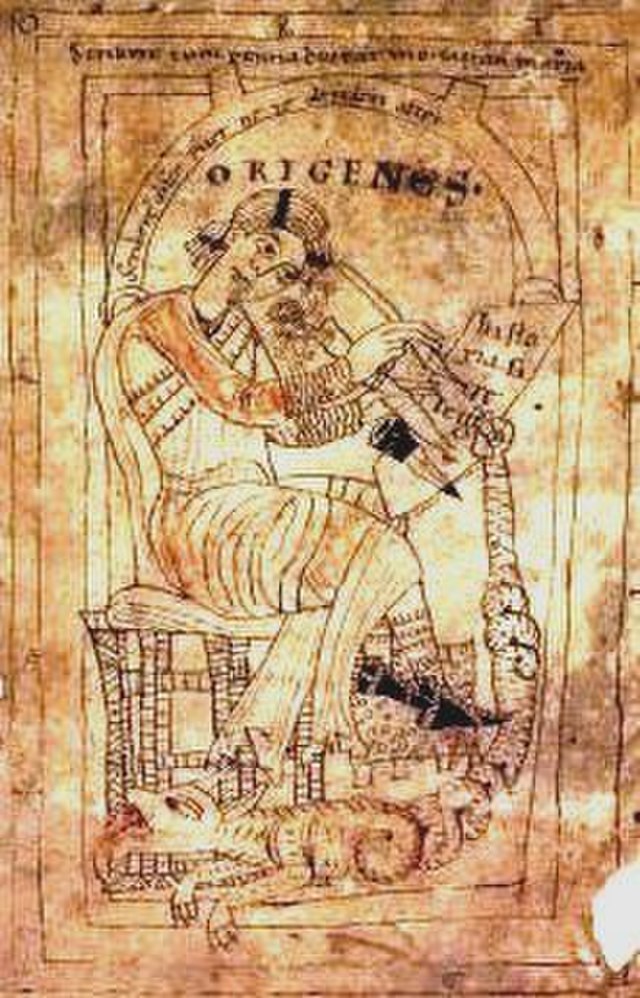
What each man honours before all else, what before all things he admires and loves . . . this for him is God. – Origen of Alexandria, 185—254 AD
In our congregation, some of us lost a good friend a few years ago – Warren Long MD. Warren had been a pioneering neurosurgeon, as well as a person with a constant, and mildly insatiable, intellectual curiosity. During his retirement and later years, like so many “men in full,” his thoughts, questions, his ruminations, turned to the “old book” as we would call it – the Old and New Testaments, or the First and Second Testaments as we would sometimes call them. Warren shared my interest in patristics, entering the spiritual and intellectual landscape of the early believers who sought to “make sense” of what happened around the Sea of Galilee and within the old city of Jerusalem during the first century. For both of us there is a kind of raw bullion, something unfiltered, unedited by the vicissitudes of Western history, found within the prayerful reflections and theological discernment of those close to the Incarnation. Warren gave me a copy of Robert Wilken’s book, The Spirit of Early Christian Thought, and I blew through it as a rehearsal of familiar ideas and themes. Recently while on sabbatical I returned to this book as an audiobook and began listening closely. Something about the pace, the topics, something about the tone of conversation in our current culture, brought Wilken’s insights closer to home. In the past I sometimes slipped into early Christian thought the way I might visit a small garden or park; delighting in the coziness and the intimacy of a curated space giving a glimpse of rest and beauty in the midst of a wider, untended landscape. However on this more recent visit, I feel that I have found a forest; where I thought I had climbed to the top of a peak, I am finding now there are mountains upon mountains before me.
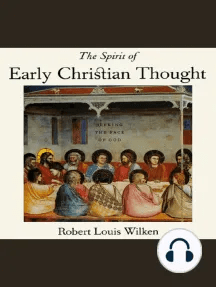
I simply offer this recommendation as a handbook for meeting fellow travelers if you are interested in moving both deeper and higher in the world of Christian thought. Most of the persons introduced in this book lived in circumstances like our own – a political landscape in perpetual turmoil, “technologies of the self” {Michel Foucault} on full display, a regular drumbeat of disagreement within the Church, etc., etc., – and still they pursue a vision of how the incarnate Christ arises in the midst of the world; “the failed project” of our common humanity being met with the surpassing power and illumination of the Logos. Of course there may be many who shy away from the sometimes white-hot witness and discovery contained in these early thinkers and writers; I have simply found they are sometimes like an outstretched hand in the midst of choppy waters. They invite and draw me onto higher ground. I am grateful that an old friend offered windows upon a new life.
Blessings and Godspeed,
Alston Johnson

 The Carpenter's Nail