

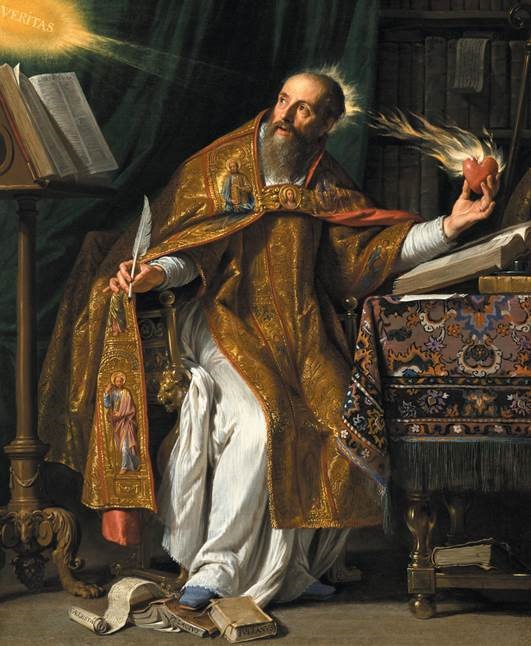
Saint Augustine of Hippo receiving the Most Sacred Heart of Jesus, painting by Philippe de Champaigne, 17th century
Saint Augustine – The City of God – Felicity
Chapter 3.—Whether the Great Extent of the Empire, Which Has Been Acquired Only by Wars, is to Be Reckoned Among the Good Things Either of the Wise or the Happy.
Now, therefore, let us see how it is that they dare to ascribe the very great extent and duration of the Roman empire to those gods whom they contend that they worship honorably, even by the obsequies of vile games and the ministry of vile men: although I should like first to inquire for a little what reason, what prudence, there is in wishing to glory in the greatness and extent of the empire, when you cannot point out the happiness of men who are always rolling, with dark fear and cruel lust, in warlike slaughters and in blood, which, whether shed in civil or foreign war, is still human blood; so that their joy may be compared to glass in its fragile splendor, of which one is horribly afraid lest it should be suddenly broken in pieces. That this may be more easily discerned, let us not come to nought by being carried away with empty boasting, or blunt the edge of our attention by loud-sounding names of things, when we hear of peoples, kingdoms, provinces. But let us suppose a case of two men; for each individual man, like one letter in a language, is as it were the element of a city or kingdom, however far-spreading in its occupation of the earth. Of these two men let us suppose that one is poor, or rather of middling circumstances; the other very rich. But the rich man is anxious with fears, pining with discontent, burning with covetousness, never secure, always uneasy, panting from the perpetual strife of his enemies, adding to his patrimony indeed by these miseries to an immense degree, and by these additions also heaping up most bitter cares. But that other man of moderate wealth is contented with a small and compact estate, most dear to his own family, enjoying the sweetest peace with his kindred neighbors and friends, in piety religious, benignant in mind, healthy in body, in life frugal, in manners chaste, in conscience secure. I know not whether anyone can be such a fool, that he dare hesitate which to prefer. As, therefore, in the case of these two men, so in two families, in two nations, in two kingdoms, this test of tranquility holds good; and if we apply it vigilantly and without prejudice, we shall quite easily see where the mere show of happiness dwells, and where real felicity. Wherefore if the true God is worshipped, and if He is served with genuine rites and true virtue, it is advantageous that good men should long reign both far and wide. Nor is this advantageous so much to themselves, as to those over whom they reign. For, so far as concerns themselves, their piety and probity, which are great gifts of God, suffice to give them true felicity, enabling them to live well the life that now is, and afterwards to receive that which is eternal. In this world, therefore, the dominion of good men is profitable, not so much for themselves as for human affairs. But the dominion of bad men is hurtful chiefly to themselves who rule, for they destroy their own souls by greater license in wickedness; while those who are put under them in service are not hurt except by their own iniquity. For to the just all the evils imposed on them by unjust rulers are not the punishment of crime, but the test of virtue. Therefore the good man, although he is a slave, is free; but the bad man, even if he reigns, is a slave, and that not of one man, but, what is far more grievous, of as many masters as he has vices; of which vices when the divine Scripture treats, it says, “For of whom any man is overcome, to the same he is also the bond-slave.”
Chapter 25.—Concerning the One God Only to Be Worshipped, Who, Although His Name is Unknown, is Yet Deemed to Be the Giver of Felicity.
Having had that reason rendered to us, we shall perhaps much more easily persuade, as we wish, those whose heart has not become too much hardened. For if now human infirmity has perceived that felicity cannot be given except by some god; if this was perceived by those who worshipped so many gods, at whose head they set Jupiter himself; if, in their ignorance of the name of Him by whom felicity was given, they agreed to call Him by the name of that very thing which they believed He gave;—then it follows that they thought that felicity could not be given even by Jupiter himself, whom they already worshipped, but certainly by him whom they thought fit to worship under the name of Felicity itself. I thoroughly affirm the statement that they believed felicity to be given by a certain God whom they knew not: let Him therefore be sought after, let Him be worshipped, and it is enough. Let the train of innumerable demons be repudiated, and let this God suffice every man whom his gift suffices. For him, I say, God the giver of felicity will not be enough to worship, for whom felicity itself is not enough to receive. But let him for whom it suffices (and man has nothing more he ought to wish for) serve the one God, the giver of felicity. This God is not he whom they call Jupiter. For if they acknowledged him to be the giver of felicity, they would not seek, under the name of Felicity itself, for another god or goddess by whom felicity might be given; nor could they tolerate that Jupiter himself should be worshipped with such infamous attributes. For he is said to be the debaucher of the wives of others . . .
Chapter 30.—Of the Eternal Felicity of the City of God, and of the Perpetual Sabbath.
How great shall be that felicity, which shall be tainted with no evil, which shall lack no good, and which shall afford leisure for the praises of God, who shall be all in all! For I know not what other employment there can be where no lassitude shall slacken activity, nor any want stimulate to labor. I am admonished also by the sacred song, in which I read or hear the words, “Blessed are they that dwell in Thy house, O Lord; they will be still praising Thee.” All the members and organs of the incorruptible body, which now we see to be suited to various necessary uses, shall contribute to the praises of God; for in that life necessity shall have no place, but full, certain, secure, everlasting felicity. For all those parts of the bodily harmony, which are distributed through the whole body, within and without, and of which I have just been saying that they at present elude our observation, shall then be discerned; and, along with the other great and marvellous discoveries which shall then kindle rational minds in praise of the great Artificer, there shall be the enjoyment of a beauty which appeals to the reason. What power of movement such bodies shall possess, I have not the audacity rashly to define, as I have not the ability to conceive. Nevertheless I will say that in any case, both in motion and at rest, they shall be, as in their appearance, seemly; for into that state nothing which is unseemly shall be admitted. One thing is certain, the body shall forthwith be wherever the spirit wills, and the spirit shall will nothing which is unbecoming either to the spirit or to the body. True honor shall be there, for it shall be denied to none who is worthy, nor yielded to any unworthy; neither shall any unworthy person so much as sue for it, for none but the worthy shall be there. True peace shall be there, where no one shall suffer opposition either from himself or any other. God Himself, who is the Author of virtue, shall there be its reward; for, as there is nothing greater or better, He has promised Himself. What else was meant by His word through the prophet, “I will be your God, and ye shall be my people,” than, I shall be their satisfaction, I shall be all that men honorably desire,—life, and health, and nourishment, and plenty, and glory, and honor, and peace, and all good things? This, too, is the right interpretation of the saying of the apostle, “That God may be all in all.”1693 He shall be the end of our desires who shall be seen without end, loved without cloy, praised without weariness. This outgoing of affection, this employment, shall certainly be, like eternal life itself, common to all.
But who can conceive, not to say describe, what degrees of honor and glory shall be awarded to the various degrees of merit? Yet it cannot be doubted that there shall be degrees. And in that blessed city there shall be this great blessing, that no inferior shall envy any superior, as now the archangels are not envied by the angels, because no one will wish to be what he has not received, though bound in strictest concord with him who has received; as in the body the finger does not seek to be the eye, though both members are harmoniously included in the complete structure of the body. And thus, along with his gift, greater or less, each shall receive this further gift of contentment to desire no more than he has.
Neither are we to suppose that because sin shall have no power to delight them, free will must be withdrawn. It will, on the contrary, be all the more truly free, because set free from delight in sinning to take unfailing delight in not sinning. For the first freedom of will which man received when he was created upright consisted in an ability not to sin, but also in an ability to sin; whereas this last freedom of will shall be superior, inasmuch as it shall not be able to sin. This, indeed, shall not be a natural ability, but the gift of God. For it is one thing to be God, another thing to be a partaker of God. God by nature cannot sin, but the partaker of God receives this inability from God. And in this divine gift there was to be observed this gradation, that man should first receive a free will by which he was able not to sin, and at last a free will by which he was not able to sin,—the former being adapted to the acquiring of merit, the latter to the enjoying of the reward. But the nature thus constituted, having sinned when it had the ability to do so, it is by a more abundant grace that it is delivered so as to reach that freedom in which it cannot sin. For as the first immortality which Adam lost by sinning consisted in his being able not to die, while the last shall consist in his not being able to die; so the first free will consisted in his being able not to sin, the last in his not being able to sin. And thus piety and justice shall be as indefeasible as happiness. For certainly by sinning we lost both piety and happiness; but when we lost happiness, we did not lose the love of it. Are we to say that God Himself is not free because He cannot sin? In that city, then, there shall be free will, one in all the citizens, and indivisible in each, delivered from all ill, filled with all good, enjoying indefeasibly the delights of eternal joys, oblivious of sins, oblivious of sufferings, and yet not so oblivious of its deliverance as to be ungrateful to its Deliverer.
The soul, then, shall have an intellectual remembrance of its past ills; but, so far as regards sensible experience, they shall be quite forgotten. For a skillful physician knows, indeed, professionally almost all diseases; but experimentally he is ignorant of a great number which he himself has never suffered from. As, therefore, there are two ways of knowing evil things,—one by mental insight, the other by sensible experience, for it is one thing to understand all vices by the wisdom of a cultivated mind, another to understand them by the foolishness of an abandoned life,—so also there are two ways of forgetting evils. For a well-instructed and learned man forgets them one way, and he who has experimentally suffered from them forgets them another,—the former by neglecting what he has learned, the latter by escaping what he has suffered. And in this latter way the saints shall forget their past ills, for they shall have so thoroughly escaped them all, that they shall be quite blotted out of their experience. But their intellectual knowledge, which shall be great, shall keep them acquainted not only with their own past woes, but with the eternal sufferings of the lost. For if they were not to know that they had been miserable, how could they, as the Psalmist says, for ever sing the mercies of God? Certainly that city shall have no greater joy than the celebration of the grace of Christ, who redeemed us by His blood. There shall be accomplished the words of the psalm, “Be still, and know that I am God.” There shall be the great Sabbath which has no evening, which God celebrated among His first works, as it is written, “And God rested on the seventh day from all His works which He had made. And God blessed the seventh day, and sanctified it; because that in it He had rested from all His work which God began to make.” For we shall ourselves be the seventh day, when we shall be filled and replenished with God’s blessing and sanctification. There shall we be still, and know that He is God; that He is that which we ourselves aspired to be when we fell away from Him, and listened to the voice of the seducer, “Ye shall be as gods,”1and so abandoned God, who would have made us as gods, not by deserting Him, but by participating in Him. For without Him what have we accomplished, save to perish in His anger? But when we are restored by Him, and perfected with greater grace, we shall have eternal leisure to see that He is God, for we shall be full of Him when He shall be all in all. For even our good works, when they are understood to be rather His than ours, are imputed to us that we may enjoy this Sabbath rest. For if we attribute them to ourselves, they shall be servile; for it is said of the Sabbath, “Ye shall do no servile work in it.” Wherefore also it is said by Ezekiel the prophet, “And I gave them my Sabbaths to be a sign between me and them, that they might know that I am the Lord who sanctify them.” This knowledge shall be perfected when we shall be perfectly at rest, and shall perfectly know that He is God.
This Sabbath shall appear still more clearly if we count the ages as days, in accordance with the periods of time defined in Scripture, for that period will be found to be the seventh. The first age, as the first day, extends from Adam to the deluge; the second from the deluge to Abraham, equalling the first, not in length of time, but in the number of generations, there being ten in each. From Abraham to the advent of Christ there are, as the evangelist Matthew calculates, three periods, in each of which are fourteen generations,—one period from Abraham to David, a second from David to the captivity, a third from the captivity to the birth of Christ in the flesh. There are thus five ages in all. The sixth is now passing, and cannot be measured by any number of generations, as it has been said, “It is not for you to know the times, which the Father hath put in His own power.” After this period God shall rest as on the seventh day, when He shall give us (who shall be the seventh day) rest in Himself. But there is not now space to treat of these ages; suffice it to say that the seventh shall be our Sabbath, which shall be brought to a close, not by an evening, but by the Lord’s day, as an eighth and eternal day, consecrated by the resurrection of Christ, and prefiguring the eternal repose not only of the spirit, but also of the body. There we shall rest and see, see and love, love and praise. This is what shall be in the end without end. For what other end do we propose to ourselves than to attain to the kingdom of which there is no end?
I think I have now, by God’s help, discharged my obligation in writing this large work. Let those who think I have said too little, or those who think I have said too much, forgive me; and let those who think I have said just enough join me in giving thanks to God. Amen.

 The Carpenter's Nail