


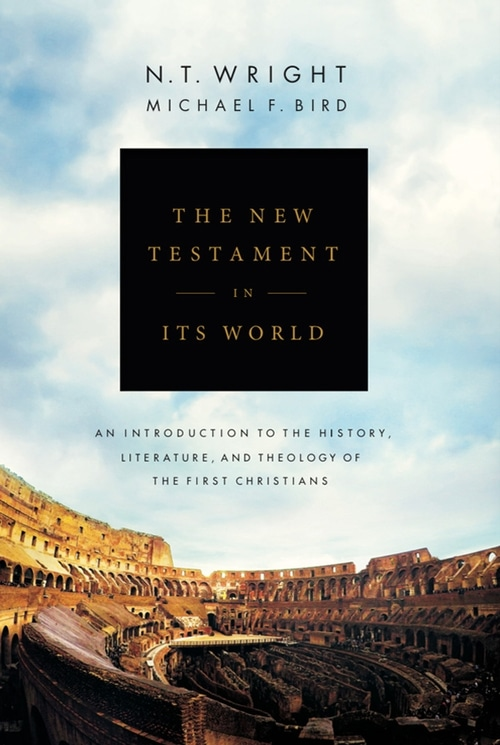


Last week we learned about the importance of studying history in conjunction with studying the spiritual and moral messages of the New Testament. NT Wright contends that without the historical context in which the New Testament is written we only gather a partial, and potentially, flawed understanding of Jesus’s message and the ways in which the first Christians sought to make that message real in their own lives.
There was also significant discussion about the differences between the modern, the post-modern, and the critical realist view of historical events. It is obvious that distance and difference exist between the “knower” and what is “known.” Wright advocates for the critical realist approach to historical understanding which acknowledges this distance and difference, and encourages students of the world of the New Testament to the use academic and scientific tools available as a means of closing that distance. There is an interplay in-between the significance of past events in the New Testament, and our ability to resource ourselves with contemporary disciplines as we undertake the task of finding what might be “known” that exists behind the curtain of time.
Given that the Bible is largely a book of stories, most of our efforts will be toward seeing such stories as “hypothesis” of scriptural fact, and then taking the contemporary tools available to us – archeology, sociology, literary theory, and branches of historical study, and deciphering the story with the advantage of these disciplines. Such an exercised does not make the message of the story “less true,” or “less meaningful,” by default; rather, it gives us greater spiritual and intellectual proximity to the world in which the story actually took place.
“Remember that the study of the New Testament as history is not an optional extra. It is a crucial part of any course of “biblical studies.””
” . . . critical realism is a way of attempting to acknowledge the possibility of historical retrieval while fully recognizing the limitations of the historical enterprise.”
“The past is a very different place. You cannot just jump from Atlanta to Antioch or leap from Rochester to Rome without doing some serious historical, hermeneutical, cultural, and social studies along the way.”{page 59}
Chapter 3 – The New Testament as Literature
This week we will take a fast walk through the various ways that the New Testament might be studied as a piece of literature – a text among texts.
“What do we mean when we say that biblical texts have meaning?” That is another way of asking – “what are we actually looking for? How do we find it?”
For most of us who read books, it is unlikely that we undertake a process of discernment any deeper than the thought, “how muck do I like what I am reading?” If we don’t like it, we don’t read it. However, given the latent authority contained in the Bible, there is a sense that we should have some deeper and more profound reasons for reading it. Wright and Bird open the conversation with the assumption that the meaning of most reading is simply a matter of the author transmitting a message via the text that is then shared with the reader –
Author . . . points to Text . . . pointed at Reader.
However with texts situated behind the curtain of time, can we always know what the author meant, can we know what the words of the text meant, without making false assumptions and providing the basis of meaning for ourselves? Various vignettes of the New Testament do not lend themselves to a simple meaning; the young man who flees the Garden of Gethsemane naked in Mark is mentioned as one such passage.
Isaiah 52 is also used to point out the difficult we face. The Servant Song of Isaiah 52 uncovers some of the problems of what the author “meant” verses how the reader ascertains what is actually being said. The writer of Isaiah may have written the Servant Song with Israel serving as the symbolic servant described in the passage. However, with the coming of Jesus and early Christians returning to the Old Testament in search of verities lending authority to the person and work of Christ, they read Isaiah’s Servant Song and see not Israel, but Jesus; even though in its original setting the writer had no direct knowledge of the “how” and the “why” of Jesus messiahship. Therefore, we acknowledge that there are places within the Bible where what the author “meant,” and what scripture actually “means,” are potentially at odds.
” . . . for Luke and Peter, it is crystal clear that Isaiah 52-53, is, in its truest sense, actually about Jesus, not (or not solely) about an 8th or 5th century BC prophet who was called to solidarity with the exiled nation.”{page 63}
The Bible displays in these case what the early Christians called the “sensus plenior {fuller sense}, by which and inspired text actually says more than the author realized at the time.”{page 63}
St. Augustine and CS Lewis, and many, many others, contend that the Bible contains an inward truth that corresponds with the search for truth that resides in the reader; and that the intentions of the author are not give implicit permission to limit the scope of what is discovered via the inspired reading of the reader.
NOTES ADDED JAN. 25, 2025
FROM PAGE 63 OF THE TEXT: “Such an approach is applied to Isaiah 53 by John Goldingay who says: Isaiah 53 is not a prophecy of the Messiah but a portrait of how Yahweh’s servant-prophet becomes the means of Israel’s being put right with God, of Israel’s personal renewal, and of the nations’ coming to acknowledge Yahweh. But one can see how the chapter came to help people understand Jesus’ significance.
Something that I found important is the third point made about getting to the root of what it means to a contemporary reader, verses what it meant to the author of the text, is the notion that early Christians, the first believers, were turning to the “stories” and messages of the Old, the First, Testament with their hearts and minds calibrated by the death and resurrection of Jesus. As Wright and Bird tell us, “they insisted that putting Jesus at the front and centre was the true and proper way of reading the Old Testament . . . that is to say they did not read their Bible prospectively, moving forward from authorial intent to messianic event . . . instead, as Richard Hays has proposed, that they read retrospectively, moving backwards from messianic event to scriptural text.”{Page 64}
Each of us have had life defining events occur in our lives; those unexpected events that give us a “before and after” sense of how our lives are unfolding. Sometimes they are joyful, sometimes sorrowful, yet on the other side of such events we find that our lives have taken the course of a “new normal,” and we are not the same being that we were before them. Most of us experience this in the midst of our family life – births, marriage, death – yet we also experience it individually – insights, triumphs, losses, hurts, healings, etc. – and for the early Christians Jesus the Christ was just such a watershed moment of transformation such that they could not read, hear, study, or consider the first messages of God to Israel without hearing our reading them through the ears and eyes of a “new normal.”
We will consider some of the tools that current “readers” of the New Testament use to try and close this distance between what the author meant at the time that he or she sat down to send a message, how that message travels through time, through the lens of Christ’s resurrection, and finds itself landing and unfolding in the midst of our own time. Below you will find some excerpts from “The New Testament In Its World” that pertain to lenses through which both scholars and laymen read the Bible in order to find ways to close the gaps on potential misunderstanding of the message. I hope that you find them useful.
Narrative criticism
“Narrative criticism has to do with the analysis of features of a text that indicate how the story means. In other words, it traces the perspectives and devices that create meaning for readers.19 These various perspectives can include those of the ‘implied author’, ‘implied reader’, ‘narrator’, and specific characters. The many devices to be employed include plot, point of view, settings, symbolism, irony, tragedy, repetition of themes, rhetoric, and intertextuality.”{Page 65}
THE ROLE OF THE IMPLIED READER ACCORDING TO NARRATIVE CRITICISM
Behind the Text we have the real and actual Author. Wright and Bird point to John’s Gospel as a good example. The actual person putting the words on the first pages of John’s Gospel titles themselves as “the Beloved Disciple.” Therefor the “implied” author of John’s Gospel, as designated by the actual writer of John’s Gospel, is this shadowy figure called the “Beloved Disciple.” And this implied author, shadow author, is writing to a group of people who have believed that Jesus is the Messiah. There are also “implied” readers, those who do not yet believe, Jews and Gentiles who will be “listening in” on the testimony of the Beloved Disciple writing to the first believers. And the actual first readers of this discourse, those who actually read it according to the historical record that we can verify, are people like those gathering in Ephesus and other diaspora locations for whom the Gospel of John was written.
Here is the forward moving trajectory of meant to meaning –
John . . . beloved disciple . . . testifier . . . believers . . . Jews and Gentiles . . . Ephesian Church
RHETORICAL CRITICISM
“Rhetorical criticism has a number of benefits for New Testament students. If we learn about ancient rhetoric, then we understand something about the literary and cultural world in which the New Testament was written. Rhetoric was always in the air, not just in the rhetorical handbooks in the academies, but in the market-place and theatre as much as in the courts. On top of that, the books of the New Testament are largely attempts at persuasion. The gospel of Mark tries to persuade readers to believe in Jesus as the Messiah not despite the cross but precisely because of it. Romans is composed to persuade the readers in Rome to embrace cross-cultural Jesus-based unity and to support Paul’s mission to Spain.”{Page 67}
CLASSIFICATION OF RHETORICAL CRITICISM{Page 68}
| Types of rhetorical proof | Types of rhetorical discourse | Parts of rhetorical speeches* |
| Ethos: appeal to moral and intellectual character | Forensic: the attempt to exonerate or indict a person or group | exordium: introduction to the subject narratio: setting forth of the facts leading to the matter of discussion propositio: statement of the thesis probatio: proofs to prove the thesis peroratio: conclusion |
| Pathos: appeal to emotion | Deliberative: the attempt to persuade or dissuade people regarding a future course of action | |
| Logos: appeal to reason | Epideictic: the attempt to bestow praise or blame on something or someone |
Criticism:
“So, while treating a text as a self-enclosed entity might be appropriate for fiction, it seems inappropriate for the genres of the New Testament, including biography, historiography, epistle, and apocalypse, especially when received in a historically situated community that believes that God spoke, and continues to speak, in and through these texts.” {Page 68}
“In any case, rhetorical criticism is not conducive to an exclusively text-centred method of interpretation, because persuasion can only ever be conceived as the influence of a speaker/author exerted upon a hearer/ reader. In other words, one cannot conceive of biblical rhetoric apart from the rhetorician and reader. Once again, we find ourselves back, not in the text by itself, but in the real world.” {Page 69}
Not all of the New Testament is a speech . . .
“There is then a family of interpretative approaches, known broadly as ‘reader-response criticism’, which allege that meaning is created by the activity of the reader. Such critics dispute the role of the text as containing and constraining meaning; what matters is the readers themselves, not least when seen within their social context.
This opens up new vistas for all sorts of readings like feminist, queer, post-colonial, psychoanalytic, Marxist, and even the eclectic, like an Eco-Evangelical-Estonian reading.29 The notion that readers bring fresh perspectives that open up a text in new ways should be obvious to anyone who has read the Bible in a multicultural context, where those who read the Bible with Asian, Latin American, or African eyes can point to elements in the text that would not be obvious to most westerners.30”{Page 70}
“The idea behind reader-centred literary theories is that the only thing to do with a text is to play with it for oneself: I must see what it does for me, and not ask whether there is another mind out there behind the text. And of course, if that is so, there is not much point discussing the text with someone else. There will be no ‘right’ or ‘wrong’ reading; only my reading and your reading.” {Page 71}
SYNTHESIS OF CRITICAL REALISM
“The best way to achieve this ‘fusion’ is, we suggest, by getting into the historical background behind the text, pursuing the authorial intentions embedded inside the text (so far as we can—this is a matter of historical reconstruction, and as such always provisional though nonetheless vital), delving into the story within the text, and prayerfully striving to live out a faithful life in front of the text.”{Page 73}
43 Augustine (Doctr. Chr. 1.36) said: ‘Whoever, then, thinks that he understands the Holy Scriptures, or any part of them, but puts such an interpretation on them as does not tend to build up into this twofold love of God and neighbor, does not yet understand them as he ought.’ See similarly on hermeneutics and love, Watson 1994, 265–87; Luz 1994, 91–6; Vanhoozer 1998, 32, 283. {Page 73}
“As a way forward, we suggest a possible hermeneutical model to consummate this fusion of horizons. It is a hermeneutic of love.43 In love, at least in the idea of agapē as we find it in the New Testament, the lover affirms the reality and the otherness of the beloved. The lover does not seek to remake the beloved into someone other than who he or she is.”{Page 73}
“In sum, this hermeneutic of love is a lectio catholica semper reformanda (a reading of and for and in the whole church, but a reading which is always in need of revising and reforming, even as such readings themselves should revise and reform the church). Such a reading seeks to be faithful to what is received, while always open to the possibility of challenge and correction.”{Page 75}

 The Carpenter's Nail