

The New Testament In Its World
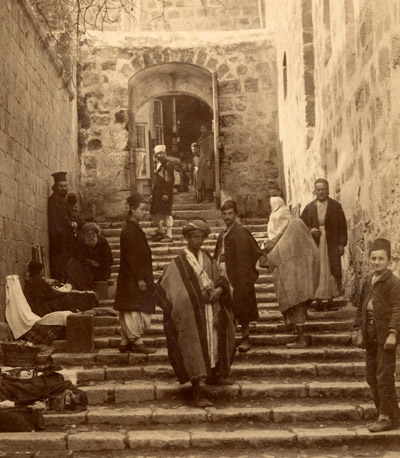
Photograph by Felix Bonfires, 1870-80 of a side entrance to the church of the Holy Sepulcher in Jerusalem. “During one of these visits we sat for a while on a bench by the wall of the Church not far from the entrance to the Holy Sepulcher. It was interesting to note the diversity of costumes and to watch the difference in the behavior of the tourists and pilgrims of the various nationalities. Palestine appeared to us to be a land where history and tradition were so curiously mixed that it was difficult to know where history ended and tradition began” A TRIP TO THE ORIENT, Robert Jacob – 1907.
“[T]o write a New Testament theology is to preside at a conference on faith and order. Around the table sit the authors of the New Testament, and it is the presider’s task to engage them in a colloquium about theological matters which they themselves placed on the agenda.” – G. B. Caird, {George Bradford Caird (17 July 1917 – 21 April 1984), D.Phil., D.D., FBA, was a British churchman, theologian, humanitarian, and biblical scholar. At the time of his death he was Dean Ireland’s Professor of the Exegesis of Holy Scripture at the University of Oxford.}
THE NEW TESTAMENT AS THEOLOGY – Notes on Chapter 4, The New Testament In Its World
Some highlights and things to think about from this chapter:
These are some of the questions that NT Wright and Mike Bird raise in conjunction with this chapter.
What does it mean when the risen Jesus says in Matthew’s Gospel – “All authority in heaven and on earth has been given to me?”
Why does the New Testament need both historical description and theological prescription?
If the authority of the New Testament derives from the its message, its theology, then what are the central tasks in any exposition of New Testament theology?
How does New Testament theology help churches grow disciples and address the wider world with its message?
These questions are found in the workbook that is attached to this study.
THE NEW TESTAMENT AS A THEOLOGICAL DISCOURSE:
I have always lived with the assumption that when any person seriously opens the Bible, they are essentially opening their own window upon how God is choosing to be made know to them in the midst of their life and the world. There is an old trope – “the Bible is God’s love letter to each of his children.” And so when we open our New Testaments, I imagine that each of us have our eyes and ears tuned to the unique way that we encounter a story, and we have a particular “God shaped hole” into which the Bible is pouring its message of hope and redemption.
That is why some will first hear the historical aspects of a reading, others may be tuned into the theological aspects of a reading; some will hear the more “human” tone to Jesus’s voice, while others are listening for the messianic, and Christological, tonality of Jesus’s words. And then there is the question of reading what is obvious on the surface, verses reading with what we know is a deeper theological message of salvation that is contained with every vignette upon each page.
Adolf Schlatter (1852–1938) was a leading German New Testament scholar in the late nineteenth and first half of the twentieth century. He eschewed the dominating liberal theology of the day and strove to allow the theological vision of the New Testament to speak when many were calling for an atheistic approach to biblical studies. Schlatter (1973, 122) wrote:
“The word with which the New Testament confronts us intends to be believed, and so rules out once for all any sort of neutral treatment. As soon as the historian sets aside or brackets the question of faith, he is making his concern with the New Testament and his presentation of it into a radical and total polemic against it.”
Essentially the “existential,” or spiritual, question for any student of the New Testament is whether or not we read these books as persons who “give the benefit of the doubt” in terms of faith and authority to those who both produced the books of the New Testament, and the corresponding institution which has both maintained and cherished these books through time.
“The caveat we must offer is that the ultimate authority is God, the creator, and since God has revealed himself in Jesus, then Jesus is the one who holds all authority. Jesus did not tell his disciples that all authority is vested in the books that they would write; he insisted that it was vested in his own person.” The footnote attached to this statement: Mt. 28.18. Many will object that this is a false antithesis that plays off Jesus against the Bible, the assumption being that what we know about Jesus we know only in the biblical writings so the biblical writings must be our primary authority. The problem is that this confuses epistemology (‘how we know’) with authority (‘who’s in charge’). While a map will be my best guide to get to church on time, when I get there I’ll find a vicar rather than the map running the place.
I will not try to convince anyone that Jesus is being “made incarnate,” somehow mystically embodied, in the psychic and soulful reading that the believing Christian brings to reading the New Testament; convince them that it is indeed a “living word.” If asked, I will generally just share my experiences, and then offer a prayerful thought that they are embarked on their own discovery. Nor will I will try to convince someone that the scriptures themselves, both written and maintained, are “watched over” by the presence of one we call the Advocate and Guide, the Paraclete, the Holy Spirit, but I have been so convinced. Given that I believe what the scriptures say about us as human beings – that we are largely as we are described in the Bible – I take it on faith, and more and more on experience, the God in Christ is also akin to what is described in scripture.
“The whole point of Christianity is that it offers a story which is the story of the whole world. It claims to be public truth, not a private self-serving and self-referential cult. The church’s job, then, is to know this truth, to live by it, and to make this truth known and put into operation across the globe.” Wright and Bird.
“To put it simply, New Testament theology is necessary to describe what it is about the New Testament that is authoritative and to define the activism that should characterize the church as a participant in God’s plan, namely the intention (as in Eph. 1.10) to sum up in the Messiah all things in heaven and on earth.” {Wright and Bird}
“The New Testament is history and theology mixed together—for the very good reason that the faith which the first Jesus-followers inherited from ancient Israel and reshaped around Jesus himself was all about the coming together of heaven and earth. Splitting them apart, as has so often been done, is a sign of our times, more specifically of the Enlightenment’s separation of timeless truths from contingent historical realities, whether by sceptics or by their devout opponents. The challenge in studying the New Testament today is to do justice to both, to history and theology alike, disregarding neither and constantly seeking their intended fusion.” {Wright and Bird}
Essentially we are involved in a project of “both-and”; both history and theology, because the two have grown like seeds planted in the one hole in the ground called the “Israel-Messiah-Christ” tree of salvation. Of course we can spend time and energy untangling the branches, identifying the unique fruits of each history and theology, but there will always be a moment when we step back and simply accept the whole as a unique and divine gift from God.
Historical particulars – Jewish life, customs, taboos, rules around eating, sleeping, working, and socializing – they are all intertwined with what Jesus is actually trying to teach and manifest in the midst of his human life; therefore to understand the “message,” we are only enriched by understanding more deeply the life that was lived by “the messenger.”
In fact, when the various biblical writings are read individually, or studied in the context of the biblical canon, or infused into the life of a believing community, they naturally lend themselves to theological formulation, and raise at once the important question of application. It may be fashionable to say that there is no single theology of early Christianity to study, but before too long the early church did opt for what they saw as a single theology, and they called it ‘the Holy Scriptures’. In the words of Bockmuehl again:
“At the end of the day, when everything is said and done about the genetic vagaries of the New Testament canon’s formation, it remains an equally historical phenomenon that the church catholic came to recognize in these twenty-seven books the normative attestation of its apostolic rule of faith.”
DISCIPLESHIP AS DEFINING THE AUTHORITATIVE STORY AND LIVING IT OUT:
This is an important paragraph:
New Testament studies has a two-pronged approach of doing both ‘history’ (the descriptive part) and ‘theology’ (the prescriptive part). Our task is accurately to describe the world behind and inside the text, in order to then shape the world—our world—in front of the text. ‘History’ attempts to trace the stories and beliefs of the early church which formed the backbone of its worldview, while ‘theology’ subsequently explains the God-dimension of that worldview with all its corollaries. What this means is that the Christian reader of the New Testament is committed to two tasks, mapping ‘early Christian history’ and then pursuing ‘New Testament theology’, while remembering that neither of these tasks can be self-sufficient. They are in fact mutually dependent. {Wright and Bird}
But if we are right, then history and theology need each other. A good cup of coffee does not consist of hot water on the one hand and coffee grounds on the other, the former to be sipped and the latter to be chewed, but a proper fusion of the two together. {Wright and Bird}
As I have mentioned elsewhere, something that caught me in the initial reading of this book is the way Wright and Bird talk about the New Testament as a “story,” a small “series,” which calls for a “self-involving performance.” My sense is that if we are not reading the New Testament with our “invitation to the party” in our own hand, then we are perhaps not reading it in its fullness. We have a part and role to play in helping the text reach its highest and deepest meanings – that is the participation of our heart, souls, minds, and bodies.
Understanding this and living it out is quite a challenge, as every generation of Christians discovers. But there is no alternative, nor should we seek one. As in a theatre where the actors have to understand ‘the story so far’ and then improvise their way faithfully towards the intended conclusion, the New Testament calls for a self-involving performance of its text, in which we, the actors, will ourselves be transformed, perhaps painfully. That is because, as Joshua Jipp puts it, New Testament theology is ‘inherently self-involving as it summons the reader to believe, confess, obey, and understand the entirety of one’s existence—both her or his thinking and willing—in light of the God revealed in the text’. {Wright and Bird}
“Like an orchestral score or an operatic libretto, the New Testament calls for a self-involving performance of its text characterized by a declaration of its testimony, the imitation of its way, and the transformation of the cast. Theology instructs us in how to use the New Testament as the script for the people of God, who perform their role in the gospel-shaped ensemble (that is, the local church) in which God has put them. Theology, in other words, enables us to use the New Testament as the basic script for the mission and life of the people of God—the local church, the global church, and every member within them.” {Wright and Bird}
Sometimes I remind myself and others that reading books about prayer, and praying, are generally two different things; in terms of scripture, reading the Bible as though your life depended upon it, or as though your dissertation and opinions depended upon it, are two different things.
Blessings and Godspeed.

 The Carpenter's Nail