
THE GOSPELS: THE LORD HAS RISEN
The reader might at this point be wondering why we did not begin with the resurrection narratives in the gospels, rather than starting with Paul. The reason is that Paul’s letters pre-date the gospels by between ten and forty years, depending on the uncertain dating of the latter. Paul’s letters show us vividly the type of things Christians were saying about Jesus’ resurrection within a short time of the events. The gospels were written in a period when the early church, diverse as it was, had already been well shaped by the gospel, particularly by the belief in Jesus’ resurrection. Our task now is to survey the Easter stories themselves, noting their distinctive features and assessing their origins and credibility.
THE ORIGINS OF EASTER
Having noted that the four gospels almost certainly reached written form some time after Paul’s letters, we should also note that the Easter stories themselves show several signs of reflecting much earlier tradition.
1. The stories lack scriptural embellishment. This is very surprising if they emerged relatively late from within a scripture-reading early community, whose members were making up stories of a bodily resurrection to bolster their beliefs in Jesus. If, as a first-century scripture-reading writer, you started with Paul’s theology, or indeed with that of Revelation or Ignatius of Antioch, and tried to turn that theology of resurrection into an artful, just-as-if-it-happened-yesterday sort of narrative, it would be extremely difficult to avoid reference to scripture. As Paul himself says, quoting very early tradition, the first Christians believed that Jesus’ resurrection was ‘according to scripture’,2 and we can see in 1 Corinthians and elsewhere the kinds of scriptural references he had in mind. Yet the Easter narratives remain scripturally unadorned. They are not littered with quotes of scriptural fulfilment and ancient prophecies come good
2. The burial of Jesus, and the discovery of the empty tomb, can be regarded as historically solid. While it is true that many victims of crucifixion were not properly buried, especially during times of war (they were left as carrion for vultures and wild dogs, or dumped in open graves), we know that many victims of crucifixion did indeed receive a proper burial. Roman officials were known to release the bodies of condemned criminals to their families particularly during festivals, as Philo attests.3 Take the famous example of Yehohanan ben-Hagkol. Yehohanan was a first-century Judean man who died by crucifixion and whose bones were discovered in Jerusalem in 1968 in an ossuary box with his name on it, a nail still lodged in his ankle bone. Roman governors of Judea were probably inclined more often than not to support Jewish burial customs about not leaving victims of execution hanging after sunset lest it cause further commotion (see Dt. 21.22–23).
3. The Easter narratives seem to reflect a mixture of eye-witness enthusiasm and strange bewilderment as to what had actually happened. Eye-witness testimony is pasted all over the narratives. The women are prominent in all of the gospels: they saw Jesus die, watched his body being laid in the tomb, discovered the tomb empty, and encountered an angel (or two). The evangelists do indeed diverge in some details, like which women were there (Mary Magdalene, Mary the mother of James, Salome, Joanna?), but that is no reason to brush them aside. Richard Bauckham comments:
The divergences . . . have often been taken as grounds for not taking them seriously as naming eyewitnesses of the events. In fact, the opposite is the case: the divergences, properly understood, demonstrate the scrupulous care with which the Gospels present the women as witnesses.
4. The wide breadth of people who saw Jesus is also telling. The appearance of Jesus to Simon Peter is significant in the tradition as it is reported by Paul, intimated by Mark, mentioned in passing by Luke, and amplified by John.10 An appearance to James, which Paul mentions, is interesting too, since Jesus’ family had been alarmed by his work. So far as we know, at no point prior to Easter had James been a follower of Jesus; yet he quickly became a key leader in the Jerusalem church.11 In addition, Jesus is said to have appeared not just to individuals but to groups of disciples, two on the road to Emmaus,12 the Eleven in an upper room,13 several on a beach in Galilee,14 and even up to five hundred all at once.15 What is more, the Easter narratives are saturated with realistic responses by people experiencing moments of confusion,16 as well as feelings of fear and joy,17 while doubt persisted for some even after the appearances.18 One gets the impression that the evangelists were really struggling to explain what it was that they and their colleagues had actually seen; they knew full well that the events they were describing were unprecedented to the point of being unbelievable. They have the feel of people saying, ‘I didn’t understand it at the time, and I’m not sure I do now, but this is more or less how it was.’ Looking at the appearances as a whole, the very strong historical probability is that, when Matthew, Luke, and John describe the risen Jesus, they are writing down very early oral tradition, representing three different ways in which the original astonished participants told the stories.
5. We have to wrestle with the question of why the early Christians said ‘Jesus is risen’ if all they had intended to describe was a hallucination, a vision, or a vague belief that Jesus had ascended post-mortem into some heavenly, otherworldly realm. The word ‘resurrection’ has a specific meaning and it is precisely not any of those things. Resurrection did not mean, ‘I have a warm feeling in my heart that our dear friend Yeshua ben-Yoseph is now safely arrived into the bosom of Abraham.’ Rather, ‘resurrection’ means the standing up of a dead corpse, a body coming back to life—a belief that was as precise as it was contested. And yet resurrection was thought to be something that God would do for all of Israel at the end of history, while the disciples claimed that God had done it for Jesus of Nazareth in the middle of history.
6. A further sign that the Easter stories in the four gospels go back to very early, pre Pauline tradition is the remarkable absence in them of any mention of the Christian future hope. As we have just noted, thinking through that question was an important part of Paul’s work and teaching, and at more or less every other point in the New Testament where Jesus’ resurrection is expounded so too is there an exposition of the Christian hope to share in that resurrection. But at no point in the Easter stories in the gospels, or indeed in the opening chapter of Acts, is that even mentioned.
7. Another similar point concerns the portrait of Jesus in the stories. If, as many have suggested, the Easter stories were invented by people who knew their scriptures and the Jewish traditions which developed them, the two models that might have influenced the writing would be Daniel 12, in which the righteous will shine like stars, or Ezekiel 37, where the dead are remade from the bones outwards, with God’s breath finally animating them. Later traditions developed these in various ways. At no point in the four gospels is Jesus’ resurrection described in such fashions. Rather, we have something new, unanticipated: Jesus as a real human being, able to eat and drink, to break bread, to be touched—and at the same time to come and go through locked doors, to appear and disappear, and finally to go into ‘heaven’, that is, God’s dimension of reality, with the promise of return.
8. It is important to think historically about how the early traditions might have developed.By themselves, neither the empty tomb alone nor the resurrection appearances alone could have generated belief in Jesus’ resurrection.19 If there had been an empty tomb, but no appearances of Jesus, then the members of the early church might have said that Jesus had been taken into heaven—but they would not have spoken of that as a ‘resurrection’. More likely, they would have concluded, like Mary in John’s gospel and like the story the soldiers were instructed to tell in Matthew, that someone had removed Jesus’ corpse. Equally, if there had been various appearances of Jesus while it was obvious that his body was still in the tomb, then the early believers might have said that Jesus’ spirit or his angel had appeared to them in a vision, as they said when they thought Peter had died but heard him knocking on the door.
MARK: FEAR AND TREMBLING
Mark’s resurrection narrative, assuming for the moment that the ‘longer endings’ normally designated Mark 16.8b and 16.9–16 are secondary additions, ends in a peculiar way. The women leave the tomb in fearful confusion: ‘Trembling and bewildered, the women went out and fled from the tomb. They said nothing to anyone, for they were afraid.’21 If this verse does represent the end of Mark’s gospel, as our best textual witnesses indicate, was it Mark’s intention to break off right there? Did he really intend his whole gospel, admittedly in rough Greek, to end with the words ephobounto gar, ‘for they were afraid’?
We note, first, that the longer endings are indeed unlikely to be authentic. The earliest manuscripts of the gospels, the great fourth-century codices Sinaiticus and Vaticanus, conclude with Mark 16.8. They are followed by several later manuscripts. Some of the early Fathers of the church either show no knowledge of the longer ending or show, even while reproducing it, that they know it to be dubious. (Unfortunately, Mark is the least well attested of all the gospels in the manuscript tradition, so we have a smaller pool of manuscripts to draw from.) But the great fifth-century manuscripts, led by Alexandrinus, include the ‘longer ending’ (Mk. 16.9–20), and most subsequent manuscripts follow this lead. In addition, four manuscripts from the seventh, eighth, and ninth centuries, and some later ones, insert the so-called ‘shorter ending’, in effect verse 16.8b; and all except one of these then continues with the ‘longer ending’ as well. A good many of the manuscripts that do contain the longer ending, however, have marks in the margin, such as asterisks and the like, to indicate that the passage is regarded as of doubtful authenticity. In coming to a verdict, the apparently independent omission in the two fourth-century manuscripts, coupled with all the other scattered evidence, makes it highly unlikely that the longer endings are original.
Some have claimed that Mark intended his ending to be deliberately ambiguous, almost parabolic. He was not interested in giving the readers closure; rather, readers had to figure out for themselves what the empty tomb and angelic news meant. Would they run away in fear like the women, or would they have faith and believe that Jesus was truly risen? Mark gives them the options, but not the answer. This all sounds well and good in our supposedly sophisticated reading world. It provides a tantalizing postmodern reading of Mark’s strange ending. But it may be a bit too clever to be true.
We need to place the fear and silence in Mark 16.8 within the wider pattern of Mark’s gospel where similar injunctions to silence lead to the broadcast of news. For example, when in Galilee, Jesus said to a man who had been healed, ‘See that you say nothing to anyone; but go, show yourself to the priest.’22 If we plot Mark 16.8 as part of the familiar Markan pattern of silence to outsiders but dissemination of news to an intended audience, then perhaps we should anticipate something like, ‘They said nothing to anyone else, but went andtold the disciples.’23 Confirmation for that possibility is that in Mark moments of fear become opportunities for expressing faith and engaging in action.
Another option is that Mark 16.8 is not the original ending to the gospel of Mark, but that there was an original longer ending that is now lost. As we have just seen, a more expansive ending, where the women said nothing to anyone but then told the disciples, fits naturally into the Markan secrecy motif and the pattern of fear and faith that Mark has constructed throughout his gospel.
Mark’s gospel, in its extant form, ends on the notes of fear and trembling, but might well have contained additional material about the son of man being raised from the dead and appearing to the disciples, all as further proof of Jesus as the divinely sent prophet who opposed the Jerusalem Temple. That ending, somewhere and somehow, is now lost to us. Many ancient texts—the Dead Sea Scrolls are good examples—lack a beginning and an end. Those are the parts of a scroll which get torn off or rot away. Perhaps that’s what happened with Mark.
MATTHEW: EARTHQUAKES AND ANGELS
Matthew goes his own way and poses his own problems. He has two stories which mark him out from the other gospels: sleeping saints walking out of their tombs and a guard of soldiers who get bribed to spread rumours. In the middle of all this, we have a story of the finding of the empty tomb, quite similar to Mark’s, though with significant differences. Matthew’s narrative then concludes with a final commissioning on a mountain in Galilee.
The earth shook, the rocks split and the tombs broke open. The bodies of many holy people who had died were raised to life. They came out of the tombs after Jesus’ resurrection and went into the holy city and appeared to many people.26
This is a strange story, not mentioned elsewhere, either in the gospels or outside them. That is part of the problem; another part is that the story is inherently not just shocking and unexpected but also very peculiar: if the dead saints came to life, but did not come out of their tombs until after Jesus’ resurrection, how did anyone know? One could say that some stories are so odd that they may just have happened. This may be one of them, but in historical terms there is no way of finding out. Alternatively, as Michael Licona suggests, Matthew might here be drawing on some apocalyptic ‘special effects’, using portents of darkness and resurrections as a dramatic way of saying that a great king has died, or that the ‘Day of the Lord’ has come.27 Or perhaps Matthew is blending the present and future together in a kind of eschatological melange, with Matthew previewing the future resurrection and underscoring the life-giving power of Jesus’ death.
Second, another story which spills over from Matthew’s Passion sequence is the vignette where the Pharisees request that Pilate should place an additional guard at Jesus’ tomb to stop the disciples from stealing the body. But then, when the resurrection happens, the guards fold up like a card table, Jesus’ body disappears from the tomb, and the chief priests and elders scramble to bribe the soldiers, telling them to spread the rumour that the disciples stole the corpse.29
The story, obviously, is part of an apologia for the bodily resurrection of Jesus. It is an attempt by Matthew to ward off any suggestion that the disciples had in fact stolen the body, which must have seemed the most natural explanation for the tomb’s being empty. What should be borne in mind is how implausible it is to suppose that the whole story would have been invented in the first place, let alone told and finally written down, unless there was already a rumour going around about a disappeared body, with speculation as to who might be responsible.
Justin reports that the story was still being told by anti-Christian Jewish apologists in the mid-second century.30 If the empty tomb itself were simply a late legend, it is unlikely that people would have spread stories about body-stealing in the first place, and doubly unlikely that Christians would have employed the dangerous tactic of reporting such stories in order to refute them. We remind ourselves again of one thing which the story reinforces: resurrection meant bodies. It did not mean ‘spiritual survival’ or a new religious experience for friends of the deceased.
Third, Matthew’s final scene (Mt. 28.16–20) is highly significant as it condenses so many Matthean themes. The main emphasis of this closing paragraph is upon who Jesus is now revealed to be, the one who has been granted ‘all authority in heaven and on earth’—virtually identical in phraseology to the kingdom-clause in the Matthean version of the Lord’s Prayer.31 This, it seems, is how the prayer is being answered; this, in other words, is how the kingdom is coming, how the will of the ‘father’ is being done. The significance of the resurrection, as far as Matthew is concerned, is that Jesus now holds the role that had been marked out for the Messiah in Psalms 2, 72, and 89, which became concentrated in such imagery-laden figures as the ‘son of man’ in Daniel 7 (v. 18 echoes Dan. 7.14) and the texts which developed that line of thought.
Matthew has written, through and through, a book of Jewish history and theology. His whole thesis is that Israel’s God has been at work in Jesus, a point proved climactically and decisively by his resurrection. Matthew believed, every bit as much as did Paul, that Jesus really did rise from the dead, leaving an empty tomb behind him, and that he was now invested with all authority in heaven and on earth.
Additional Quotes added May 30, 2025
LUKE: BURNING HEARTS AND BROKEN BREAD
Like the other evangelists, Luke is telling the Easter stories in his own way. He feels himself free to shape them and point up particular lessons, repeated in each section of the chapter. Luke has followed Mark in many ways throughout his gospel, but he cheerfully departs from him here, with no mention of the disciples being told to go to Galilee, and no hint of resurrection appearances anywhere other than in and near Jerusalem. Luke names three women as the early visitors to the tomb: Mary Magdalene, Joanna, and Mary the mother of James; but he also speaks of ‘the others with them’ (Lk. 24.10). There is no mention of the women seeing Jesus, as they do in Matthew, and as Mary Magdalene does in John. The women fulfil their commission to tell the disciples, but ‘their words seemed to them an idle tale, and they did not believe them’ (Lk. 24.11). Most noticeably perhaps, among incidental features of the chapter, the entire sequence of resurrection appearances, culminating in the ascension itself, appears to take place on a single day. Luke also has unique material: he refers to a resurrection appearance to Peter (Lk. 24.34), provides particular emphasis on the physicality of Jesus’ resurrection body (Lk. 24.38–43), and uses the Emmaus story as the central vehicle by which to convey his message about Easter and its meaning (Lk. 24.13–35).
Across the narrative, Luke highlights two features: the fresh exposition of scripture and the breaking of bread. The hearts of the two on the road to Emmaus are burning within them at the first of these; their eyes are opened at the second (Lk. 24.27, 32, 35). Then, in the upper room, Jesus ‘opened their minds to understand the scriptures’ (Lk. 24.25).
John’s two Easter chapters rank with Romans 8, not to mention the key passages in the Corinthian correspondence, as among the most glorious pieces of writing on the resurrection. John lacks the rigorous logic of Paul’s ‘Therefore . . .’ at the end of a long and gritty argument, and John’s Easter narrative is comparatively more dramatic and more laden with deeper symbolism than the synoptic accounts. He provides a breathtaking synthesis of theological testimony, early tradition, apostolic memory, and vibrant metaphor, unmatched elsewhere in the New Testament. John’s gospel ends with new-found faith, but it is faith that must now go out into a new world, a risky resurrection-faith facing a new day, and must attempt new tasks without knowing in advance where it will all lead.
The basic features of John’s Easter story are easily laid out. The initial story of the finding of the empty tomb (Jn. 20.1–18) overlaps in content with that of the synoptics, but it is the differences that stand out: Mary Magdalene is mentioned alone among the women, and she meets Jesus (as the women do in Matthew). As in Luke 24.12, Peter runs to the tomb on hearing the news; but in this gospel he is accompanied by the ‘beloved disciple’, and in a dramatic scene they run together, with the beloved disciple getting to the tomb first.
Next follow two stories set in the evening in the upper room: the first on the same day as the events in the garden; the second a week later. The first (Jn. 20.19–23) seems to correspond, in content though not much in wording, with Luke 24.36–49: Jesus commissions his followers for a mission to the world, and bestows the spirit on them to equip them for the task. The second presents a scene beloved of artists, ancient and modern. Thomas, who was not present on the first evening, acquires his now perpetual nickname by declaring his doubt that the lord has truly risen, and is then confronted by the risen Jesus inviting him to touch and see for himself. Thomas refuses the invitation, blurting out instead the fullest confession of faith anywhere in the whole gospel: ‘My lord and my God’ (Jn. 20.28). Jesus makes a wry comment, the scene is over, and so too is the book in its original form.
But it is not the end. John 21 provides more appearance-stories, this time set in Galilee. John, just like Matthew, has Jesus appear in both Jerusalem and Galilee, though the appearances are far fuller, and the Galilee appearance is by the lakeshore, not on the mountain. Peter and six others of the disciples go fishing and catch nothing; Jesus, unrecognized, directs operations from the shore, as once before in Luke’s gospel, resulting again in a spectacular catch. Coming ashore, they find Jesus already cooking breakfast and inviting them to share it. ‘None of the disciples’, comments the author, ‘dared ask him, “Who are you?” They knew it was the lord’ (Jn. 21.12 NTE/KNT [amended]). Jesus then takes Simon Peter for a walk along the shore, and asks him three times if he loves him, corresponding to Peter’s triple denial in John 18. Receiving a triple ‘Yes’ for reply, he commissions Peter to be a kind of under-shepherd, which will require him, too, to face suffering. Then, seeing the beloved disciple following them, they have a brief exchange about him (‘Lord, what about this man?’) which leads to the open-ended challenge, ‘What is that to you? You must follow me!’ This leads straight into the ending, which we have already noted.
John’s gospel is supremely a gospel of witness, giving its testimony to Jesus’ resurrection and the constellation of meaning and mission that it generates. It matters for John that Easter actually happened; it is not just a theological idea or an inner experience of the disciples. Precisely because he is an incarnational theologian, committed to recognizing, and helping others to recognize, the living God in the human flesh of Jesus, it is vital and non-negotiable for John that when Thomas makes his famous confession in John 20.28 he should be looking at the living God in human form, with the eye not simply of faith, but of ordinary human sight, which could be backed up by ordinary human touch—though Thomas, it seems, remained content with sight. Similarly, the 153 fish that Simon Peter dragged up on the shore may well be intended to symbolize something (though interpretations of this have always varied), but the man who cooked breakfast for the disciples was a living person, Jesus, not an allegory of faith. The evangelist reiterates the point by saying that this was the third resurrection appearance of Jesus to the disciples (Jn. 21.11–14). There is, in other words, nothing about John 20—21, seen in the context of the gospel as a whole and particularly of the prologue which it balances so well, to suggest that these stories originated as, or would have been heard by their first hearers as, an allegory or metaphor of spiritual experience. John believes that the Word was made flesh, that he was crucified in this flesh, and that he was bodily raised on the third day.
HE IS RISEN!
The historical verdict before us is this: prevalent and pervasive in the early church was the belief that Jesus of Nazareth had been bodily raised from the dead by the God of Israel. This conviction constituted the axis upon which their prayers, praise, praxis, narrative, symbols, and confession all turned; it was the basis of their recognition of Jesus as Messiah and lord, their insistence that the creator God had inaugurated the long-awaited new age, and above all it provided the pledge for their own hope in Jesus’ return, the resurrection of all believers, and God putting all things to right.
FIRST:
The resurrection constitutes Jesus as the world’s true sovereign, the ‘son of God’ who claims absolute allegiance from everyone and everything within creation. Jesus is the one in whom the living God, Israel’s God, has become personally present in the world, has become one of the human creatures that were made from the beginning in the image of this same God. He is the start of the creator’s new world: its pilot project, indeed its pilot.
SECOND:
It is self-involving. It means trusting in God, in this God, who raises the dead, who calls for a commitment to discipleship and to the worldwide mission that the resurrection has launched. Resurrection faith calls people to new tasks embodying Jesus’ kingdom-praxis, belonging to the renewed covenant-family, and proclaiming Jesus as lord and saviour. For Christians, the road to Emmaus is not just a story. It is a way of life.
THIRD:
Third, resurrection generates a counter-cultural perspective. No wonder the Herods, the Caesars, and the Sadducees of this world, ancient and modern, were and are eager to rule out all possibility of actual resurrection. They are, after all, staking a counter-claim on the real world. It is the real world that the tyrants and bullies (including intellectual and cultural tyrants and bullies) try to rule by force, only to discover that in order to do so they have to quash all rumours of resurrection, rumours that would imply that their greatest weapons, death and deconstruction, are not after all omnipotent (see ‘Blast from the past: John Chrysostom on the resurrection’).
John Chrysostom’s famous Paschal homily is read every Easter in Orthodox churches. It contains these moving words about the resurrection:
He has destroyed death by undoing death.
He has despoiled Hades by descending into Hades.
He vexed it even as it tasted of His flesh.
Isaiah foretold this when he cried:
Hades was filled with bitterness when it met Thee face to face below;
Filled with bitterness, for it was brought to nothing;
Filled with bitterness, for it was mocked;
Filled with bitterness, for it was overthrown;
Filled with bitterness, for it was put in chains.
Hades received a body, and encountered God.
It received earth and confronted heaven.
O death, where is your sting?
O hell, where is your victory?
It is the real world that, in the earliest stories of Jesus’ resurrection, was decisively and for ever reclaimed by that event, an event which demanded to be understood, not as a bizarre miracle, but as the beginning of the new creation. It is the real world that, however complex this may become, historians are committed to studying. And, however dangerous this may turn out to be, it is the real world in and for which Christians are committed to living and, where necessary, dying. Nothing less is demanded by the God of creation, the God of justice, the God revealed in and as the crucified and risen Jesus of Nazareth.
WALKING THE ROAD TO EMMAUS IN A POSTMODERN WORLD
Mission and evangelism were never meant to be a matter of throwing doctrine at people’s heads. They work in a far more holistic way: by praxis, symbol, and story, pointing beyond the world the way it is to the new world that has been uncomfortably launched within creation by the creator God acting in his son and now by his spirit. We must get used to telling the story of God, Israel, Jesus, and the world as the true metanarrative, the story of healing and self-giving love. We must get used to living as those who have truly died and risen with Christ, so that our self, having been thoroughly deconstructed, can be put back together, not by the agendas that the world presses upon us but by God’s spirit.
To drive us towards this goal, we end with a parable, returning once more to the story of the Emmaus road. This parable functions against the background of one of the great symbols of secular modernism, Matthew Arnold’s poem ‘Dover Beach’. There Arnold describes from his late-nineteenth-century perspective the way in which what he calls ‘the sea of faith’ has emptied; the tide has gone out; all we can hear is the ‘melancholy, long, withdrawing roar’ of the distant sea, leaving us in the gloom where, all too prophetically, ignorant armies clash by night.
Two serious-minded unbelievers are walking home together, trying to make sense of the contemporary world. The dream of progress and enlightenment has run out of steam. Critical postmodernity has blown the whistle on the world as they knew it. Yet postmodernity has provided no solution for, or even comfort to, the world in its current state, beset as it is with Islamic extremism, with a widening gap of rich and poor, with myths of a secular utopia (‘if only we could get religion out of the public sphere!’), and with resurgent cultural imperialism and crooked forms of capitalism.
Our two unbelievers walk along the road to Dover Beach. They are discussing, animatedly, how these things can be. How can the stories by which so many have lived have let us down? How shall we replace our deeply ambiguous cultural symbols? What should we be doing in our world now that every dream of progress is stamped with the word ‘Babel’?
Into this conversation comes Jesus, incognito. ‘What are you talking about?’ he asks. They stand there, looking sad. Then one of them says, ‘You must be about the only person in town who doesn’t know what a traumatic time the twenty-first century has been. Nietzsche, Freud, Foucault, and Derrida were quite right: life is empty. We thought we’d brought peace to the middle east through war, and we’ve had nothing but more wars ever since. We had a sexual revolution, and now we have an epidemic of sexual harassment, and more lonely and confused people than ever before. We are so connected with one another through social media that we ignore the people sitting in front of us. We pursued wealth, but we had the global financial crisis and ended up with half the world in crippling debt. We can do what we like, but we’ve all forgotten why we liked it. Our dreams have gone sour, and we don’t even know who “we” are any more. And now even the church has let us down, corrupting its spiritual message with talk of cosmic and political liberation.’
‘Foolish ones,’ replies Jesus. ‘How slow of heart you are to believe all that the creator God has said! Did you never hear that he created the world wisely? And that he has now acted within his world to create a truly human people? And that from within this people he came to live as a truly human person? And that in his own death he dealt with evil once and for all? And that he is even now at work, by his own spirit, to create a new human family in which repentance and forgiveness of sins are the order of the day, and so to challenge and overturn the rule of war, sex, money, and power?’ And, beginning with Moses and all the prophets, and now also the evangelists and apostles of the New Testament, he interprets to them in all the scriptures the things concerning himself.
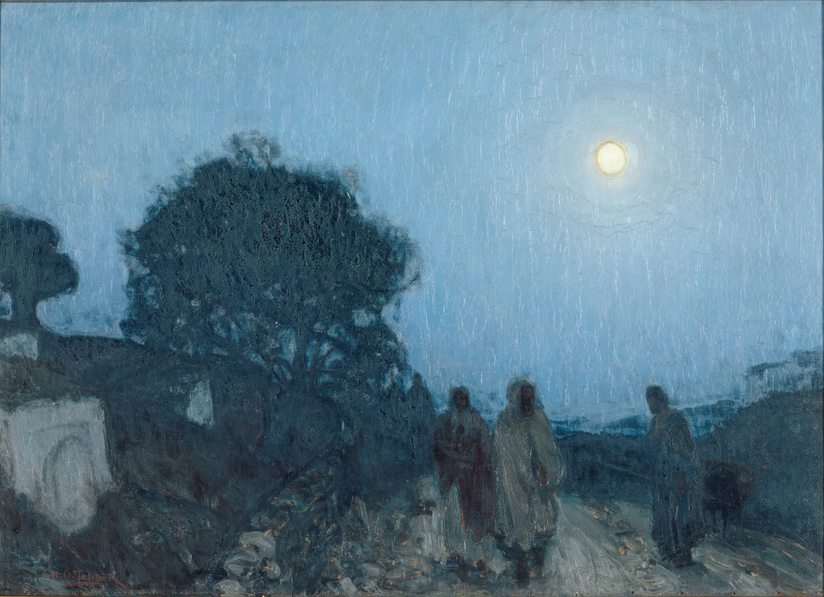
They arrive at Dover Beach. The sea of faith, having retreated with the outgoing tide of modernism, is full again, as the incoming tide of postmodernism proves the truth of Chesterton’s dictum that when people stop believing in God they don’t believe in nothing, they believe in anything. On the shore there stands a great hungry crowd—people who had cast their bread on the retreating waters of modernism only to discover that the incoming tide had brought them bricks and centipedes instead. The two travellers wearily begin to get out a small picnic basket, totally inadequate for the task. Jesus gently takes it from them, and within what seems like moments he has gone to and fro on the beach until everyone is fed. Then the eyes of them all are opened, and they realize who he is, and he vanishes from their sight. And the two say to each other, ‘Did not our hearts burn within us on the road, as he told us the story of the creator and his world, and his victory over evil?’ And they rush back to tell their friends of what happened on the road and how he had been made known in the breaking of the bread.
Actually, that is not a story. It is a play, a real-life drama. And the part of Jesus is to be played by you and me. This is Christian mission in a postmodern world.
All the quotes listed above are taken from:


 The Carpenter's Nail