
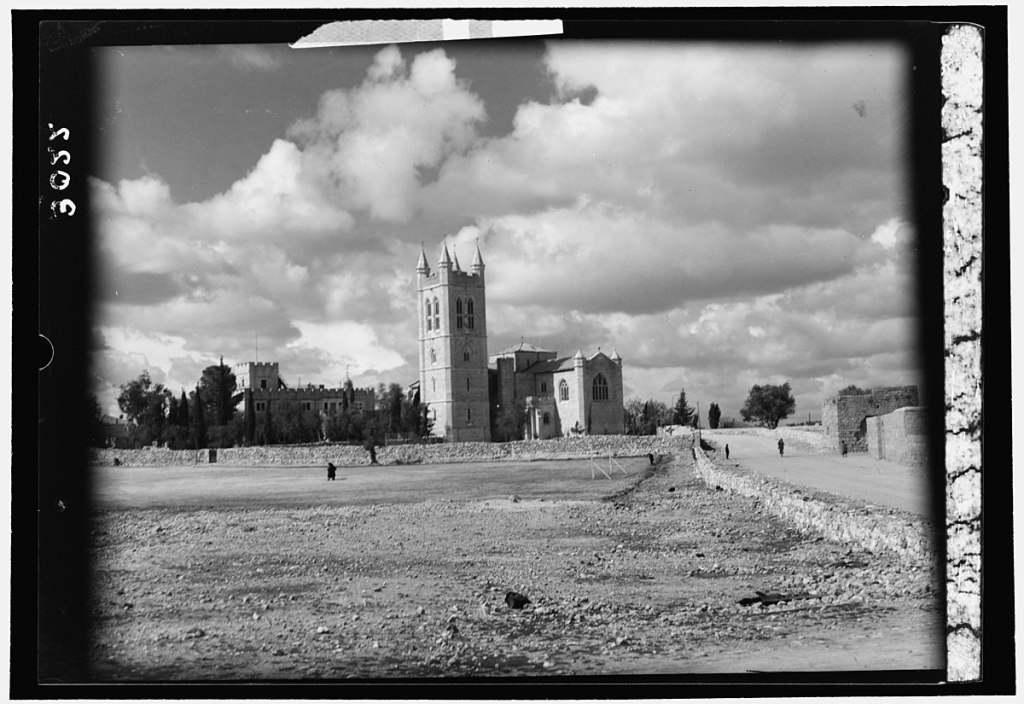
Jerusalem and suburbs. St. George’s Cathedral and Belfry. Nablus road, 1920
Good Morning Friends. It was brought to my attention that there may have been some email issues with my previous emails. If you have not been receiving my priors, please let me know; and could some of you let me know if you receive this one.
I will also be posting these messages to my blog – The Carpenter’s Nail – https://thecarpentersnail.blog/ – so that you can find them there as well. Blessings, Alston

Good Afternoon Friends,
I hope that you are well and enjoying these lovely days. We will be meeting this Sunday to look into our first chapter of “Know the Heretics,” Judaizers: The Old Rules Still Apply. Within this chapter we will linger upon the earliest arguments within the infant Church – the flexing that went on between Peter and Paul about the place of Gentiles Christians within the new body. We will look at significant passages from the New Testament that highlight this tension, and how Paul actually paves the way for most Christians that we know – Gentile Christians who come to a Jewish Messiah seeking paths of grace and salvation. We will also discuss how Christians can fall prey to the same behaviors and perspectives that Paul confronts in his fellow Jews.
“In fact, since obedience can become a point of pride, doing good can even be detrimental — we must sometimes re- pent of our virtues as well as our vices.” – Justin Holcomb
Please read through the Introduction, or the notes provided, and read through Chapter 1 of the book, or from the scan included in this email.
I hope to see you Sunday. Blessings and Godspeed,
Alston
September 24, 2023
Notes for Sunday School – Know the Heretics, Justin Holcomb
INTRODUCTION
Two weeks ago, Sunday, September 10th, we shared a general introduction to the history of Heresy in the Church. I wanted to stress that this endeavor is not a living history experience of carrying out a “witch hunt.” In fact, my own sense of having read a bit in Church History and the points made by those called “heretics” is how sympathetic I am to their points of view and some of their personalities. Nor is this walk into the past a project of deconstruction, and a reframing of the responses that those who came to be called “orthodox” gave to their counterparts. In my mind we are trying on suits of armor, walking a while in the shoes of those who have gone before us as a way of preparing ourselves for encounters we may have in the future.
Points from the Introduction:
- Over the course of the first centuries of the Church a number of individuals were trying to make sense of all that the Bible has to say about God, and about God in relation to the One who would call Himself the Son of God – Jesus.
- “Orthodoxy” literally means “right teaching.” However this right teaching was not apparent to all persons at all times. The popular mind of the Christians sometimes sways too and fro, and during the Arian controversy most of the clergy were on the side of Arius. Justin Holcomb goes so far as to say simply that in some cases what was deemed “orthodox” was the teaching that won the day. Holcomb’s definition of Orthodoxy: “I will define orthodoxy as follows. Orthodoxy is the teaching that best follows the Bible and best summarizes what it teaches — best accounts for the paradoxes and apparent contradictions, best pre- serves the mystery of God in the places where reason can’t go, and best communicates the story of the forgiveness of the gospel.”
- “Heresy,” literally means “Choice.” Essentially it is the exercising the “choice” to go one’s own way from traditional teaching toward individual illumination. In the past, Heresy has been punished by extreme measures – something I find unfortunate and not entirely successful. I appreciate that Holcomb brings us Galileo and the struggles he faced. There is always tension between the freedom of intellectual and spiritual exploration, and those things the Church has considered foundational.
- Christianity has always been in conversation with disparate cultures and other beliefs or “religions.” In fact some of my own understanding has been deeply enriched by the overlay of Christian Theology and Neo-Platonist philosophy; however if I were forced to choose, I would try to follow the Carpenter rather than the sophist.’
- “Who do you say I am?” (Mark 8:29)
- The Bible is replete with accounts of disputes about interpretation and authority. As some might expect, we find this especially in the experiences of St. Paul and the prophets of the Old, first, Testament.
- To quote Demarest again, “The early church defended itself against heretical teaching by appealing to ‘the rule of faith’ or ‘the rule of truth’, which were brief summaries of essential Christian truths . . . The fluid ‘rule of faith’ gave way to more precise instruments for refuting heresies and defining faith, namely, creedal formulations such as the Apostles’ Creed, the Nicene Creed, the Definition of Chalcedon and the Athanasian Creed.”
- There is variability in degree as to what is considered wrong teaching and heretical thought. There are varying degrees of seriousness in both Catholic and Protestant traditions as to what constitutes and affront to established doctrine.
- Some today wonder if there is really any conversation to be had about heresy and orthodoxy given what we know of the history of the Church, and given the egalitarian {the world is flat} environments in which religious identity is formed in the modern, secular West.
- Holcomb asserts that there is still value in studying heresy and its counterpoints because God certainly exists, we exist in order to discover God in our lives; therefore we have an appropriate concern to “know the way.” A flawed understanding of that way might simply leave us wandering, without discovering the actual purpose of our lives.

 The Carpenter's Nail
I
LikeLike