

The quotes contained in this post are taken directly from the groundbreaking work by NT Wright and Mike Bird, “The New Testament In Its World,” published by Zondervan and SPCK.
INTRODUCTION
Revelation is a strange book, nearly as strange as some of its readers. People have found in Revelation a dramatic account of the cosmic struggle of the church against the satan, a powerful consolation that God will one day end all suffering, a timetable for the end times, a mirror of the tyrants and turmoil of their own day, or—in many cases—a montage of pictures that they simply do not understand. The book is popular in the way that some music is popular: we don’t understand it but it’s an exciting set of tunes! Yet the book is as majestic as it is mysterious and magnetic. According to Richard Bauckham, one of the finest recent scholars in this area, ‘Revelation is a book of profound theology, intense prophetic insight and dazzling literary accomplishment.’ Despite its many eccentric and esoteric interpreters, it has ‘inspired the martyrs, nourished the imagination of visionary artists and hymn-writers, resourced prophetic critiques of oppression and corruption in state and church, and sustained hope and resistance in the most hopeless situations’. So much so that ‘Revelation can be seen to be not only one of the finest literary works in the New Testament, but also one of the greatest theological achievements of early Christianity’. We might not fully understand Revelation—who does?—but nobody can afford to ignore it.
In terms of content, the book is John’s account of the ‘revelation of Jesus Christ’ which he received on the island of Patmos (setting aside for the moment the question of which ‘John’ we are talking about).
To begin with, the genre of ‘revelation’ itself is eclectic, combining features of letter-writing on the one hand and prophecy on the other, while ultimately resembling an ‘apocalypse’, a particular species of Jewish literature in which the Jewish vision of heaven and earth coming together is turned into literary artistry.
The book also uses deliberately coded language about the Roman empire. John piles one metaphor on top of another in order to describe his visions and draw out their significance. Indeed, readers have always struggled to say what in the book is literary art and what is transcription of the author’s visions.
It is certainly fair to say that John struggles to find language, categories, or word-pictures to explain fully what he has seen and heard. We should sympathize with him. His task of explaining his vision of the risen Jesus, heavenly worship, the ongoing war against the dragon, the fall of the Roman empire, and the ultimate consummation of the creator’s purposes for the world, could be likened to our coming across a primitive tribe, deep in the highlands of Papua New Guinea, people living in stone-age conditions, who have never had contact with western civilization—and then trying to explain the Internet to them. Where would you begin?4 The author of Revelation has seen and heard things which probably put him in that position in relation to people of his own day; how much more in relation to us.
The other complicating factor is that John’s vision assumes a deep connection between heaven and earth. George Caird provides a memorable analogy. Imagine, he says, a military headquarters. Flags are clustered together on a map, and then an official gets up to move the flags around. The flags signify either current manoeuvres on the battlefield or else proposed positions for the various units to be deployed.
Caird comments: The strange and complex symbols of John’s vision are, like the flags in this parable, the pictorial counterpart of earthly realities; and these symbols too may be either determinative or descriptive. John sees some things happening in heaven because God has determined that equivalent events should shortly happen on earth, but other heavenly events take place . . . because earthly events have made them possible.
The point is that John is witness to an ‘unveiling’. He has been granted a glimpse of God’s glory, of the divine strategy and plan for the world. He has seen things which, though normally invisible, are radically shaping the world around us. We are given to understand that there is considerably more going on than meets the eye: tyrannical power is neither absolute nor everlasting. God’s purposes for his people and the world will not be thwarted.
John is trying to explain, in fact, how the divine purpose is working itself out to bring about a marriage between heaven and earth, and how, at the centre of it all, is Jesus himself, the ‘lamb’ who was slain, the king who will return to conquer all his adversaries, so that God will in the end dwell fully and finally with his people. John’s pastoral purpose is as much to exhort his hearers to endurance as to assure them of God’s ultimate victory over their adversaries. He therefore provides a God’s-eye view of the plight of the Asian churches, and explains how Jesus’ people are destined to reign with him in the new creation. Along the way there are exhortations and prophecies, warnings and judgments, triumphs mixed with tears, old adversaries and a new world.
For all the (to us) vagueness of John’s vision, and the vagaries of his language, the book of Revelation gives its audience confidence and hope that ‘the lamb’ has triumphed, and will yet triumph, over the evils of the world.
The book of Revelation has always appealed to artists: here, above all, the reader needs a disciplined imagination as well as a praying heart and a reasoning mind. Like a great piece of music that will only yield its secrets to the mature and sensitive player, the New Testament is designed not just to offer information about God, Jesus, the world, and ourselves, but also to urge us, by inviting us to penetrate its innermost core, to become the kind of people for whom, and indeed through whom, it will at last all make sense. That challenge applies to every book in the New Testament, but perhaps to Revelation even more than the others.
Date and provenance
Irenaeus, at the end of the second century, reckoned that Revelation was to be dated towards the final years of the reign of the emperor Domitian (AD 81–96). Domitian was remembered as a megalomaniac, consumed with the promulgation of his own divine status, demanding to be addressed as ‘lord and god’. He was thought to have unleashed a brutal persecution against Christians, and many from early times have supposed that it was his malevolent figure that could be seen looming up in the darker passages of Revelation.
Another important factor in assessing the setting of the book is the extent to which onlookers could see just how expansive and dominant Roman political, military, and economic power had become. Roman power was celebrated in public media like coins and inscriptions, and was venerated through the imperial cult and the famous temple to Mars Ultor (‘the avenger’) in Rome itself. Babylon the Great became for the early church a symbol of Rome, seen as both a luxuriating whore and the seat of Mediterranean military power. John offers a voice from elsewhere, from among the ‘others’ who lived on the margins of the empire, with the boot of Roman power on their throat. Rome’s prosperity and glory was the cause of their poverty and shame; Roman ‘justice’ was often perceived as its opposite. As one subdued chieftain was alleged to have said about the Romans: ‘To violence, rape, and plunder, they give the name “empire”; they create desolation and call it “peace”.’ John’s apocalypse is a theologically loaded critique of Rome’s vaunted greatness and goodness, its self-styled blessedness and benevolence. The book decries Rome’s actual pretentiousness and brutality, offering an alternative perspective on how Rome looks from below. David deSilva puts it elegantly:
John raises his voice alongside those of other protesters like the authors of 4 Ezra and 2 Baruch. John was not a solitary, raving lunatic. The asylum was full of people who just couldn’t ‘see things’ in line with the official picture. The multiplicity of voices calling out against Rome’s injustices at the close of the first century, of which John’s voice was one, help us to see that Jews and Christians in Asia Minor were not only concerned about local affairs, internecine strife, or throwing stones at the church or synagogue across the way. The ‘system,’ together with all its local manifestations, was also a major problem. Uniting the practice of exerting control and maintaining peace through violent suppression of dissent, the promotion of an economy arranged for the great benefit of the few, and the prominent use of religious language and ritual to claim sacral legitimation for these arrangements—uniting these is both the genius of Rome and the heap of her sins for which John excoriates her.
Participation in rites and rituals, whether at the dinner of a trade guild, during public games, or before a family shrine featuring the emperor’s image, was the moment to demonstrate one’s loyalty and gratitude towards the imperial family. This is why John singles out Pergamum as the place where ‘Satan has his throne’, since Pergamum was among the first to receive the title ‘temple warden’ of the imperial cult. It had a temple to the goddess Roma and to the Augusti, along with an immense altar to Zeus on top of a nearby mountain. Yet John urges his readers to flee from Babylon the Great, to refuse to worship the beast, and to reject the seduction of prosperity enmeshed in blasphemy. According to John, it was not Rome’s dios (Zeus/Jupiter) but Israel’s theos (God) who was in charge of history; it was not the sebastos (venerable emperor) but the christos (Messiah) who was the agent of salvation; and it was not the Roman people, but the church, that was destined to reign over the earth.
Genre
The book of Revelation is an eclectic mixture of epistle, prophecy, and apocalypse. First, the book is bracketed with an epistolary framework and contains several prophetic oracles couched as letters. Second, Revelation is umbilically connected to biblical prophecy in both form and content, and explicitly presents itself as ‘prophecy’ (see further below). Third, above all, the book is an apocalypse since it is titled as the ‘apocalypse of Jesus Christ’ and exemplifies several devices and themes associated with the slippery category of ‘apocalyptic’. The book of Revelation is, then, a lengthy circular letter, substantively a prophetic apocalypse, that was intended for dissemination among the Asian churches.
First, central to ‘apocalyptic’ is the report of revelatory experiences like visions or dreams. We refer here to someone, the ‘seer’, who experiences a revelation of things not usually perceptible—sometimes seeing, sometimes hearing, sometimes both. We know about this because seers often write down what they remember having seen and heard, which they interpret as an ‘unveiling’ of the true nature, the God’s-eye perspective perhaps, of present reality and/or events yet to come. This kind of experience presupposes that reality is more complex and multi-dimensional than it normally appears, and that, in particular, the sphere of normal human experience is not after all separated from the sphere of the angels and their creator by a great gulf, but rather ‘heaven’ and ‘earth’ in fact overlap and interlock in a variety of ways.
Second, this leads us to what some have supposed to be a particular apocalyptic worldview, the theological map of reality that is disclosed through an unveiling of otherwise concealed mysteries. Here we have to be careful, because the literary genre, and the experience which may or may not lie behind it, should not itself be mistaken for a ‘worldview’. ‘Apocalyptic’ texts regularly display a number of binary configurations (present and future, heaven and earth, light and darkness, good and evil).
Third, when Jewish groups throughout the period were faced with a crisis, such as a major threat from pagan powers, their understanding of this crisis and their yearning for their God to act to undo the problem could and sometimes did lead to what some have perhaps misleadingly called apocalypticism. This purported apocalypticism is an entire mood or mode in which a group organizes itself socially, culturally, narratively, and religiously around the perceived crisis, believing that it is playing a central part in the situation and looking for a divine resolution.
Fourth, an ‘apocalypse’ is therefore the specific literary expression, in the mode of ‘revelation’, of this much larger worldview. An apocalypse, according to one definition, is
a genre of revelatory literature with a narrative framework, in which a revelation is mediated by an otherworldly being to a human recipient, disclosing a transcendent reality which is both temporal, insofar as it envisages eschatological salvation, and spatial, insofar as it involves another supernatural world . . . intended to interpret present, earthly circumstances in light of the supernatural world of the future, and to influence both the understanding and the behaviour of the audience by means of divine authority.
Interpretation and purpose
The history of the interpretation of the book of Revelation reveals something of the open nature of the book. It has generated a constellation of interpretative strategies and elicited a wide range of meanings.
From Hippolytus’s Christ and AntiChrist to the Left Behind novels, many have seen it as offering a timetable, a road map towards the ‘end times’. From as early as the second century there has been a steady stream of ‘millennialist’ interpreters who saw the book as prophesying a concrete ‘new world’ very like the present one, only with evil, sin, and death banished. This kind of approach was taken by Papias, Cerinthus, Justin Martyr, and Tertullian. The first actual commentary on Revelation, that of Victorinus in the third century, was also millennial (in other words, believing that Jesus would reign on earth for a thousand years).
On the other hand, there have always been interpreters who have understood the book to be figurative, symbolic, and thus inviting allegorical interpretation. Debates about its interpretation go back to at least third-century Egypt, where Nepos argued for a ‘Jewish’ and ‘literal’ interpretation, while in response Dionysius commended what he thought was a deeper and more considered allegorical appropriation. Others again—one thinks here of John Calvin, who wrote commentaries on all the books of the New Testament except Revelation—are honest enough to confess to being straightforwardly confounded as to what the book is about. To look at it positively, the multiple ways the book has been received and interpreted around the world proves just how rich and powerful the text is, and how many ways it can resonate with readers in diverse cultural contexts.
Four major approaches to the interpretation of the book of Revelation have emerged down the years.
First, there are preterist perspectives. These look for a specific fulfilment of the prophecies of the book in actual events that have now already happened, with some fixing on the events leading up to the fall of Jerusalem in AD 70 and others supposing that fulfilment came in the fourth-century collapse of the pagan Roman empire and its Christianization under Constantine. This view certainly appears to make Revelation relevant to the immediate circumstances of its early readers, but it appears to make it much less relevant to subsequent generations, including our own. And, as many have noted, even Constantine’s Christian empire does not look exactly like the new heavens and new earth promised in Revelation 21—22.
Second, there are historicist approaches. By this scholars have meant that Revelation was predicting the entire course of subsequent world history, including things like the rise of the Goths, the Arabs, the Mongols, the medieval papacy, Napoleon, Hitler, and the Soviet Union. This has the opposite problem to the preterist interpretation: instead of the book being relevant to early readers but to nobody else, these readings make it sporadically relevant from time to time in subsequent history while making it hard to see what its first readers were supposed to think of it. Such readings have proved a happy hunting-ground for various small groups who have managed to interpret this or that passage in specific reference to their own localized situation.
Third, there are futurist perspectives. This is like the ‘historicist’ reading, with Revelation predicting long-range future events, except that the ‘history’ in question only begins in what, for us, is the ‘modern’ period. Revelation is thus seen as primarily predicting distant future events, usually transpiring in the twentieth or twenty-first century, such as the rise of the European Union, the establishment of the modern state of Israel, the United Nations, and the World Council of Churches, and the emergence of Saddam Hussein, or even Al Qaeda and ISIS. Interpreters of this type usually understand the letters to the seven churches in Revelation 2—3 allegorically, as temptations faced by the church in every age, and then treat the visions of Revelation 6—19 as a literal and linear series of events, complete with the ‘rapture’, the ‘tribulation’, and the ‘millennium’ that is to take place on the eve of the world’s end. The problem here is that interpreters fail to grasp the rhetorical and symbolic nature of apocalyptic discourse, and frequently display a highly parochial and provincial interpretative strategy, supposing that world history is all about themselves.
Fourth, there are idealist interpretations. These regard Revelation as a multi-layered symbolic portrayal of the conflict taking place between the kingdom of God and the kingdoms of this world in the time between the victory of Jesus on the cross and his final return. This generalized account leaves room for various kinds of allegorical and symbolic understandings of the theological, spiritual, and political realities of the whole period. What can be lost with this approach, however, is the sense of imminence. John insists that he is talking about things that will happen ‘soon’.
The best course seems to be an eclectic approach to the interpretation of Revelation. We must insist that the book would have been highly relevant to its first readers (who lived in a culture where this kind of book was much better known than it has been in the modern period). There were specific challenges and Revelation was written to meet them; we should not regard the problems facing the seven churches, or the letters addressed to them, as other than specific words to specific situations (though of course with multiple subsequent resonances).
John the Seer’s apocalypse is designed to be highly affective, not just by stirring the emotions, but in challenging and reshaping the audience’s imagination. The book is designed to inspire its readers to reaffirm their allegiance to God and his Messiah, and in that light to praise the faithful, shame the wicked, and steel the resolve of the churches to resist the monstrous and idolatrous Roman power. John intends to call out lukewarm faith and acculturation, and above all to urge his hearers to persevere in the faith despite suffering. It is those who ‘overcome’ who will receive the crown of life. To achieve this end, Revelation uses vivid imagery to describe a cosmic conflict, layered with symbolism, dripping with biblical allusions, and replete with local knowledge. A. D. Callahan writes:
The auditors who came together to hear the Apocalypse were summoned to a transformative experience. Those first ancient auditors of the Apocalypse came together not merely to be informed, but to be transformed, to undergo a collective change in consciousness, an aspiration that makes modern individual and group reading practices trivial by comparison, with the possible exception of the reading of wills. Reading the Apocalypse aloud, and hearing the Apocalypse read aloud, was effectual: through exhortations and exclamations, threat and thunder, the reading of the Apocalypse moved its hearers, affected them; the text did something to them.
The author is not trying to console his audience with the truth that all is well in heaven and one day all will be blissful on earth. Rather, he is calling them to believe and behave in the light of the triumph of the ‘lamb’ and the coming redemptive judgment of God. He reassures readers, but also calls them to repent if they have compromised with false teaching or consorted with the beast and its agents. John’s descriptions of his own visions are designed to recast the church’s vision of God and the world by seeing them in the light of the ‘divine actions above, within, and beneath the surface of history’s tapestry’.
THE STORY OF THE BOOK OF REVELATION
THE TITLE OF THE BOOK
In most early manuscripts, the title of the book is simply ‘Revelation of John’ (Apokalypsis Iōannou), but in later witnesses there are manifold varieties of, and expansions to, the title. The longest and most descriptive title comes from a manuscript housed at Mount Athos, numbered 1775, which reads: ‘The Revelation of the all-glorious Evangelist, bosom-friend [of Jesus], virgin, beloved to Christ, John the theologian, son of Salome and Zebedee, but adopted son of Mary the Mother of God, and Son of Thunder.’ * Metzger 1994, 729.
Prologue (1.1–3)
The first line designates the book as ‘the revelation of Jesus Christ’ (see box: ‘The title of the book’). The word apocalypsis means the unveiling of a hitherto unknown transcendent reality. Jesus is both the author and content of this unveiling, which pertains to events which ‘must soon take place’. The order of the transmission of the revelation depicted here runs:
God → Jesus Christ → angel → John → servants of God
As a prophet-servant of God, John had a vision; he now provides a ‘testimony’ to what he saw, which is no less than ‘the word of God’ and the ‘testimony of Jesus’. Added to that is a benediction, the first of several, indicating that John expects the readers and auditors of this prophecy to be blessed if they adhere to its message (evidently it was to be read out in corporate worship). They must do so because ‘the time is near’: many of the events displayed here will soon come to pass.
2. Opening greetings, doxology, and oracle (1.4–8)
John, writing this ‘letter’, designates himself as the author and greets the ‘seven churches of the province of Asia’ (as in chapters 2 and 3). The greeting comes from the triune God himself: throughout the book Jesus the Messiah is the mediator of divine testimony, pre-eminent in the new creation, and supreme over the kings who conspire against God’s reign (1.4–5a). John refers to the spirit dramatically in terms of seven spirits, reflecting the number of perfection. God’s gospel of love has rescued people from sin, to make them ‘priests’ and ‘kings’ (see Ex. 19.5; Rev. 5.10; 20.6). The church, like the ‘son of man’ and his people in Daniel 7.14, 27, are destined to hold dominion in a transformed world-order. Christ is the Passover lamb whose love and sacrifice brings about a new exodus and a reordering of power in heaven and earth where the church has a royal and priestly vocation (1.5b–6).79 John adds two prophetic oracles, rooted in scripture, highlighting respectively the vindication of Jesus and the overall sovereignty of God (1.7–8).
- John’s vision of the son of man (1.9–20)
John’s opening vision, constituting his prophetic commission, came to him when in a spirit-given ecstasy on the lord’s day. A loud voice told him to write an account of what he saw and send it to the seven churches (1.9–11). When he ‘turned to see the voice’, he saw the glorified Christ, whom he describes in language drawn from Daniel 7.9, 13 and 10.5–6: ‘one like a son of man’ standing among ‘seven golden lampstands’, recalling the seven-branched lampstand in the Temple. The figure is majestic, both royal and divine, and John falls at his feet; but Jesus tells him not to be afraid, and commissions him as his messenger.
- Letters to the seven churches (2.1—3.22)
The letters to the seven churches are prophetic oracles of paraenesis (advice, counsel), praise, and rebuke. They follow the general pattern of: (1) a command to write to ‘the angel’ of a given church (that is, its angelic representative); (2) a pronouncement formula, ‘Thus says’ (Greek tade legei, sometimes rendered ‘These are the words of ’), combined with a self-description by Christ, drawn mostly from imagery already given in Revelation 1.16–20; (3) a statement of something Christ knows about the church, generating particular exhortations, commendations, and/or accusations, all in the light of Christ’s parousia;83 (4) a command to heed what the spirit is saying to the churches; and (5) a promise of deliverance, made to ‘the one who overcomes’.
The letter to the Ephesians (2.1–7) commends the church for endurance and the non-tolerance of wicked and deceitful persons. But Christ rebukes them for forsaking their first love.
The Smyrneans (2.8–11) are characterized by social poverty, perhaps because they refused to partake in commerce tainted with idolatry; but they are spiritually rich. They are involved in sectarian tensions with local Jewish groups, who ‘denounce’ the church to the local authorities for not worshipping the local gods or the emperor. By calling them a ‘synagogue of Satan’, John indicates that these Jewish leaders have become ‘accusers’, siding with Roman idolatry against the Messiah’s people.
Jesus addresses the Pergamum church (2.12–17) from his position as the one bearing a ‘sharp, double-edged sword’, symbolizing his role as judge. The church has remained true, right there where the satan is enthroned (referring to the Altar of Zeus and the imperial cult). But there is false teaching and immoral practice in the church, and its members must repent.
John (perhaps following the apostolic letter of Acts 15.20, 29) took a harder line, forbidding the consumption of any meat associated with pagan sacrifices, and regarding it as a form of spiritual adultery. Whereas some, the ‘Jezebel’ of Thyatira and the ‘Nicolaitans’ of Pergamum, were attempting to secure the participation of Christians in social and economic life, for John, true faithfulness requires the churches to adopt a separatist disposition. If the believers in Pergamum avoid idol-food, they will be given ‘hidden manna’ and a ‘white stone’ with a new name written on it, that is, nourishment and protection.
The church in Thyatira (2.18–29) is praised for many virtues, but scolded for tolerating immorality, represented by the figure of ‘Jezebel’. As Stuckenbruck observes: ‘For John the influence of Jezebel within the Christian community is the microcosm of a porneia that is taking place on a grander scale in the Roman Empire.’ Those who resist such idolatry, a spiritual and political form of porneia, are promised a share in the Messiah’s worldwide rule, as in Psalm 2.
The church in Sardis (3.1–6) has a history of good deeds, but is in spiritual torpor. The believers there need to wake up and change their ‘dirty clothes’ for clean ones. The lord is coming like a thief in the night and they must be ready. The book of life will contain the names of those who ‘conquer’.
The letter to the church in Philadelphia (3.7–13) stresses Jesus’ messianic authority as the one who holds the all-powerful ‘key of David’. The Philadelphians are faithful yet weakened through opposition from a local synagogue. Jesus offers them a door into his presence, reversal of status from marginalization to vindication, and defence in the coming trial.
The Laodicean letter (3.14–22) is perhaps the most famous of all. Laodicea was a prosperous church, yet riches had corrupted the believers. Whereas the nearby cities of Hierapolis and Colossae were known for hot springs and cold fresh water respectively, the Laodicean water, half way between, was known for its tepid temperature. The Laodiceans are like that: spiritually lukewarm. Jesus is nauseated by them. He is knocking on their door, offering them close mealtime fellowship. If they accept the offer and overcome, they will share his throne, just as Jesus shares the father’s throne. .
PORTALS AND PARALLELS: IMPERIAL HYMNS IN PERGAMUM
The cities of Asia would celebrate and worship the imperial family in a number of ways, often with festivals, featuring singing, feasting, and merriment. Those who did not turn up to sing, cheer, eat, and make merry would have been noticeable by their absence, and would eventually have aroused suspicions about their loyalty and devotion to the local deities and the imperial regime. One inscription from Pergamum reads:
Since one should each year make clear display of one’s piety and of all holy, fitting intentions towards the imperial house, the choir of all Asia, gathering at Pergamum on the most holy birthday of Sebastos Tiberius Caesar god, performs a task that contributes greatly to the glory of Sebastos in hymning the imperial house and performing sacrifices to the Sebastan gods and conducting festivals and feasts . . . * Cited in Price 1984, 105.
- John’s visions of the heavenly thrones (4.1—5.14)
John is now granted access into the divine throne-room in heaven itself. He is not, as some have supposed, looking into the ultimate future; contrast this vision with that in chapters 21 and 22. Rather, he is glimpsing what is going on in God’s presence throughout the present time. God is on the throne, surrounded by twenty-four elders, seven spirits of God, and four living creatures (4.1–8a). They are perpetually worshipping the one on the throne: the creatures praise the holy God, and the elders give the reason: because he created all things (4.8b–11). Whatever is happening with God’s people on earth, this praise continues perpetually. The apparent tension emerges in chapter 5: God’s purposes cannot go forward, because there is no human being to act on God’s behalf to rescue the human race and so get the project of creation itself back on track. The ‘lion of Judah’, however, who is also the ‘lamb of God’, has won the victory over the dark powers. A new song emerges from the assembled company, whose ranks then vastly swell: blessing, honour, glory, and power belong to the one on the throne, and the lamb. Jesus, the lion-lamb, Israel’s Messiah, the true man, shares the worship which belongs uniquely and exclusively to the one creator God.
- The seven seals (6.1—8.5)
The scroll has seven seals which the ‘lamb’ must now undo. The first four release four riders, bringing judgment in the shape of conquest, deadly warfare, famine, and multifarious forms of death (6.1–8). Breaking the fifth seal brings forth cries from the martyrs, longing for vindication in the form of divine retribution. The sixth seal, when broken, unleashes portents of destruction, from which people try to hide. The warning is clear: God will avenge his people (6.9–17).
Before the seventh seal comes an interlude, hinting at an explanation for why God’s judgments have been held back. God’s servants must first be protected from disaster and are presented as a kind of messianic army. The number of 144,000 from the twelve tribes is symbolic for the church as the continuing expression of Israel (7.1–8). They are joined by a vast uncountable throng, consisting of all the martyrs now promised the healing and consoling divine presence (7.9–17).
Then at last the seventh seal is broken. After a time of silence (a sign of God’s presence), seven angels are given trumpets to blow to unleash judgments. At the same time, another angel, at the altar in the heavenly temple, is dispersing incense, symbolizing the prayers of God’s people and God’s startling purposes (8.1–5).
- The seven trumpets (8.6—11.19)
In Jewish tradition trumpet blasts often mean impending judgment. Here the trumpet blasts unleash various portents and manifestations of divine judgment. John has in mind the exodus, preceded by the ‘plagues’ on the Egyptians (Ex. 7—12): he sees the Passover-like rescue of God’s people preceded by similar judgment against the world’s inhabitants.
The next three trumpets are distinguished from the first four as ‘woes’. They signal an attack not just on people’s habitations but on the people themselves. John the Seer describes seeing a falling star, a destroying angel, who opens the Abyss, a vat of supernatural evil. From the Abyss rises toxic smoke and an army, described as locusts (see again Ex. 10.1–6). The angel’s name is given as ‘Apollyon’, the destroyer (8.13—9.12). The sixth trumpet brings further plagues of destruction, unleashing an army of 200 million cavalry troops from the River Euphrates. This image plays on the Roman fear of a massive Parthian invasion from the east; the description of the army as exuding fire, smoke, and sulphur indicates its demonic origin. The onslaught is another opportunity to repent from various practices—murder, magic, perversion, and theft—which all follow from not worshipping the true God (9.13–21).
Just as there was an interlude between the sixth and the seventh seal, so now there is another interlude between the sixth and the seventh trumpets. First, John receives a renewed commission (10.1–11). Second, in the scroll he is given, there is a metaphorically charged account of the church as witness to the Roman empire and its preservation despite its hostility. John is told to measure the temple and altar of God (here symbolizing the church), even while gentiles trample its outer court and the holy city (11.1–2). Just as Ezekiel’s measuring of his visionary temple was a way of marking out God’s intended dwelling-place (Ezek. 40—42; see Zech. 2.1–5), so John’s marking out of this human temple signals that God intends to come and dwell with his people, as indeed in the climactic chapter 21. The two witnesses who prophesy about this (11.3–14) are perhaps an echo of Moses and Aaron, confronting Pharaoh, as well as of Zechariah 4.11–14. Their invincible testimony, suffering, and vindication mirror the whole narrative of Revelation.
As Bauckham comments:
This is the heart of the revelation contained in the scroll, the heart of Revelation’s message: that the church redeemed from all nations is called to suffering witness which, by virtue of its participation in Jesus’ sacrificial witness, can bring the nations to repentance of idolatry and conversion to the true God. In this way—as Jesus’ witness is extended universally in the life and death, as well as the preaching, of the church—God’s kingdom can come to the nations as salvation, rather than judgement [11.1–14].
The seventh trumpet, blown at last (11.15), leads to praise and thanksgiving in heaven: the division between God’s kingdom and worldly kingdoms has been dissolved. God’s rule and wrath have pacified the angry nations, judgment has begun, and the heavenly temple is open to view, however dangerously (11.15–19).
- The dragon, the beast, and the church (12.1—15.4)
If the first half of the book (broadly speaking) is focused on the seven trumpets, a similar role is given in the second half to the seven ‘plagues’ (once again, echoing the original exodus). Between these is a bridging narrative, central to the book, which provides a rhetorically charged depiction of the insidious and demonic power of Rome as it threatens the church.
The first phase in that sequence is a symbolic nativity scene (12.1–6).
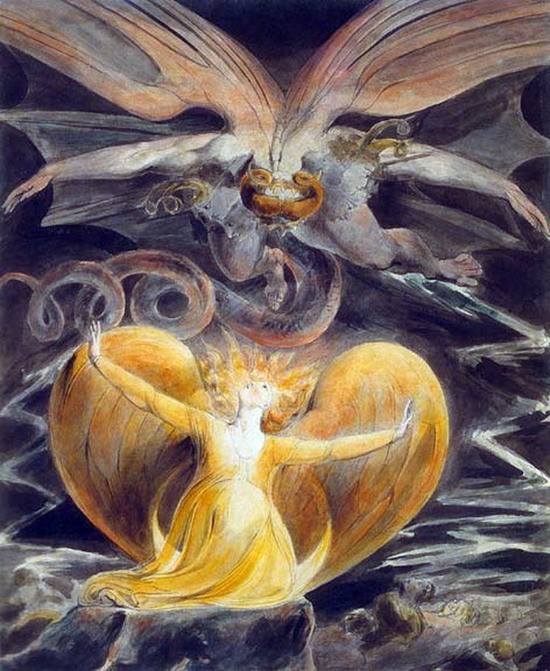
This evokes Jewish traditions about Leviathan and fallen angels, as well as the mythic tale of how Apollo killed a python for stalking his mother while she was pregnant with him. The episode features the people of Israel and/or the messianic community, described as a woman who is about to give birth to the messianic son who will rule over the nations. Opposing the woman is a seven-headed red dragon, the satan, who conspires to destroy the child the moment he is born. However, the child is snatched away to God’s throne while the woman is taken to a deserted place to be cared for.
A war then rages in heaven between the archangel Michael with his angels against the dragon and his angels (12.7–18). The dragon and his minions are expelled to the earth where they will lead the whole world astray (see ‘Portals and parallels: fallen angels’). The heavenly community celebrates the victory (12.10) which must then be worked out in the suffering and endurance of the church.
The dragon was left on the shore of the sea—the sea symbolizing the untamed power of chaos and evil (12.18). John then describes (13.1–10) a beast coming out of the sea; it is in fact a kind of super-beast, combining the features from Daniel’s four monsters. The beast—obviously Rome and its empire—is given authority by the satan, and is revered and worshipped by the whole world. Like Daniel’s fourth beast, this one utters blasphemies, and makes war on the saints; its apparently fatal wound, now healed, is reminiscent of what many thought happened to Nero.
There is then a second beast, ‘from the land’, also called the ‘false prophet’; this seems to be the local priesthoods of the imperial cult, the civic elites who enforce Rome’s will. If the first beast is a parody of Christ (died and returned to life), then the second beast is a parody of the spirit-led prophetic witness of the church (leading worship, doing miracles). The mark of the beast, which people need in order to buy and sell things, is again a parody of God’s sealing the foreheads of faithful believers. The number of the beast is ‘666’, and the number is the calculation (by the letter–number method called ‘gematria’) either of the Greek word for ‘beast’ when transliterated into Hebrew, or of the name ‘Nero Caesar’ written in Hebrew (13.11–18).
John then depicts the redeemed saints, again described as an army of 144,000 (see 7.4–12), ready to do battle against the beast, emphasizing their purity and moral fitness. The holy army is accompanied by three angels who warn the people of the earth to repent of worshipping the beast. The beast will face formidable judgment, while those who die resisting are promised a blessed rest (14.1–13). The nations thus stand on the crest of either salvation (symbolized by a harvest) or judgment (symbolized by a wine press). The angels gather together a harvest of the faithful and inflict a punitive pressing of the wicked (14.14–20).
This brings John to the seven plagues, the final elements of God’s wrath. The judgment on the ‘Egypt’ of the world is balanced by the new ‘victory song’, corresponding to the song of Moses and Miriam in Exodus 15 (15.1–4).
- The seven bowls (15.5—16.21)
The third and final cycle of seven judgments is now expressed in the form of seven bowls of wrath, again largely echoing the plagues in Egypt. The judgments are partly punitive and partly aimed at driving people to repentance, and to worship the God who is just and true; but their effect is to make people curse God. The catastrophes then become more complete and even climactic.
The first four bowls are poured out on the various spheres of creation: land, sea, waterways, and heavens. These directly affect the worshippers of the beast. The fifth bowl attacks the very throne of the beast, plunging his kingdom into darkness (15.5—16.9). The sixth bowl, only indirectly a form of judgment, dries up the River Euphrates, so that armies from the east (namely Parthia, Arabia, and India) can easily manoeuvre to join the beast and defeat the returning Jesus at ‘Armageddon’. The dragon, beast, and false prophet are thus allied with the eastern armies, and unleash a trio of evil spirits to deceive and direct the kings of the world (16.12–16). The seventh bowl, completing the judgment, falls massively on ‘Babylon the Great’.
- Babylon the whore (17.1—19.10) The fall of Babylon (that is, Rome) is now narrated at length. This is where John the Seer comes closest to the normal ‘apocalyptic’ genre in which an angel interprets visions. Babylon is pictured as a woman—a whore, in fact—who rides on the beast: Rome’s economic power depends on its military power. She is like a rich courtesan who exploits her clients and enriches herself, just as Rome does with its own client-kingdoms. The vision causes John great anxiety, and the angel explains the nature of the beast. The beast is both a parody of God (who was, and is, and is to come), since the beast ‘once was, now is not, and yet will come’. This appears to be based on the legend that Nero would return from the east with the Parthian armies to wreak vengeance on Rome. Nero belongs to the seven previous emperors mentioned in Revelation 17.10, but he is also—truly or typologically—the eighth still to come, the climax to all their evil. John the Seer thus splices together the propaganda of Roman invincibility and the fear of an eventual eastern conqueror. In the end, the beast with its client kings will make war against the lamb; Rome and its allies will persecute the church; but they will be defeated by the Messiah because of his superior might as ‘Lord of lords and King of kings’ (17.7–18).
Babylon’s demise is heralded by an angel coming down from heaven. The declarations of destruction are modelled on prophetic denunciations of Babylon and Tyre. John portrays Rome as the epitome of evil empires and, like them, as subject to divine judgment. Accordingly: ‘OT Babylon prefigures Rome’s political supremacy and oppression, but OT Tyre prefigures Rome’s economic power and oppression.’ The nations and kings of the earth have committed adultery with a city that is demonic and defiled (18.1–4).
A voice from heaven, echoing the instruction to God’s people to leave Babylon in Isaiah 52.11–12, exhorts God’s people to get out of ‘Babylon’ lest they share in its sins and the coming torture, grief, death, mourning, famine, and fire that will result. This is John’s way of warning Christians to avoid not only Rome’s idolatry but also spiritual idolatry by not embedding oneself in Rome’s oppressive, exploitive, and idolatrous system of economic power. The fall of Babylon is grievous to the kings of the earth, the merchants, and the sea captains who had enriched themselves through Babylon’s luxury and opulence. The church can rejoice because Babylon has been judged for the way it mistreated the saints, apostles, and prophets (18.5–20).
An angel now throws a boulder into the sea (the place of chaos) as a symbol for the downfall of Babylon. The daily life of Babylon, its labour, love, and leisure, is coming to an end. The seer here provides the most formidable indictment of Roman power anywhere in ancient literature, exposing the repressive and self-serving nature of Rome’s socio-economic system, the cruelty of its military power, and the falsehood of its propaganda about its own eternal invincibility. Rome had subjugated and suppressed nations and different groups, from Jews to Druids. It will be judged for ‘all who have been slaughtered on the earth’ (18.21–24).
The fall of Babylon occasions a multitude of voices in heaven to sing ‘hallelujah’ to God for his salvation, for condemning Babylon and avenging the blood of his servants. A further voice celebrates the arrival of God’s sovereign rule and the wedding supper of the lamb (19.1–8). At this point, John—strangely—mistakes the angel speaking to him for God himself and begins to worship him but is duly rebuked. Only God can be worshipped (19.9–10).
11. The open heaven and the new Jerusalem (19.11—21.8)
John’s vision takes us from Babylon to the new Jerusalem via Christ’s parousia and the final judgment. This section could be aptly named, as it is by Stuckenbruck, ‘The End of Evil’. John sees ‘heaven standing open’ and he narrates Christ’s return in terms of a divine warrior leading a heavenly army—probably the ‘saints’ as in Revelation 7.1–17; 14.1–5; 17.14—to make war on the nations who were seduced by the beast (19.11–16).
An angel summons the faithful for a feast where kings and generals are the main course, a graphic if stomach-churning image for the defeat and subjugation of their foes.
The point is that when God has finally dealt with evil it will have no chance to return, to spoil the renewed world he is now making.
‘This portrait of God imposing eternal suffering seems as un-Christlike a punishment as imaginable. Yet John is dealing with the twin concepts of justice and mercy/grace. For him, one cannot exist without the other. For the evil that has been perpetrated, there needs to be justice, and he conceives of it in its most undiluted form as eternal suffering in the lake of fire and sulfur (brimstone). It is important to remember, however, that this is a figurative and not a literal “lake”. What John is describing is not real, physical torture but the kind of continuous, perpetual spiritual torment that he imagines must occur when a being is separated forever from the presence of God. . . . He was trying to think of an image that would have “teeth” for them, an image that would shock persons who were accommodating to the draconian lordship demands of Rome into resisting them and testifying in word and deed to the lordship of God and the Lamb instead. He wanted them to fear being forever separated from the presence of God. His most forceful metaphorical attempt at conveying what that separation would feel like is the lake of fire and sulfur (brimstone). A twenty-first-century effort should focus on the language of separation from God’s presence and look for a contemporary metaphor appropriate to that separation, one that does not include the image of physical torture, whether eternal or otherwise.’ -Brian Blount, Revelation, 371–2
Excursus: Revelation 20.1–10 and the millennium
Revelation 20 narrates the binding of the satan for a thousand years. During that time, resurrected martyrs will be reigning with Christ (20.1–6). The satan will then be released for a short while, ahead of his final defeat and destruction (20.7–10). All will be judged according to deeds (20.11–15). This passage has generated much discussion: is the millennium in Revelation 20.4–5 literal or figurative? The case for a literal reading, and the case for reading this passage as a recapitulation of themes in the book, can be laid out in grid form (see text grid: ‘Alternative ways to read Revelation’).
John goes on to describe the arrival of the new heavens and new earth, which takes the form of the new Jerusalem descending from heaven, described as a bride on her wedding day. Its arrival signals that God is truly, fully, and finally dwelling with his people. Just as the story of the original exodus ended with the construction of the tabernacle and the divine glory coming to dwell in it, so this new exodus finishes not with humans going up to heaven but with the God of heaven coming to earth.
This will signal the end of suffering, and the old order of sin and death passing away. The abolition of ‘the first heaven and the first earth’ (21.1) does not mean that God will destroy the present space-time world and create a new one from scratch; the ‘oldness’ of the first heaven and earth consists precisely in their corruption, their subjection to decay and death (see Rom. 8.18–30). God now speaks directly from his throne, declaring that all things are made new (21.1–8).
12. The bride of the lamb (21.9—22.9)
One of the angels then shows John ‘the bride, the wife of the Lamb’ (21.9). We realize that the picture of the great whore, Babylon, was always a parody of the true ‘city of God’, just as the tower of Babel (Babylon) had been an arrogant human attempt to create a single worldwide community by human power alone when God’s plan was to call Abraham and promise him that worldwide family by sheer grace. Thus, now, ‘carried away in the Spirit’, John beholds a great mountain with the new Jerusalem coming down out of heaven from God.
The city is built around a series of twelves (that is, twelve gates, angels, foundations), symbolizing both the Israelite tribes and the apostles. The angel measures the city in front of John, and it turns out—as we might have guessed from the parallel towards the end of Ezekiel—that the whole new world is a vast temple, just as Genesis 1 was a ‘temple’, a heaven–earth construction with an ‘image’ at its heart. The city, at the heart of the new creation, is a giant cube, like the Holy of Holies in the original tabernacle and Temple.
That is why, of course, the city has no temple: the Jerusalem Temple was always an advance signpost to God’s new creation, just as the sun, the source of light and heat in the original creation, is no longer needed when the true light and life is visibly present in the form of the Lord God Almighty and the lamb. The city is both universal and accessible. The nations walk in its light, the gates are never shut, and the glory of the nations is brought into it. The city has nothing impure or shameful, but is filled with those whose names are written in the lamb’s book of life (21.9–27).
The angel shows John a river of water of life—echoing the rivers flowing from Eden in Genesis 2—that flows from the throne of God and the lamb into the middle of the city. Abnormal water-flows were a feature in prophetic visions of Jerusalem’s re-creation. On each side of the river stands ‘the tree of life’, with supernatural fecundity; its leaves are for ‘the healing of the nations’. All this results in the reversal of creation’s curse; the luminous divine presence; the redeemed seeing the very face of God; and their active reign over God’s new world (22.1–5).
John’s interaction with the angel in Revelation 22.6–9 is similar to that in Revelation 19.9–10, where the concluding message about the destruction of one city (Babylon) has its sequel with a concluding message about the descent of the heavenly city (New Jerusalem). The angel tells John that the visions he has received are ‘trustworthy and true’ and pertain to things ‘that must soon take place’. John is once more tempted to worship the angel, and once more rebuked. Only God is to be worshipped (22.6–9).


