

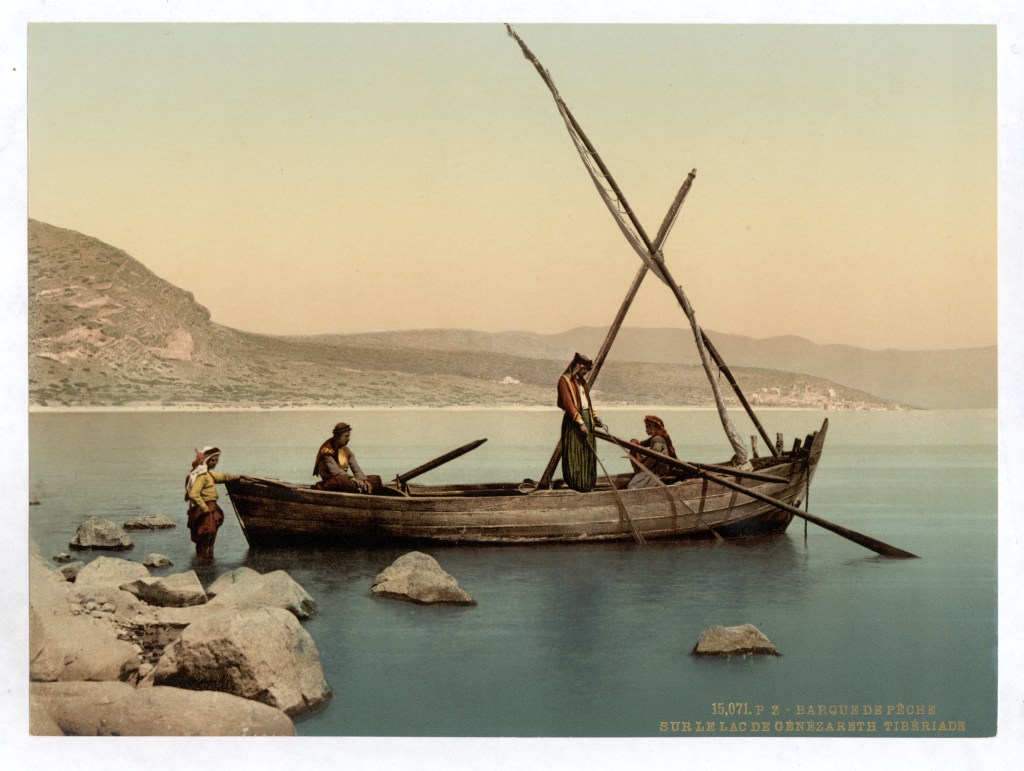
Date between 1890 and 1900
Simon bar-Jonah was one of the front rank of leaders in the early church. Jesus nicknamed him ‘rock’ (Aramaic Kêpā; Greek transliteration Cēphas; Greek translation Petros), from which we get the name ‘Peter’. Simon Peter was a fisherman from Bethsaida whom Jesus called to be his follower and fellow-worker. Not only was he one of the Twelve; he, along with the brothers James and John, was part of Jesus’ inner circle. It was Peter who made the dramatic pronouncement that Jesus was the Messiah. It was also Peter, notoriously, who denied Jesus in the high priest’s hall. However, he became a key witness to Jesus’ resurrection, not least through a personal meeting with the risen Jesus in which he was restored to his position of leadership.
The early chapters of Acts display Peter as a key leader in the early church, working in Judea and Samaria. Luke links him with the early stages of the gentile ‘breakthrough’. At the Jerusalem council, Peter became an advocate for gentile inclusion without male circumcision as practised in Antioch—despite his temporary lapse in Antioch itself.
According to tradition, Peter eventually journeyed to Rome, perhaps travelling via Corinth. The Roman churches were probably founded by Jewish Christians very early on, and Peter gravitated towards them as a possible mission-field. It was during the late 50s or early 60s that Peter probably wrote 1 Peter from Rome (that is, ‘Babylon’) to churches in Asia Minor. Tradition, once more, has it that Peter was martyred during Nero’s pogrom against Christians. It may have been shortly after that that John Mark wrote a gospel based largely on Petrine reminiscences.
Peter is remembered in Christian tradition as a fisherman who became a fisher of men and women, an apostle, a martyr, saint, and even the first pope. His memory is woven into the gospels, Acts, and the two epistles bearing his name, as well as into various apocryphal writings like the Gospel of Peter, the Preaching of Peter, the Acts of Peter, and the Apocalypse of Peter. An entire Petrine hagiography developed around his legacy. In the end, Peter can be lauded for his role as a successful organizer of the early churches, a mission strategist to Jews and gentiles, and a bridge-builder among factional divides.
CONTEXTUAL AND CRITICAL MATTERS
Many suppose the life-setting of the epistle to reflect a later period when Christians had spread into northern Asia Minor and believers were undergoing persecution like that under Domitian (AD 81–96) or Trajan (AD 98–117). Some have seen this letter not as the literary production of an early founder of the church, but as a post-70 pseudepigraphical writing which was attempting to universalize Peter’s memory and turn him into a generic apostle with Pauline traits. At most, say some, the letter is the product of a ‘Petrine school’ that attempted to offer a ‘fitting tribute to the quality, character, and content of what Peter was remembered as teaching and preaching’.
However, we should not too quickly assume that 1 Peter is pseudepigraphical. To begin with, we should not underestimate Peter’s facility in Greek. He grew up in Bethsaida, a Greek-speaking territory with a gentile majority. He spent a considerable amount of time in the Jewish Diaspora. In any case, as we have observed elsewhere, Greek was at least the second language of most males right across the old imperial lands of Alexander the Great. For Peter to be able to write good Greek is no more remarkable than for someone brought up speaking Arabic in the Gulf States to be able to write good English. In any case, while the Greek style of 1 Peter is proficient, it is hardly highbrow. Some have suggested that the syntax exhibits signs of bilingual influence from a person whose first language was semitic rather than Greek. Moreover, if Silvanus acted as Peter’s scribe or secretary (as well as carrying the letter), then maybe he could have edited or refined Peter’s expression. There are too many variables here to be on secure ground.
In fact, in musical terms, 1 Peter is hardly a Pauline cover, but more like a collection that incorporates several theological, intertextual, and ethical motifs that were current in various wings of the Christian church. The letter displays signs of the Jesus-tradition, as well as a residue of traditional materials. There are even plot similarities between 1 Peter, James, and Hebrews. As for the life-setting of 1 Peter, nothing here requires a post-70 date. The persecutions appear to consist mostly of social ostracism, not imperial suppression or official persecution. The readers seem to be facing the same kind of localized and periodic harassment that we see described in Acts, Paul’s letters, and Hebrews.
In the end, we surmise that Petrine authorship cannot be proven but remains entirely plausible. If so, we do not have to treat 1 Peter as a petrified tradition looking for apostolic legitimation by artificially borrowing a famous name. We are free to hear in the letter the authentic testimony of Peter himself.
Date of 1 Peter
Irenaeus made explicit citations of 1 Peter in the 180s AD. Polycarp echoed 1 Peter in his letter to the Philippians dated perhaps around 120 to 140 AD. 31 Even earlier, Papias’s testimony to 1 Peter (as recorded by Eusebius) may date as early as 110, though it might be a bit later. Some would even suggest influence from 1 Peter on 1 Clement, which would take us into the 90s, but this is less certain. If 1 Peter is pseudepigraphical, then a date around AD 80–110 is most likely. However, if the letter derives from the historical Peter himself, as we are proposing, then any time from the late 50s to the early 60s AD would do. The letter would then be written in the vicinity of Rome (referred to in the letter as ‘Babylon’) on the eve of Nero’s persecution.
Audience of 1 Peter
The letter is addressed to churches in Pontus, Galatia, Cappadocia, Asia, and Bithynia, which together encompass parts of western, northern, and central Asia Minor (modern-day Turkey). We know a little (through Paul and Acts) of how Christianity came to the Roman province of Asia and the region of southern Galatia, but we do not know when the other regions mentioned first heard the gospel. Perhaps Jewish pilgrims visiting Jerusalem for the Pentecost of Acts 2 joined the Jesus-movement and took their new faith back to Asia Minor. We also know that the emperor Claudius (AD 41–54) established Roman colonies in all five of the regions mentioned in 1 Peter 1.1. It is quite possible that Jewish émigrés from Rome were settled there, or perhaps fled there after Claudius’s expulsion of Jewish Christians in AD 49.
Are the intended readers Jewish or gentile or both? In favour of a Jewish audience is the description of the believers (reminiscent of Jas. 1.1) as ‘foreigners’ and ‘exiles’, making it sound as though they were part of the Jewish Diaspora.
The motifs of election and holiness climax with the designation of the audience as ‘a chosen people, a royal priesthood, a holy nation, God’s special possession’. The audience is also explicitly contrasted with the ‘Gentiles’. If Peter was the apostle to the ‘circumcision’, then this is exactly who we would expect his letter to be addressed to. Readers from Eusebius to Calvin have agreed: 1 Peter is addressed to a Jewish audience.
Others, however, have thought a gentile (or at least mixed) audience is intended. They point out remarks about the ‘evil desires’ the readers had during a time of ‘ignorance’, how they have left the ‘empty way of life handed down to you from your ancestors’, mentioning a time when ‘you were not a people’, who were called ‘out of darkness’, who had been ‘like sheep going astray,’ and how they formerly ‘spent enough time in the past doing what pagans choose to do.’
But, equally, we should remember that Paul sees gentile converts as having been grafted into the renewed people of Israel, and can address them in language very similar to that of the ostensibly ‘Jewish’ designations noted above. Perhaps it is best to remain agnostic on this question.
Asia Minor
Are the intended readers Jewish or gentile or both? In favour of a Jewish audience is the description of the believers (reminiscent of Jas. 1.1) as ‘foreigners’ and ‘exiles’, making it sound as though they were part of the Jewish Diaspora. It might then make sense to detect further signs of their Jewish identity in the scriptural designations of the audience as ‘Sarah’s children’, God’s ‘elect’, people called to the covenantal vocation of holiness. The motifs of election and holiness climax with the designation of the audience as ‘a chosen people, a royal priesthood, a holy nation, God’s special possession’. The audience is also explicitly contrasted with the ‘Gentiles’. If Peter was the apostle to the ‘circumcision’, then this is exactly who we would expect his letter to be addressed to. Readers from Eusebius to Calvin have agreed: 1 Peter is addressed to a Jewish audience.
Others, however, have thought a gentile (or at least mixed) audience is intended.45 They point out remarks about the ‘evil desires’ the readers had during a time of ‘ignorance’, how they have left the ‘empty way of life handed down to you from your ancestors’, mentioning a time when ‘you were not a people’, who were called ‘out of darkness’, who had been ‘like sheep going astray,’ and how they formerly ‘spent enough time in the past doing what pagans choose to do.’ All this would better describe a gentile audience.46 It is true that such language reminds us of fairly typical intra-Jewish prophetic rebukes, treating Israelites as if they were pagans. But, equally, we should remember that Paul sees gentile converts as having been grafted into the renewed people of Israel, and can address them in language very similar to that of the ostensibly ‘Jewish’ designations noted above.47 Perhaps it is best to remain agnostic on this question.
Genre and purpose of 1 Peter
In terms of genre, 1 Peter is much like James: it is a Diaspora letter with a mixture of exhortation and consolation. It was written to exhort Christians in Asia Minor to maintain their faith in the midst of social scorn, shaming, slander, and stigma. They do not appear to be facing organized persecution, sponsored officially by this or that city-state. Their adversaries are more likely local groups who have come to regard Christians as dangerous social deviants and are pressuring them, verbally and perhaps physically, to return to the normal web of socio-religious relationships and cultural and religious practices that characterized the city and/or province. .
We remind ourselves once more that in the ancient world those who abstained from worshipping the local gods were suspected of wishing trouble upon their city or region. Peter encourages the believers to hold fast, stressing the divine verdict about their identity: they may be disparaged by their neighbours, but in God’s eyes they are precious, royal, and holy.
They enjoy the promises given in Israel’s sacred history. They have experienced a new birth, purification, and redemption. They look forward to a future salvation with an imperishable inheritance. Peter further urges his readers to give outsiders no reason for malice; they should rest in their baptized identity as ‘Christians’. Jesus died for them, leaving them an example: the letter’s emphatic christology, supported by carefully crafted citations of and allusions to the Old Testament, underlies the entire appeal. One may legitimately regard the letter as a kind of christological exposition of Isaiah, Psalms, and Proverbs, applying scripture to a Christian audience facing severe hardships.
THE ARGUMENT OF 1 PETER
- Letter opening (1.1–2)
The letter begins with Peter identifying himself as an ‘apostle of Jesus Christ’ and addressing his letter to God’s ‘elect exiles’ scattered among the provinces of ‘Pontus, Galatia, Cappadocia, Asia and Bithynia’. We detect here a clear consciousness of the church as a ‘renewed Israel’. According to Johnson: This should not be construed as evidence for a later form of Christianity that was distanced both chronologically and theologically from its Jewish beginnings. Rather, it reveals what was inherent in early Christianity from the start: God was forming a new people through Christ and all those who believe—both Jew and Gentile—are God’s ‘chosen.’
The readers’ chosen nature is elaborated further as indebted to God’s foreknowledge, operative through the sanctifying work of the spirit. Their calling is to be obedient to Jesus, who has cleansed them with his blood sprinkled for them like a sacrificial offering.
- God’s salvation in Jesus Christ (1.3—2.10)
Peter launches into an encomium of praise to God the father and the lord Jesus Christ because divine mercy has resulted in new birth into a living hope. According to Miroslav Volf: ‘The new birth is neither a conversion to our authentic inner self nor a migration of the soul into a heavenly realm, but a translation of a person into the house of God erected in the midst of the world.’97 Believers experience new life through Jesus’ resurrection and have received an inheritance that cannot spoil because it is kept safe in ‘heaven’, God’s space, not in order that believers may then ‘go to heaven’ to experience it but in order that in due time it will be revealed, transformatively, on the earth. Knowing this, the audience can rejoice in the midst of trials, knowing that faith is their divinely empowered shield, tested and proved through adversity. Peter praises his readers’ faith: although they have not seen Jesus in person, they believe in him, they love him, and they are filled with joy about him. The result of such faith is the salvation promised by the prophets, who pointed ahead to the Messiah’s sufferings and glory even though they never quite knew when or how this event would transpire (1.3–12).
Peter addresses the letter’s recipients with a series of ethical exhortations that follow on from the value of their faith and the certainty of their hope. They should be ready, literally, to ‘gird up the loins of your mind’ and ‘be fully sober’. Negatively, they must resist the evil desires that characterized them when they lived in ignorance. Positively, they are to be holy in all they do because the one who called them is himself holy (1 Pet. 1.13–16).
We could easily regard 1 Peter 1.17–21 as a synopsis of New Testament teaching:
God as Father, as impartial judge, redemption through the blood of Christ, Christ as sacrificial lamb, Christ as preexistent, Christians living in the last days, resurrection and exaltation of Christ by God, God as the one in whom Christians place their trust and hope.
The members of the audience, though ‘foreigners’ (Greek paroikia), must live in reverent fear, as is fitting for those for whom Christ died a redemptive and sacrificial death. They must trust in God through him, and wait for the fulfilment of their hope when he is revealed.
Attention shifts to the responsibility of the community members towards one another. They have been purified by obeying the word of truth. This leads to a moral renewal, where they can exhibit heartfelt and sincere love for one another. The source of their new birth is the living and enduring word of God, which contrasts with the transitory and fleeting nature of human life (1.22–25).
According to Achtemeier: The contrast between what is transitory and what is permanent . . . would be highly appropriate for a beleaguered community of Christians facing what gave every appearance of being the permanent, even eternal, power and glory of the Roman Empire. In such a situation, the announcement that the glitter, pomp, and power of the Roman culture was as grass when compared to God’s eternal word spoken in Jesus Christ, available through the gospel preached to and accepted by the Christians of Asia Minor, would give them courage to hold fast to the latter while rejecting the former.
Peter urges his readers to rid themselves of the many vices that interfere with their capacity to love one another. Since they are new babes, they need pure milk, God’s holy word, which nourishes them into salvation. They have tasted this salvation and therefore know that the ‘Lord is good’ (2.1–3).
The topic shifts, somewhat abruptly, to Christ as the living stone, rejected by people, but precious to God. The same imagery is applied to the church as a corporate entity being built into a spiritual house, a temple, with sacrifices and offerings acceptable to God. Peter then quotes Isaiah 28.16, Psalm 118.22, and Isaiah 8.14 in quick succession to stress that Christ is the chosen ‘stone’, and that believers in him will never be ashamed, while those who rejected him and disobey him stumble and fall away from God. Again, as for Christ so for believers, they are God’s chosen and special people, a fact bolstered with a cascade of intertextual imagery from the Old Testament.
- God’s people among the gentiles (2.11—4.11)
Peter now turns to a lengthy central section focusing on the exemplary way of life which believers must display in a hostile context. Rooted in a rich christological exposition, this is intended to highlight just how different the Christian way of life is from the surrounding culture while also mitigating any animosity that their social nonconformity might invoke. Peter, by calling his readers ‘foreigners and exiles’, reminds them of the social displacement they have already experienced. Their continuing response should be to abstain from sinful desires and to live lives filled with good deeds so that the gentiles might glorify God on the day of his visitation (2.11–12).
Peter adds that believers must be subject to governing authorities, even those as ungodly as the Roman emperor. Political leaders are sent by God to maintain order in society and so must be respected. Serving the true God by living a peaceful, wise, visibly good life is, in the end, far more revolutionary than simply overthrowing one corrupt regime and replacing it with another. Although Christians’ ultimate allegiance is to God and to the church family, they are no less obligated to show proper regard for everyone else (2.13–17).
In the ancient world, slavery was assumed in the same way that we assume the use of cars or electricity. Many of the early Christians were themselves slaves, vulnerable to all kinds of ill-treatment. Peter calls on slaves to submit to their masters, whether kind or harsh. If they suffer, it should not be because they deserved it. The unjust suffering of Christ himself is the obvious example. He was sinless, and did not repay evil for evil, but simply entrusted himself to the one who judges justly.
Some cultural norms, it appears, are to be resisted; others are to be adopted, if modified. The latter is the case in Peter’s presentation of the classic greco-roman household codes, in which wives were expected to submit to their husbands—in this case, Peter stresses, to the unbelieving husbands who might thereby be won over to the faith. At the same time, in a radical break with normal culture, husbands are to respect their wives, particularly given their physical vulnerability, and to regard them as co-heirs of God’s grace (3.1–7).
The instructions given to slaves, wives, and husbands are then applied to the entire church vis-à-vis wider society. The believers’ attitudes and posture should be characterized by harmony, sympathy, love, and humility.
HISTORICAL EXIT
Pliny the Younger was the Roman governor of Bithynia between AD 111 and 113. He wrote to the emperor Trajan about what to do with those who had been discovered to be Christians or had been denounced as Christians yet protested their innocence. In this correspondence we get both Pliny’s letter and Trajan’s reply. Its relevance to 1 Peter is clear as it shows how, in north-west Asia Minor, Christians were known and despised, and mere profession of Christianity was a capital offence.
Pliny to the emperor Trajan
It is my practice, my lord, to refer to you all matters concerning which I am in doubt. For who can better give guidance to my hesitation or inform my ignorance? I have never participated in trials of Christians. I therefore do not know what offences it is the practice to punish or investigate, and to what extent. And I have been not a little hesitant as to whether there should be any distinction on account of age or no difference between the very young and the more mature; whether pardon is to be granted for repentance, or, if a man has once been a Christian, it does him no good to have ceased to be one; whether the name itself, even without offenses, or only the offenses associated with the name are to be punished.
Meanwhile, in the case of those who were denounced to me as Christians, I have observed the following procedure: I interrogated these as to whether they were Christians; those who confessed I interrogated a second and a third time, threatening them with punishment; those who persisted I ordered executed. For I had no doubt that, whatever the nature of their creed, stubbornness and inflexible obstinacy surely deserve to be punished. There were others possessed of the same folly; but because they were Roman citizens, I signed an order for them to be transferred to Rome.
Soon accusations spread, as usually happens, because of the proceedings going on, and several incidents occurred. An anonymous document was published containing the names of many persons. Those who denied that they were or had been Christians, when they invoked the gods in words dictated by me, offered prayer with incense and wine to your image, which I had ordered to be brought for this purpose together with statues of the gods, and moreover cursed Christ—none of which those who are really Christians, it is said, can be forced to do—these I thought should be discharged. Others named by the informer declared that they were Christians, but then denied it, asserting that they had been but had ceased to be, some three years before, others many years, some as much as twenty-five years. They all worshipped your image and the statues of the gods, and cursed Christ.
They asserted, however, that the sum and substance of their fault or error had been that they were accustomed to meet on a fixed day before dawn and sing responsively a hymn to Christ as to a god, and to bind themselves by oath, not to some crime, but not to commit fraud, theft, or adultery, not to falsify their trust, nor to refuse to return a trust when called upon to do so. When this was over, it was their custom to depart and to assemble again to partake of food—but ordinary and innocent food. Even this, they affirmed, they had ceased to do after my edict by which, in accordance with your instructions, I had forbidden political associations. Accordingly, I judged it all the more necessary to find out what the truth was by torturing two female slaves who were called deaconesses. But I discovered nothing else but depraved, excessive superstition.
I therefore postponed the investigation and hastened to consult you. For the matter seemed to me to warrant consulting you, especially because of the number involved. For many persons of every age, every rank, and also of both sexes are and will be endangered. For the contagion of this superstition has spread not only to the cities but also to the villages and farms. But it seems possible to check and cure it. It is certainly quite clear that the temples, which had been almost deserted, have begun to be frequented, that the established religious rites, long neglected, are being resumed, and that from everywhere sacrificial animals are coming, for which until now very few purchasers could be found. Hence it is easy to imagine what a multitude of people can be reformed if an opportunity for repentance is afforded.
Trajan to Pliny
You observed proper procedure, my dear Pliny, in sifting the cases of those who had been denounced to you as Christians. For it is not possible to lay down any general rule to serve as a kind of fixed standard. They are not to be sought out; if they are denounced and proved guilty, they are to be punished, with this reservation, that whoever denies that he is a Christian and really proves it—that is, by worshipping our gods—even though he was under suspicion in the past, shall obtain pardon through repentance. But anonymously posted accusations ought to have no place in any prosecution. For this is both a dangerous kind of precedent and out of keeping with the spirit of our age. (Pliny Ep. 10.96–7)
RETURN TO 1 PETER
Peter adds an important element: Christians need to be ready to offer a public defence for the hope they possess. Yet, as always, the medium is the message: the defence must be made with gentleness, respect, and a clear conscience. People must be won over not just with arguments but with example (3.13–17).
All this is again rooted in the events of Jesus’ death and resurrection. Jesus, as Messiah, died a substitutionary and atoning death, ‘the righteous for the unrighteous’, to bring people to God. But at this point Peter introduces one of the most perplexing christological descriptions in the entire New Testament: ‘After being made alive, he went and made proclamation to the imprisoned spirits—to those who were disobedient long ago when God waited patiently in the days of Noah while the ark was being built.’ This has been understood in various different ways. It could conceivably refer to: (1) the preaching of the preexistent Christ, through Noah, to those bound in sin, urging them to repent; (2) the offer of salvation to the ‘imprisoned spirits’ who were alive in Noah’s day, but who then resided in Hades; (3) the risen Jesus announcing his triumph to the imprisoned wicked angels of Noah’s time, telling them of the judgment still to come.
The third option is in fact the most likely. It corresponds with a well-known motif in which rebellious angels were held in subterranean subjugation ahead of a final judgment, which would in turn foreshadow the judgment of all human powers who opposed God and God’s people. Pierce rightly concludes that Peter ‘offers comfort to a marginalized community: because of the victorious resurrection of Christ, all forces of evil, both human and cosmic, are now under the lordship of Christ’.105
All this is woven together with the allusion to Noah. His building of the ark, to rescue his family, points forward to baptism, and baptism is less about washing people clean and more about ‘the appeal to God of a good conscience’.
This sets the context for a renewed exhortation to those facing suffering. Again the sufferings of the Messiah serve as example. Peter is encouraging those who have to face downright hostility because of their following of the Messiah, and because they refuse to go along with the wild and dehumanizing behaviour of those around them. All this, he says, will be sorted at the final judgment (4.1–6).
We next encounter some general ethical instructions. Peter premises his appeal with a sense of eschatological urgency: ‘The end of all things is near.’ This requires sobriety of mind and prayerfulness.
- Exhortation to endure suffering (4.12—5.11)
Peter now recapitulates earlier themes: persecution, Christ’s suffering, doing good, and God’s glory. His readers are not to be surprised at the ‘fiery ordeal’ that has fallen upon them—possibly a reference to the start of Nero’s persecution, or, more likely, a localized persecution in Asia Minor. They are sharing in the Messiah’s own sufferings. If they are insulted, then God will bless them. If they suffer, it should not be for criminal behaviour, but as ‘Christians’ (see ‘Blast from the past: the correspondence between Pliny and Trajan about Christians’).
Elders of the church receive special instructions on how they are to lead the congregations during times of hardship, with the emphasis on ethos, not organization. The elders must be shepherds, operating selflessly.
All this is the more important because there is a diabolical enemy, like a roaring lion, hungry for prey. The believers must stand firm and trust God to bring them through their trials (5.8–11).
- Letter closing (5.12–14)
The letter ends with Peter commending Silvanus (that is, Silas), probably the letter-carrier. Urging the believers to stand fast in God’s true grace, he sends them greetings (from ‘Babylon’, presumably code for ‘Rome’) and wishes them peace (5.12–14).
PLEASE NOTE THAT ALL THE MATERIAL ON THIS POST IS TAKEN DIRECTLY FROM THE NEW TESTAMENT IN ITS WORLD: An Introduction to the History, Literature, and Theology of the First Christians
N. T. Wright (Author) , Michael F. Bird (Author), Zondervan SPCK, 2019.


Thanks for your time : ) I miss the in-person encounters, but your posts keep me connected. ❤
A reminder to get rid of the vices that interfere with my capacity to love…the kingdom is now!
LikeLike